Loading [Contrib]/a11y/accessibility-menu.js

This website uses cookies

We use cookies to enhance your experience and support COUNTER Metrics for transparent reporting of readership statistics. Cookie data is not sold to third parties or used for marketing purposes.

Skip to main content
null
J Orthopaedic Experience & Innovation
  • Menu
  • Articles
    • Brief Report
    • Case Report
    • Case Series
    • Conference Proceedings
    • Data Paper
    • Editorial
    • Meeting Reports/Abstracts
    • Methods Article
    • Product Review
    • Research Article
    • Review Article
    • Review Articles
    • Systematic Review
    • All
  • For Authors
  • Editorial Board
  • About
  • Issues
  • Blog
  • "Open Mic" Topic Sessions
  • Advertisers
  • Recorded Content
  • CME
  • JOEI KOL Connect
  • Resident Research League
  • search
  • RSS feed (opens a modal with a link to feed)

RSS Feed

Enter the URL below into your favorite RSS reader.

https://journaloei.scholasticahq.com/feed
ISSN 2691-6541
Editorial
Vol. 7, Issue 1, 2026May 03, 2026 EDT

From My Perspective™…The Incision Point…The Robot in the Room: More proof that robotic assisted surgery is still not superior

Michael Meneghini, MD,
Robotic SurgeryTHATKAJoint Replacement
Copyright Logoccby-nc-nd-4.0 • https://doi.org/10.60118/001c.160810

Articles in Vol. 7, Issue 1, 2026

Vol. 7, Issue 1, 2026
  • At The Conference...My 5, maybe 6 Pearls for Hip Revision
    Jon Minter
  • At The Conference...Total Joint Infections: Cutting-Edge Updates and Game-Changing Strategies
    Joshua Rozell, MD
  • Analyzing Ankle Injuries in the NFL: A Video-Based Investigation of the Impact of Artificial Turf on Injury Mechanisms
    Mina GhaliNabeel MohammadRodolfo J. RodriguezHeidi IsraelLisa K. Cannada
  • At The Conference™...Revision Total Joint Arthroplasty in the ASC
    Brandon Naylor, DO
  • From My Perspective...InSpace Balloon: Real Solution?
    Matthew DiPaola, MD
  • Impact of Lower Extremity Injuries on Performance Metrics by Position in Male Major League Soccer Players: A Position-Specific Analysis of Return to Play and Performance from 2018-2023
    Marcela TreviñoSymone M. BrownTiffany LuiShreya M. SarafMia V. RumpsMary K. Mulcahey
  • Intraoperative Dynamic Planning with Robotics Improves Patellar Tilt following Primary Total Knee Arthroplasty
    Travis R WeinerCatelyn A WoelfleMouhanad M El-OthmaniAlexander L NeuwirthJeffrey A GellerH John Cooper
  • Percutaneous Ultrasonic Tenotomy for Patients with Plantar Fasciitis: A Retrospective Review
    Suganthi KandasamyAngel ValenciaAlexander TurnerJijia WangGeorge T. LiuMichael D. Vanpelt
  • Innovation in Orthopedic (Shoulder Surgery): Culture, Context, Creativity – Our Personal Perspective
    John "JP" Warner, MDSusanna GallaniDevin Vasquez
  • At The Conference...Spine Surgery ASCs: The Good, The Bad, and The Ugly
    Neil Badlani, MD
  • Voices in Orthopaedics™... The Residency Programs: Columbia Orthopedics- A Day in The Life of Orthopaedic Residents
    William Crockatt, MDD. Joanna Kim, MDNatalia Czerwonka, MDVibav Mouli, MDPrashanth Kumar, MDNana Sarpong, MD
  • At The Conference...A Case-Based Overview of the Evaluation and Management of Juvenile and Adult Osteochondritis Dissecans (OCD) Lesions of the Knee
    Brian ColeKrish SardesaiKyle KunzeJason Jesse
  • The Path to Full Robotic Integration in Orthopaedic Surgery: A Binational Perspective
    Umberto VitaleFederico D'AmarioFabio Orozco
  • Quadriceps Tendon Versus Bone-Patellar Tendon-Bone Autograft for ACL Reconstruction in Athletes: A Systematic Review and Meta-Analysis
    Paula Salazar Mendoza, MSEmre Adalier, BSThierry Grimm, MSJakub Kaszyński, PT, PhDFrank Lartey, MDDiego J. L. Lima, MD
  • Bridged-Enhanced ACL Restoration: An Adolescent Case Report with 18-Month Follow-up
    Zachary W SigmanFrederick J PimentalAndrew K ChowMarco T Di StefanoScott A Sigman
  • Impact of the COVID-19 Pandemic on Total Knee Arthroplasty Outcomes in US Veterans
    Mckenzie D. BrandtMelanie K. PetersonRamsey C. Kinney
  • At The Conference™... The Case for Distal Femoral Replacements over ORIF
    Christopher Johnson
  • In My Experience™...Minimally Invasive Resurfacing UKA: The Ultimate Kinematic Knee
    Martin H. Redish, MD
  • In My Experience™...My 20-Year Kinematic Alignment Journey: How It Led to a KA-Optimized Implant and a Forgotten Joint Score Similar to Anterior Hip Arthroplasty
    Stephen Howell, MDMaury L. Hull, PhD
  • Artificial Intelligence Provides Helpful Information to Patients Undergoing ACLR, But Patients May Not Fully Understand The Answers
    Grace BasralianKevin M. PosnerGrace ChesterMallery ZeimanYair D. KissinStephen G. SilverAmit Y. Merchant
  • Retrospective study identifying risk factors for severe glass injuries in paediatric population.
    Jerome Yung Kang ChanYun Xiu LamSpencer Jia Jie LohNicole Kim Luan LeeRonald Ming Ren TanShu-Ling ChongAshik Bin Zainuddin MohammadArjandras MahadevKenneth Pak Leung Wong
  • High Satisfaction Post Local Osteo-enhancement Procedure (LOEP): An Open Label Study in Patients with High Fracture Risk
    Jonathan ShaulKoen BulterysJo De Schepper
  • About The Innovation™…The Abanza WasherCap for ACL Fixation
    Larry Padgett, MDBlake Padgett, BS
  • MRI and Patient Reported Outcomes of a Hyaluronic Acid Based Rotator Cuff Augmentation Implant: A Pilot Case Series
    Andrew MooreRaahil PatelHumberto CardonaViktoria SochorEric CohenChristopher Baker
  • At The Conference™...No Extensor Tendon, Now What?
    Richard Buch, MD
  • Tart Cherry Supplementation in Postoperative Orthopedic Recovery: A Narrative Review of a Novel Anti-Inflammatory Adjunct
    Ambrose Loc NgoRachana TadakamallaCynthia ShahbendehJared Nichols
  • At The Conference...Deceptive Appearances: Case Studies of Tumors Mimicking
    Scott Porter, MD
  • At The Conference...Disasterplasty 2025: Are Cones Really Necessary in Revision; Cost is Prohibitive?
    Chris Johnson, DO
  • Evaluating Factors Influencing Patient Reviews: Variations in Professional Credentials and Demographics of Orthopedic Oncologists
    Roban ShabbirAnnika SurapaneniOrrin WilsonRobert HoySaqib Rehman
  • Retrospective Outcomes of Augmented Medial Patellofemoral Ligament Repair with a Reinforced Bioinductive Implant: A Short-Term Follow-up Analysis
    Sean McMillanElizabeth Ford
  • An Assessment of the Top 100 Most-Liked Orthopaedic Surgery TikTok Videos
    Connor J. TupperEmily A. ReesonMichael R. BurdynyLaura M. CoguaEugenia A. LinKate W. Nellans
  • Shoulder Arthroplasty Outcomes Using Glucagon-Like Peptide-1 Receptor Agonists: A Systematic Review
    Kha Minh Kami P. NguyenVincent LeeEmily N. JonesRamtin DoroodchiJohn S. AvantBrent A. Ponce
  • Evaluating Suture Passer Performance in Arthroscopic Repair of Rotator Cuff Tears with Deep Layer Tendon Retraction
    Evan MoonAlexandra MakenzieMichael Greiwe
  • Trapdoor technique with adjuvant dehydrated alcohol and cryoablation for monostotic fibrous dysplasia
    Hong Jing LeeMohammad Ashik Bin ZainuddinArjandas MahadevKenneth Pak Leung Wong
  • Health Technology Assessments as an Alternative to Clinical Practice Guidelines
    Enrique RomeroMathew MendozaGregory Brown
  • Substantial Variability Exists in the Reporting of Clinically Significant Outcomes Following Meniscal Procedures: A Systematic Review
    Benjamin T. LackJustin T. ChildersColton C. MowersGarrett R. JacksonDerrick M. KnapikSteven F. DeFroda
  • Emerging Surface Coating Innovations for Orthopedic Implants: A Review
    Yousif AboazizaErick AghaianRonald Hillock
  • Cost Analysis of Orthopaedic Tumor Treatment: A Comprehensive Review
    William NguyenDiego Alvarez-VegaAlexander NguyenGennaro DellicarpiniShyam Patel
  • Efficacy of Intra-Operative Hematoma Blocks Before Spica Casting of Pediatric Femoral Shaft Fractures: A Pilot Study
    Carson TwissJeremy BrownRobert UmberhandtShaban Demirel
  • From My Perspective™...The Incision Point...The Robot in the Room: More proof that robotic assisted surgery is still not superior
    Michael Meneghini, MD
  • Is an Opioid Prescription Necessary after Joint Replacement in 2026?
    Anjali MalhotraKayleigh CorradoBrian FullerAndrew Wickline
  • High-Volume Total Joint Arthroplasty in Resource-Limited Settings: A Systems-Based Framework for International Surgical Collaboration
    Ahmed SiddiqiMuhammad ChinoyJunaid MakdaBrian FullerKhalid YousufUmar Burney
  • Image-guided injections versus anatomical-based injections for carpometacarpal (CMC) arthritis: A Systematic Review
    Troy PugaCharles MarcheseVincent DieuMcKenna BoxJohn BadylakJohn Riehl
  • Emerging Peptide Therapies in Orthopaedics: Evidence, Safety, and Perioperative Implications
    Ahmed SiddiqiKhalid YousufPaul B. Jacob
  • Integrating Patient-Reported Functional Outcome Measures in Determining Eligibility for Outpatient Total Hip Arthroplasty
    Derrick KangLachlan KirbyAlex Hernandez ManriquezManjot SinghJoyce HararyPeter L SchillingWayne E Moschetti
  • Does Liposomal Bupivacaine Provide Additional Postoperative Pain Control for Distal Radius Fracture Volar Plating Performed with a Supraclavicular Nerve Block?
    Yen Hsun ChenCharles EksteinChloe HeitingDavid TuckmanAndrew GreenbergKate Nellans
  • Complications following Hook Plate Fixation of Acromioclavicular Joint Injuries: A Systematic Review
    Udit DaveAyobami T. AdeagboGabrielle E. Owusu-AnsahShreya M. SarafMia V. RumpsMary Mulcahey
  • Idiopathic Medial Patellar Instability Treated with Lateral Patellofemoral Ligament Reconstruction Using Semitendinosus Allograft
    Jason KreincesThomas BedardZachary Vredenburgh
  • Custom PEKK Triflange Implant for Reconstruction of a Post-infectious Acetabular Defect: A Case Report
    Jon Minter, MDGeorgiana Hopper, MD
  • Computer Navigation in Revision Total Joint Arthroplasty: National Utilization and Comparative Mid-Term Outcomes
    Zachary FullerManjot SinghShriyaus LingamJorden UriasAlan H DanielsZuhdi E Abdo
  • Open Latarjet Versus Arthroscopic Free Bone Block for Anterior Shoulder Instability: A Comparative Review
    Paul SethiShariff K BishaiFrank AlbertaParth KamdarJohn SharpeTim SaundersEllie Sheehan
  • Novel Plate Fixation of Tibial Tubercle Osteotomy in Revision Total Knee Arthroplasty: A Cadaveric Study
    Tessa DeCiccoBenson ChanTimothy Damron
  • No-Code AI for Surgeons: Bridging Clinical Insight and Digital Tool Development—A Conceptual Perspective
    Aibin B MichaelSuyog WaghBurhannuddin Fakhruddin Chhatriwala
  • Citation Inaccuracies in Orthopaedic Surgery: A Novel Classification and Precautions for AI-Generated Bibliographies
    Erik R NakkenVictoria AquilinoJacqueline K KobayashiEmily K PorterWilliam R Aibinder
  • Incidence and Barriers to Bone Health Specialist Appointments Following Geriatric Hip Fracture
    Brooklyn CampbellJoshua OlatundeJeffton PierreDavid FreezeKylee Rucinski
  • Evaluating the Baseline Risk Factors and Post-operative Outcomes of Patients Internally Referred to a Subspecialist Surgeon for Total Knee Arthroplasty: A Pilot Study
    Jack R. FelknerIshani A. DeliwalaWilliam R. DavisMichael A. LyHeidi IsraelJames F. FraserLisa K. Cannada
  • Can you Pay your way to Readership? In Total Hip Arthroplasty Literature, Free Open Access Publications Outperform Paid Publications
    Jean P. BontempsTimothy R. BuchananRobert J. CuetoAndrew B. HarrisJulius K. Oni
  • From Incision to Recovery: Advances and Challenges in Wound Closure After Total Knee Arthroplasty
    Mohamed ElfekkyMohadese RajaeiradEmam Mohamed AhmedMohamed Ahmed Hassan Abdou ElsayedEslam Mohammed ShalabyMohamad Aikrch Al HarounSari AidekFarivar BagheriHamidreza EsmaeiliSamih Tarabichi
  • Health Literacy and Outcomes of Shoulder Arthroplasty Using the Campbell Assessment of Shoulder Education (CASE) Score
    Andrew D. NahrTanner R. PoppeCarlos A. Rivera-PerazaDerek T. DixonTyler J. BrolinThomas W. ThrockmortonDavid Bernholt
  • One Dedicated Operating Room Team Member Improves Total Joint Arthroplasty Efficiency
    Caleb A. FordBryant M. SongAndrew M. SchneiderRyan M. NunleyGrace GarrettIlya Bendich
  • The Accuracy of Mechanical Axis Measurements with an Image-based Robotic Total Knee Arthroplasty System
    Keith M. Baumgarten
  • A Look at the Outliers: Optimal Placement for Reverse Total Shoulder Arthroplasty
    Evan MoonAlexandra MakenzieMir AshrafMichael Greiwe
  • Radiographic Measurements in Reverse Total Shoulder Arthroplasty: Accuracy of Preoperative Planning
    Aman ChopraLinda ZhangGrace KnoerJiling ChouMelissa WrightAnand Murthi
  • The Top 50 Most Cited Articles on Iliotibial Band Syndrome: a bibliometric analysis
    Abdullah B ChandasirNoora S ChandasirYagni PatelAkshar PatelUmar GhilzaiPhillip N Williams
  • Surgical and Conservative Management of Adductor Tendinopathy Yield Comparable Outcomes and Complications: A Systematic Review
    Colton C. MowersLaura del Baño-BarragánEric J. CotterFelicitas AllendeMatthew T. McKinleyJorge Chahla
  • Total Hip Arthroplasty in the Bundled Payments for Care Improvement Advanced Model: Who Will Bust the Bundle?
    Penelope N. HalkiadakisSimran SahnanAlison K. KlikaChao ZhangJordan McInerneyWael Barsoum
  • In My Experience™...Why A Frozen Shoulder Doesn’t Get Better and What Actually Works to Fix it
    Don Buford,, MD
  • Association Between Posterior Cruciate Ligament Resection and Medial Gap Laxity in Robotic-Assisted Total Knee Arthroplasty
    William K. CrockattKyle S. NulandMichael B. HeldRoshan P. ShahH. John Cooper
  • Gender Inequality in Reporting Injuries of U.S.A. Collegiate and Professional Athletes: a Narrative Review
    Ravali ReddyChristina FreibergerMia RumpsBryan VopatMary K. Mulcahey
  • Assessing the Utility of Pedometer Data in Predicting Spine Surgery Outcomes: A Scoping Review of Clinical Progress
    Sepehr KhavariNicholas D'AmbroseDillan PrasadJames G. LymanMichael C. OblichMatthew B. AllenNikhil PrasadAnastasios G. RoumeliotisAlok D. Sharan
J Orthopaedic Experience & Innovation
Meneghini, MD, Michael. 2026. “From My PerspectiveTM…The Incision Point…The Robot in the Room: More Proof That Robotic Assisted Surgery Is Still Not Superior.” Journal of Orthopaedic Experience & Innovation 7 (1). https://doi.org/10.60118/001c.160810.
Save article as...▾
Download all (1)
  • Download

Error

Sorry, something went wrong. Please try again.

If this problem reoccurs, please contact Scholastica Support

Error message:

undefined

View more stats

Abstract

Will robotic-assistance improve outcomes in knee replacement over traditional optical navigation? Is there something about the actual mechanized arm of a robot that is better than a surgeon’s highly skilled arm if computer navigation determines the correct implant location?

Go to The Incision Point for more articles by Michael Meneghini, MD

We are routinely told by surgeon thought leaders, implant manufacturers and sales reps that “robotic assisted surgery is here to stay” and that the robots will improve outcomes and reduce the often quoted and outdated “20% of knee replacement patients are not satisfied”. The slides are elegant. The data is cherry-picked. And the price tag is significant.

Will robotic-assistance improve outcomes in knee replacement over traditional optical navigation? Is there something about the actual mechanized arm of a robot that is better than a surgeon’s highly skilled arm if computer navigation determines the correct implant location?

That question has haunted the robotic surgery conversation in orthopedics for over a decade. Compared to manual instruments with no navigation? Sure, robotics wins on alignment precision. But compared to computer-assisted navigation - the technology that’s been available for nearly 30 years and costs a fraction of the price? Nobody had run that trial.

Until now.

The Study the Industry Didn’t Want

Published this year in The Bone & Joint Journal, the RASKAL trial (Robotic-Assisted Surgery and Kinematic ALignment in TKA) is the first properly powered randomized controlled trial to pit robotic-assisted surgery directly against computer-assisted surgery in total knee replacement.

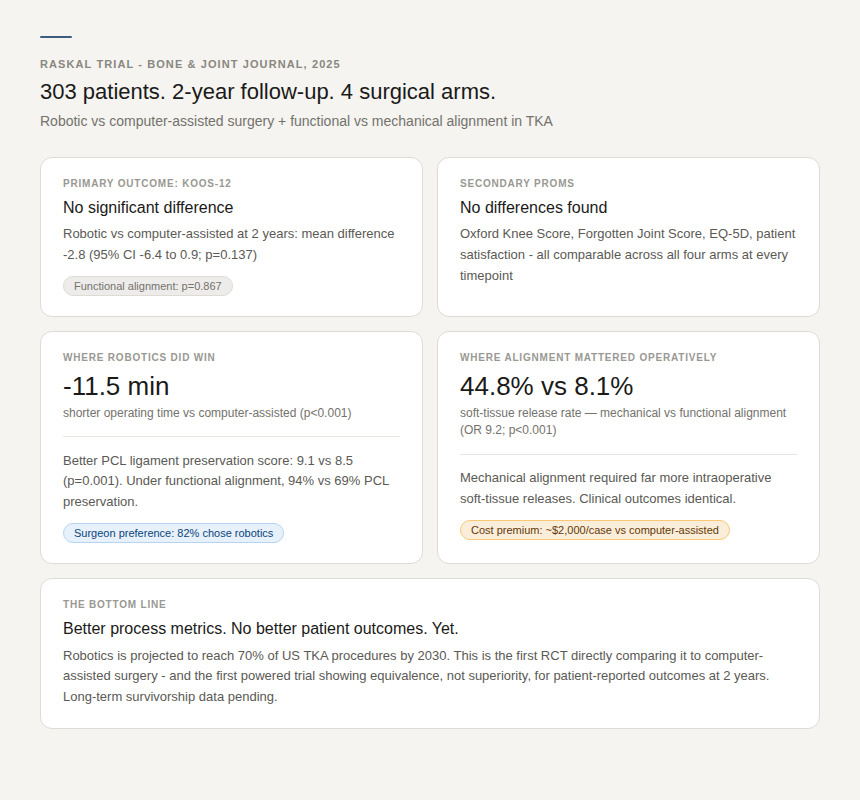
303 patients. 14 surgeons across 11 hospitals. A 2x2 factorial design also testing functional alignment against mechanical alignment. Two-year follow-up with validated patient-reported outcomes.

The primary outcome: KOOS-12 - a 12-item patient-reported score measuring pain, function, and quality of life.

The finding: no significant difference.

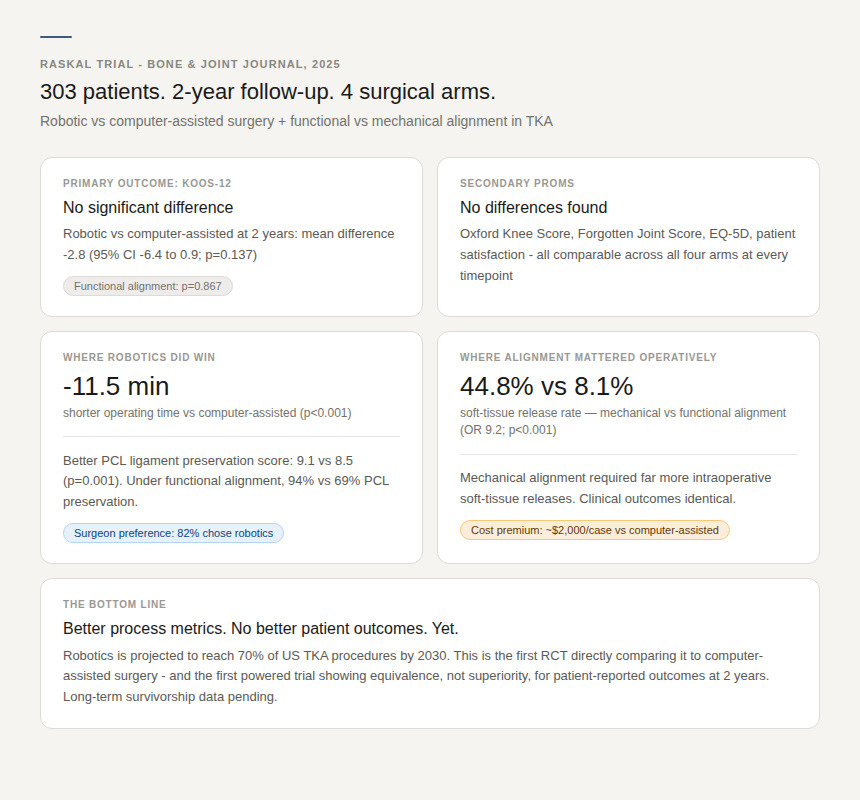
Robotic versus computer-assisted surgery at two years showed a mean KOOS-12 difference of -2.8 points (95% CI -6.4 to 0.9; p=0.137). Functional alignment versus mechanical alignment: essentially identical (mean difference 0.3; p=0.867).

No differences in Oxford Knee Score, Forgotten Joint Score, patient satisfaction, or quality of life at any timepoint from three months to two years.

The system that healthcare’s been investing billions in - the one projected to be used in 70% of knee replacements in the United States by 2030 - produced outcomes statistically indistinguishable from a technology we’ve had since the 1990s.

Read that again.

What the Data Actually Shows - and What It Doesn’t

Before I go further, I need to be precise here. This is not a study saying robots are useless. I am not saying that. The data has nuance that the headline can’t hold.

Robotics did produce meaningful process improvements. Operating time was 11.5 minutes shorter with the robotic arm (p<0.001). PCL ligament preservation was measurably better - and under functional alignment, the robotic group showed 94% PCL integrity versus 69% with computer-assisted surgery.

Surgeons preferred robotics in 82% of cases. Functional alignment dramatically reduced the need for intraoperative soft-tissue releases - 8.1% versus 44.8% with mechanical alignment (OR 9.2; p<0.001).

These are real advantages. Shorter operative time is real. Ligament preservation is real. Reduced soft-tissue releases are real. But the decreased soft tissue releases is not due to the robotic arm…modern navigation systems are capable of enabling functional alignment.

What is not demonstrated - not yet, at two years - is that any of this translates into better outcomes for patients. Better technical execution did not produce better clinical results. That gap is something the field needs to sit with, honestly, rather than explain away.

Two important caveats. First, this trial was conducted in Australia using a specific robotic platform (Stryker Mako) and a single implant system (Triathlon). Results may not generalize to all robotic platforms. Second, two years is not the whole story. Where robotics may ultimately prove its value is in long-term implant survivorship - reduced aseptic loosening, lower revision rates. A 2025 retrospective analysis of 22,000 TKAs suggested exactly that. The RASKAL trial isn’t designed to answer the survivorship question. We need those answers.

But we should not let the long-term hypothesis excuse the short-term reality.
The $2,000-Per-Case Question

Here is the uncomfortable math.

The additional cost of robotic-assisted TKA has been estimated at approximately $2,000 per case versus computer-assisted surgery - and roughly $2,600 per case compared to manual instrumentation. In the United States, with roughly 700,000 knee replacements performed annually and robotic adoption climbing toward that projected 70% threshold, we are talking about hundreds of millions of dollars in additional healthcare spending per year.

For outcomes, at two years, that are statistically equivalent.

I am not anti-technology. My engineering degree sits next to my medical degree for a reason. I have been involved in implant design. I believe precision matters and that technology, properly applied, makes surgeons better. What I am against is the uncritical adoption of expensive technology driven by marketing momentum rather than clinical evidence - particularly in a healthcare system already collapsing under its own cost burden.

When I built Indiana Orthopedic Institute, one of the foundational principles was this: every dollar spent on care delivery must earn its place at the table. We have grown to over $40M in revenue and 100 employees, including 16 surgeons, in three years. We did that by asking hard questions about what actually improves patient outcomes - not what looks impressive in a brochure.

The question “compared to what” applies just as much to your capital budget as it does to your surgical approach.

The Moment I Got Humbled

I want to be honest about something.

I have used robotic assistance. I have felt the precision it offers - the way a well-planned robotic case tightens your confidence at the critical moments. There is a real subjective experience of control that the technology provides, and I understand why 82% of the surgeons in this trial preferred it.

But I have also had the harder experience: a patient - a 64-year-old retired teacher, otherwise healthy, excellent bone stock, a technically well-executed case by every objective metric - who at one year still had persistent stiffness and functional limitations that defied my surgical explanation. By all the numbers I track, that case was a success. She did not experience it that way.

What did I do differently for her? Not much, initially. And that failure to ask better questions earlier in her recovery is something I carry.

The point is this: technical precision and patient outcome are not the same variable. The RASKAL trial just proved that at scale. I proved it to myself one patient at a time.

That gap - between what we measure in the OR and what the patient actually lives - is where the real research frontier sits.

A Framework for Evaluating Surgical Technology

After 10,000+ joint replacements, I have developed what I call the Evidence-Before-Investment Framework for evaluating new surgical technology. It is not complicated, but it is disciplined.

  1. Define the comparator. “Better than nothing” is not a standard. What is the best current alternative, and what is the data against that specific alternative?

  2. Separate process metrics from patient outcomes. Alignment precision, operative time, and ligament preservation are process metrics. KOOS scores, Oxford scores, revision rates, and patient satisfaction are outcomes. Technology must eventually move the outcomes needle to justify its cost.

  3. Understand the time horizon. Short-term equivalence may coexist with long-term superiority. Be honest about which claim the data supports at any given moment.

  4. Account for cost in the value calculation. A technology that produces identical two-year outcomes at $2,000 more per case is not neutral - it is a net negative until proven otherwise. Our patients are already financially strained by the cost of care. That is not an abstraction; it is a moral responsibility.

  5. Follow surgeon preference with skepticism. In the RASKAL trial, 82% of surgeons preferred robotics - even though outcomes were equivalent. Preference and efficacy are not the same. We are not immune to the cognitive biases that come with expensive, impressive tools.

What This Means for the Field

I want to speak directly to the surgeons and orthopedic leaders reading this.

The RASKAL trial is not the last word. It is the first rigorous word. What it demands is that we stop treating robotic adoption as inevitable progress and start treating it as a hypothesis that requires ongoing validation.

The technology may yet prove its value in long-term survivorship. The process improvements - shorter OR time, better ligament preservation, reduced soft-tissue releases - are clinically meaningful and may prove cost-effective when properly analyzed. I am not closing the door.

But the door should not have been this wide open without this data existing first.

The hospital systems and device companies that are pushing robotic adoption are not doing so primarily because of your patients’ two-year outcomes. They are doing so because of market share, capital investment recovery, and competitive positioning. That is not cynicism - it is just business. The question is whether you let their business logic drive your clinical decision-making.

Build your own framework. Ask “compared to what.” Read the trials, including the ones that challenge your existing investments.

Your patients deserve decisions made on evidence, not on the quality of the sales presentation.

That is the incision point. Where intention meets reality. Where the question “does this actually work better” has to be answered before the robot enters the room.

The RASKAL trial was published in The Bone & Joint Journal (MacDessi et al., 2025). Full citation: https://boneandjoint.org.uk/Article/10.1302/0301-620X.108B.BJJ-2025-1472.R2

Submitted: April 18, 2026 EDT

Accepted: April 18, 2026 EDT

Attachments

Powered by Scholastica, the modern academic journal management system