
Introduction
Distal radius fracture is one of the most common orthopaedic injury, with an estimated incidence of 643,000 per year (Chung and Spilson 2001). While the optimal treatment modality remains controversial (Koval et al. 2014), operative fixation has rapidly increased by approximately 39% from 1999 to 2007 (Chung and Spilson 2001). Operative fixation has further increased with the recent popularity of volar-based plating, which has been shown to decrease the rate of fracture malreduction and allow earlier return to work (Rozental and Blazar 2006). Pain management for these fractures is typically either general or regional nerve block, followed by opiate-based oral medications in the post-operative period.
Post-operative pain management for distal radius surgery is critical not only for patient satisfaction, but also for recovery and long-term functional outcomes. Egol and colleagues compared the effect of general anesthesia versus regional nerve block in 178 patients who underwent distal radius volar plating (Egol et al. 2012). At 3 and 6 months, patients who received a regional nerve block exhibited less pain and improved function based on better wrist and finger range of motion and better DASH scores, as compared to patients who received general anesthesia.
Numerous studies have reported the efficacy of regional nerve blocks in improving post-operative pain control in both upper and lower extremity orthopaedic procedures (Egol et al. 2012; Mirza and Brown 2011; Schroeder et al. 1996; Shah et al. 2005; Hadzic, Karaca, et al. 2005; Hadzic, Williams, et al. 2005; Bruce et al. 2012). Regional nerve blocks are particularly useful in the ambulatory surgery setting, facilitating discharges to home with pain well-controlled. Regional nerve block is standard of care at our institution, providing about 12-18 hours of meaningful analgesia (Bruce et al. 2012).
A problem to this approach, however, is the phenomenon of “rebound pain,” a period of significant increased pain when the nerve block wears off (Abdallah et al. 2015). Galos and colleagues performed a randomized controlled trial on 36 patients undergoing distal radius fracture surgery, comparing general anesthesia versus infraclavicular brachial plexus block. While the nerve block group experienced better control than the general anesthesia group overall, rebound pain was observed that peaked 12-24 hours post-operatively as measured by VAS.
At our institution, a similar experience has been anecdotally reported of the rebound phenomenon occurring 12-24 hours after surgery, and is often associated with increased patient anxiety and decreased satisfaction. In an effort to improve post-operative pain control, we proposed the use of liposomal bupivacaine (LB) to mitigate rebound pain. LB is an extended release formulation of bupivacaine that has been purported to provide up to 72 hours of analgesia, although evidence of its full 72 hours of efficacy has been inconsistent (Alter et al. 2017; Ketonis et al. 2016; Hamilton et al. 2016). Anecdotally, post-operative pain has improved, patient satisfaction has increased, and rebound pain has been mitigated in cases where LB was administered as an adjunct to a regional nerve block for distal radius fracture surgery.
In this study, we aim to evaluate the efficacy of liposomal bupivacaine in providing meaningful, additional pain control on top of a regional nerve block for patients undergoing volar plating after distal radius fracture. We hypothesize that LB will confer clinically and statistically significant improvement in post-operative pain control up to 72 hours post-operatively by mitigating the rebound pain phenomenon observed with regional nerve block alone and having improved early functional outcomes measured by the QuickDASH at 2 weeks post-operatively.
Materials and Methods
After institutional review board approval, 46 adult patients (age 18 or older) with isolated distal radius fractures treated with open reduction and volar plating between January 2017 and February 2018 were prospectively enrolled. Patients from five orthopaedic surgeons at our institution were included. Both intraarticular and extraarticular fractures with or without associated ulnar styloid fractures were included. We excluded all patients who did not have an isolated distal radius fracture or had a condition that may affect pain scores, including opioid use, history of poly-trauma or previous pain due to other injuries, or neuropathy. Exclusion criteria included polytrauma, peripheral neuropathy, baseline narcotic use, preexisting pain syndrome, or fracture pattern that necessitated additional stabilization beyond volar plating through a single volar incision. All procedures were performed in a similar manner utilizing the volar approach of Henry. Fixation was achieved using a volar locking plate from either Synthes (Westchester, PA) or Medartis (Exton, PA), depending on surgeon preference.
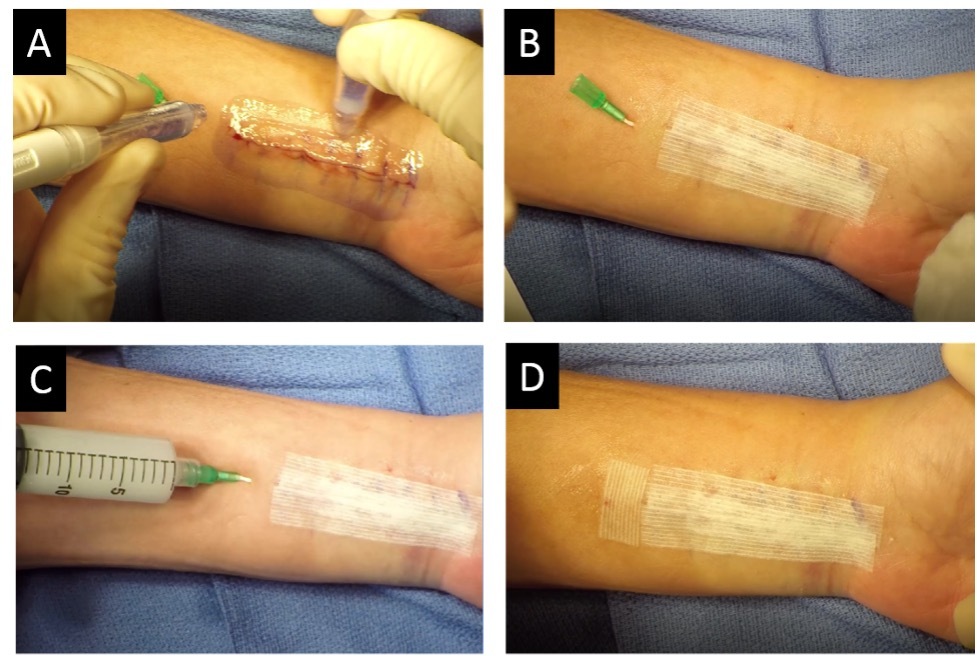
Patients received either a supraclavicular nerve block alone (n=20), or a supraclavicular nerve block with LB (n=26), based on surgeon preference. Supraclavicular nerve blocks were performed by anesthesiology under ultrasound guidance immediately prior to prepping and draping in the operating room. For administration of LB, an 18G angiocath was inserted into the surgical bed under direct visualization. 20 mL of undiluted LB (266 mg) was administered via the angiocath after wound closure with cyanoacrylate surgical adhesive and surgical tape strips (Figures 1A-D). Puncture site was sealed after removal of the angiocath to ensure all 20 mL of LB were contained within the surgical bed. All procedures were performed as ambulatory surgery, and patients were discharged with oxycodone/acetaminophen 5/325 mg 1-2 tablets q4-6 hours for pain.
**_wound_is_closed_and_sealed_with_cyano.jpg)
Data collected included age, gender, Charlestone Comorbidity Index (CCI), and days between injury and surgery (time to surgery). Outcome measures included Pain Catastrophizing Score (PCS), Visual Analogue Scale (VAS) pain score, and QuickDASH scores. Baseline PCS, VAS, and QuickDASH scores were obtained prior to surgery. Follow-up VAS and QuickDASH scores were obtained 18h, 72h, 1 week, and 2 weeks post-operatively.
Data were assessed for normality using the Shapiro-Wilk test, and appropriate statistical tests were selected based on the distribution of data. Statistical analyses were performed with Student’s t-tests for continuous variables (age, time to surgery), Chi-square test for dichotomous variables (gender), and Wilcoxon rank sum tests for categorical variables (CCI, VAS, QuickDASH, PCS). Spearman correlation coefficients were calculated to evaluate the correlation between PCS and VAS scores. VAS and QuickDASH scores were compared to minimal clinically important differences (MCID) to assess clinical difference (Randall et al. 2022; Franchignoni et al. 2014). A p-value of less than 0.05 was considered statistically significant. SAS version 9.4 (SAS Institute Inc., Cary, NC) was used to perform all statistical analyses.
The study was originally powered to detect differences in the functional status (QuickDASH score) measured 2-weeks post-surgery. According to a prior published research article that looked at patients with distal radius fractures (Loisel et al. 2015), the average QuickDASH score 2 weeks post-surgery is about 61, among patients repaired with volar plating. Also, according to results published by Hunsaker et al. (Hunsaker et al. 2002), the general population would score 10.1 on the DASH with a standard deviation of 14.68. Lastly, per an RCT comparing volar locking plates and Intramedullary nails for unstable distal radius fractures, the mean score for QuickDash Volar locking plate 2 weeks post-op is about 68, with a standard deviation (SD) about 15 (Plate et al. 2015). Since no known common SD is available for our study population, an assumption of 15 for our study population’s SD was made for purposes of sample size estimation. It was determined that a sample size of 143 in each group would have 80% power to detect a difference in means of 5 points on the QuickDASH (assuming that the common SD of 15.0) using a two- sample t-test with a 0.05 two-sided significance level. To account for minimal loss to follow up (<5%), a sample size of 150 per arm would have afforded enough power to detect a small (5-point difference) in QuickDASH scores between the two groups, and to perform subgroup analyses on the main outcome of interest, VAS pain scores at 72 hours post-surgery. (Assuming that the SOC group would have a mean VAS pain score of 8.5 and SD of 1.5 at 72 hours post-surgery based on prior literature [MacDermid et al. 2003], a sample size of 13 in each group would have 80% power to detect a probability of 0.827 that an observation in the Block plus LB group is less than an observation in the SOC group (specifically -2.0 difference in mean VAS pain score) using a Wilcoxon rank-sum test with a 0.05 two-sided significance level.)
However, due to recruitment difficulties, the study was terminated prematurely, yielding 20 subjects in the nerve block alone group and 26 in the supraclavicular nerve block with LB, allowing sufficient power only to detect a 2.0 difference in mean VAS pain score between the groups. Given the small sample size this study was underpowered to be able to conduct sub-group analyses and to detect differences in the outcome of functional status measured 2-weeks post-surgery.
Results
Baseline cohort characteristics are shown in Table 1. No significant difference in patient demographics, including mean age or standard deviation (58.4 ± 13.8 vs 57.8 ± 15.8 years) or gender (69% vs 75% female), were observed between the Block plus LB and the Block only cohorts. There were also no significant difference in mean CCI (1.88 ± 1.84 vs 1.67 ± 1.41), baseline VAS (4.5 ± 2.8 vs 3.3 ± 2.5), baseline QuickDASH (79.1 ± 11.1 vs 75.3 ± 9.9), PCS (17.5 ± 14.4 vs 10.9 ± 9.4), or mean time to surgery (8.1 ± 5.2 vs 9.7 ± 6.0 days) between the Block plus LB and the Block only cohorts, respectively (p>0.05).
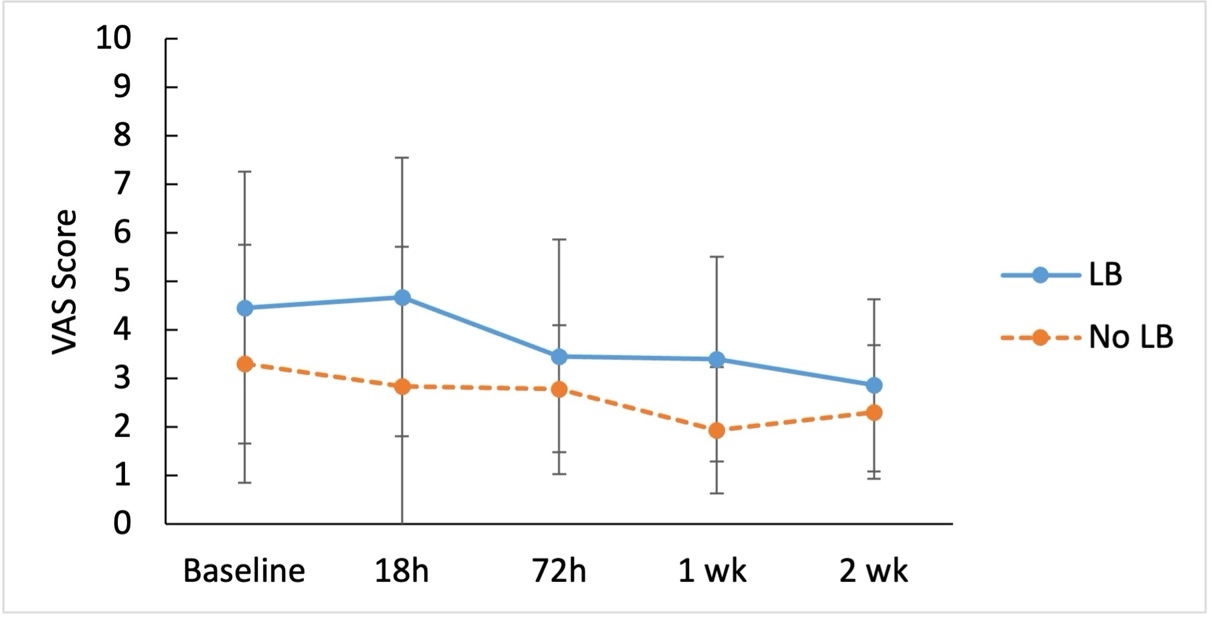
VAS pain scores demonstrate the highest amounts of pain at baseline that, on average, gradually improved over the two-week follow-up period (Figure 2). For the Block only group, VAS scores improved from (mean, SD) 2.84 ± 2.45 at 18 hours post-operatively to 2.79 ± 1.31, 1.94 ± 1.3 to 72 hours, and 1 week, respectively. For the Block plus LB group, 18 hour post-operative mean VAS scores were 4.68 ± 2.87, improving to 3.45 ± 2.42 and 3.4 ± 2.11 and 72 hours and 1 week. At 2 weeks, we saw an increase in mean VAS scores in both groups (2.31 ± 1.38 in block only group and 2.86 ± 1.77). No clinical or statistical difference in VAS pain scores was observed between the two groups at any of the time points (p>0.05).
_with_block_plus_lb_(solid_line)._err.jpeg)
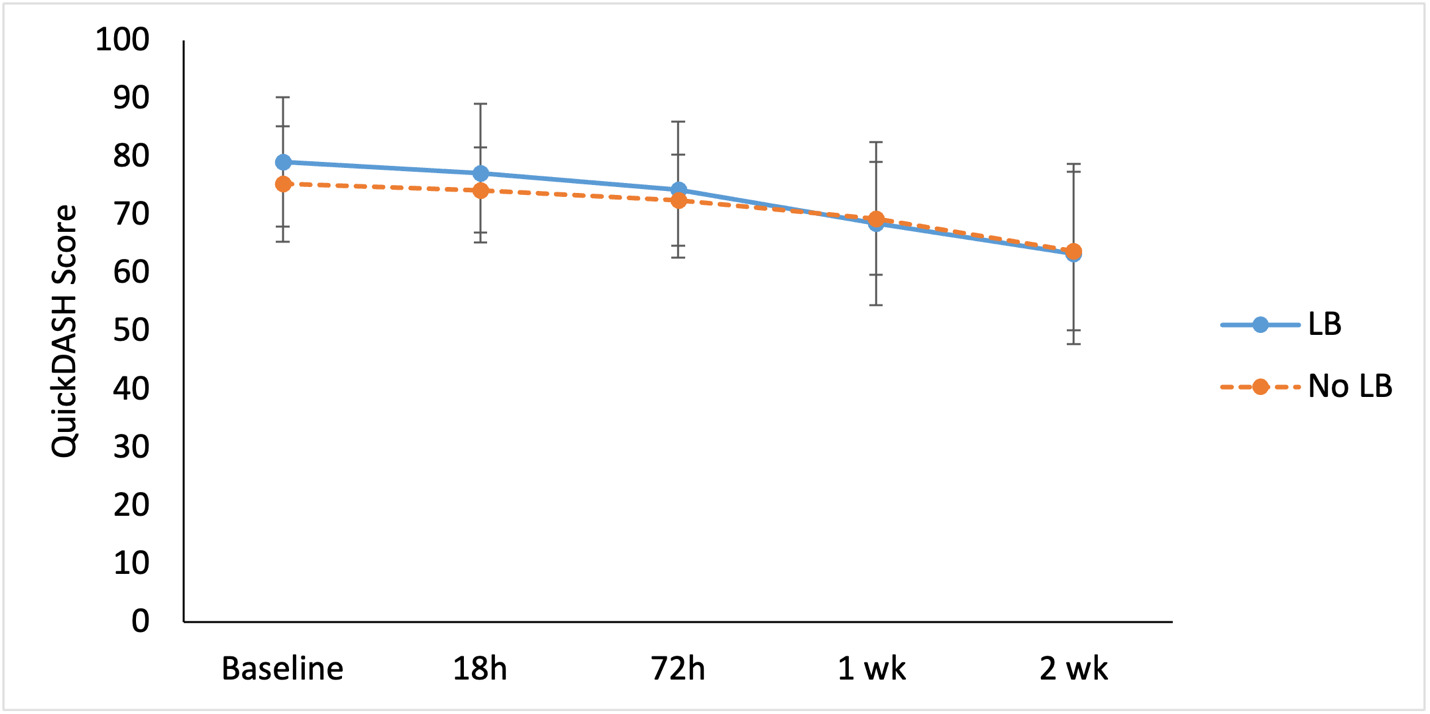
Similarly, QuickDASH scores were highest/worst at baseline and gradually improved (Figure 3). For the Block only group, QuickDASH scores were 74.28 ± 7.35, 72.56 ± 7.85, 69.39 ± 9.68, and 63.81 ± 13.65 at 18 hours, 72 hours, 1 week and 2 weeks, respectively. For the Block plus LB group, QuickDASH scores were 77.18 ± 11.89, 74.37 ± 11.7, 68.52 ± 14.03, and 63.31 ± 15.49 at 18 hours, 72 hours, 1 week and 2 weeks, respectively. Again, none of these differences represent any clinical or statistical difference between the two groups at any of the time points (p>0.05).
_with_block_plus_lb_(solid_.png)
In all patients, the Pain Catastrophizing Scale was modestly correlated with VAS scores at 18 hours (r=0.29, p=0.05) and again at 72 hours (r=0.35, p=0.04).
Discussion
Our study aimed to evaluate whether LB provided additional post-operative pain relief for patients undergoing distal radius volar plating who have received a supraclavicular nerve block. In particular, we expected LB to mitigate the rebound pain that occurs 12-24 hours after surgery. The liposomal formulation of LB was designed to provide extended release of bupivacaine. A single dose of LB has been reported to provide up to 72 hour of pain relief and reduction of opioid consumption, when compared to bupivacaine alone (Dasta et al. 2012). The extended release profile should provide continued pain relief after the nerve block wears off, improving post-operative pain control.
Ultimately, we did not find any statically or clinically significant difference to suggest that LB provided a measurable benefit in VAS pain scores at 18 hours, 72 hours, 1 week, or 2 weeks post-op. No difference was observed in QuickDASH function scores between the two groups, but as previously mentioned, this study was not powered to detect a meaningful difference in this metric. While baseline VAS pain scores were slightly higher in the Block plus LB group that may potentially confound results, the magnitude of decrease of the VAS pain score for the two groups between each time point were not statistically different.
Also unexpected was the lack of rebound pain in the Block only group. The 18 hour and 72 hour time points were chosen to best capture the effects of LB and its effect on the rebound pain window based on previously published studies (Galos et al. 2016). It is unclear whether rebound pain occurred but was not captured, or if truly no rebound pain occurred in our cohorts. If no rebound pain occurred, this may be due to differences in the injection cocktail or technique used for the supraclavicular nerve blocks in the present study as compared with cocktails used in other studies. Along a similar vein, it is also possible that in our cohort, the nerve block wore off at an earlier time point than expected and was subsequently not captured by our earliest time point of 18 hours. Regardless, the addition of LB did not improve pain scores at any of the follow-up time points.
The lack of evidence supporting efficacy of LB is not surprising given the mixed results published previously in the literature. While some clinical trials report clinically meaningful pain relief for up to 72 hours (Ketonis et al. 2016; Dasta et al. 2012), other groups have reported little or no efficacy. Alter and colleagues randomized 41 distal radius fracture surgery patients to compare injection of 0.5% bupivacaine alone with injection of 0.5% bupivacaine plus LB (Alter et al. 2017). All patients received 20 mL of 0.5% bupivacaine prior to incision, and 20 of the 41 patients were randomized to receive an additional 10 mL of liposomal bupivacaine prior to wound closure. LB was found to improve pain scores and reduce opioid consumption only on the day of surgery, but not afterwards. A systematic review of the efficacy of liposomal bupivacaine infiltration at surgical sites for post-operative pain concluded that presently there is insufficient evidence supporting the superiority of LB over plain bupivacaine (Hamilton et al. 2016).
Other studies have suggested that additional surgical site injection of regional anesthetics does not provide added benefit in patients who have already received a regional nerve block. Chung and colleagues studied 44 patients undergoing distal radius volar plating performed under an axillary block, half of whom received an additional surgical site injection of a mixture of ropivacaine, morphine, and epinephrine (Chung et al. 2010). No difference in pain scores were observed for the first 48 hours after surgery. All patients also received patient-controlled analgesia for 24 hours, however, which may have confounded results.
Our study had several limitations. While our study was powered to detect a 2 point difference in VAS pain score corresponding to the literature reported average of 2 point VAS score increase associated with rebound pain, our sample size was not large enough to detect small, but possibly clinically meaningful differences. The small sample size increases the possibility of numerous types of error and limits this study’s generalizability. No randomization was performed, which increases the risk of unmeasured confounders that may affect results. Although patients were assigned a cohort based on surgeon preference, selection bias is possible given that each surgeon performed all distal radius volar plating exclusively with LB or without LB. Opioid consumption was not tracked due to concerns from the IRB about respondent burden in this study. The lack of difference in VAS pain scores and QuickDASH function scores may have been due to variations in self-medication with opioids, but unfortunately, our study was not large enough to perform covariate adjustment. Only short term follow-up of up to 2 weeks was performed, although long term outcomes are unlikely to be different if there are no differences detected in the early post-operative period. A third arm of LB only without supraclavicular nerve block was not included in this study. It is possible that there may be a ceiling effect in which a maximum degree of pain control can be achieved with either regional nerve block or LB alone, but that which cannot be surpassed by the combination of the two modalities.
Future directions include evaluating the efficacy of LB alone in comparison with a regional nerve block, as well as comparing costs. At an estimated price of $285 per dose of LB, our study suggests that LB is cost-ineffective for patients undergoing distal radius volar plating that have already received a nerve block. It may be cost-effective, however, should LB alone provide comparable pain control profiles as a single shot regional nerve block.
Statement of Informed Consent
Informed consent was obtained from all individual participants included in the study.
Statement of Human and Animal Rights
All procedures followed were in accordance with the ethical standards of the responsible committee on human experimentation (institutional and national) and with the Helsinki Declaration of 1975, as revised in 2008. Informed consent was obtained from all patients for being included in the study.
Statement of Funding
No funding was received for this study.