

INTRODUCTION
Artificial intelligence is rapidly transforming medicine by enabling more precise diagnostics, personalized treatment planning, and improved patient management. A recent review found that AI is driving a “transformative shift” in orthopedics, particularly by enhancing preoperative planning, intraoperative navigation, and postoperative care (Han et al. 2025). For example, deep learning algorithms can now assist in fracture detection, implant alignment, and patient outcome prediction, contributing to more efficient and accurate care. However, translating these AI advances into everyday practice often requires substantial software development expertise. Most orthopedic surgeons have deep domain knowledge but typically lack programming skills, creating a barrier between clinical insight and technical implementation. This is where artificial intelligence and its recent advances bring about tremendous change.
The no-code AI programmers help to build tools and programs to curated uses using prompts and graphical interface rather than cryptic codes. In essence, a surgeon can describe the desired functionality or input/output requirements, and the platform generates the underlying application. Such no-code platforms have already been demonstrated in healthcare. For instance, a study on hematopathology showed that medical professionals could use a free web-based no-code AI tool (Google’s Teachable Machine) to train a model that accurately classifies blood cell types, even without coding experience. The authors noted that these tools “help transcend the computing-healthcare boundaries and harness the power of AI” to improve patient care (Hoseini and Dewar 2024).
Similarly, orthopedic surgeons come across a lot of scenarios where there is a need for a tool for a particular custom function. These developments point to a practice where orthopedic surgeons can directly craft apps and analytical tools using the power of AI by specifying requirements in plain language, rather than relying on dedicated software teams. The following sections examine the practical applications and implications of this no-code trend in orthopedics.
Application in Orthopedic research and preop planning
Artificial intelligence-powered no-code application development can support a wide range of orthopedic applications. As orthopedic surgeons, we are well-versed in the principle of all procedures and accurate planning is the cornerstone of successful surgeries. Unfortunately, exposure to state-of-the-art tools and applications may be limited due to a lack of exposure and financial constraints.
This prompt-based technique for developing tools can assist surgeons in various ways. For instance, a surgeon, especially in a low-resource setting, may not have access to an application that can assist in planning a distal femur osteotomy or a high tibia osteotomy. The implementation of AI in developing these tools can provide the surgeon with sophisticated planning and analytical tools.
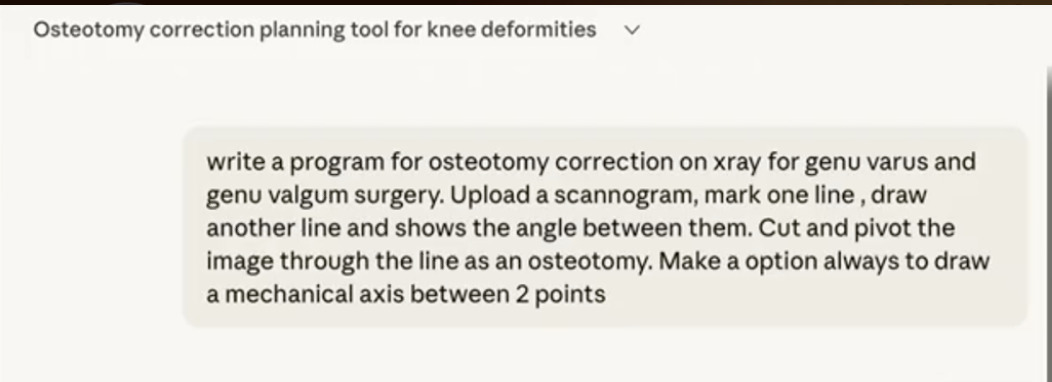
This process begins with a problem that the surgeon encounters in daily practice. First, the problem must be clearly defined. The surgeon visualizes a solution for it and provides clear prompts to the publicly available large language models. The more detailed and clear the prompts are, the better the results. The AI will generate code for the tool that the surgeon has conceptualized.

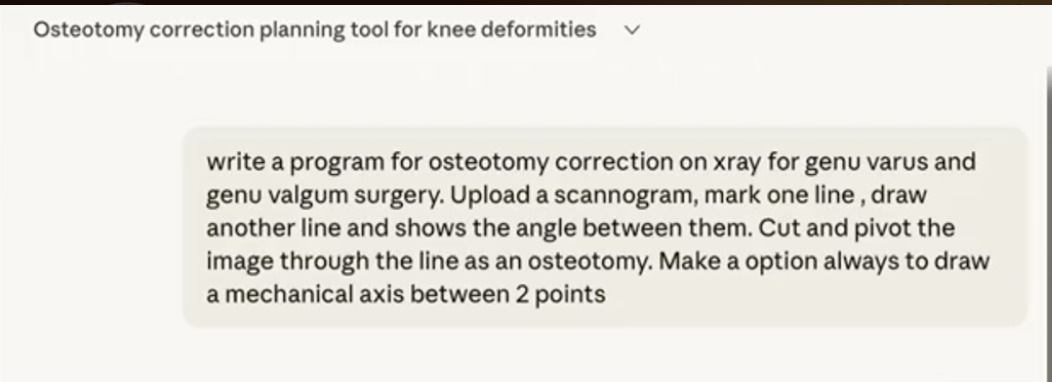
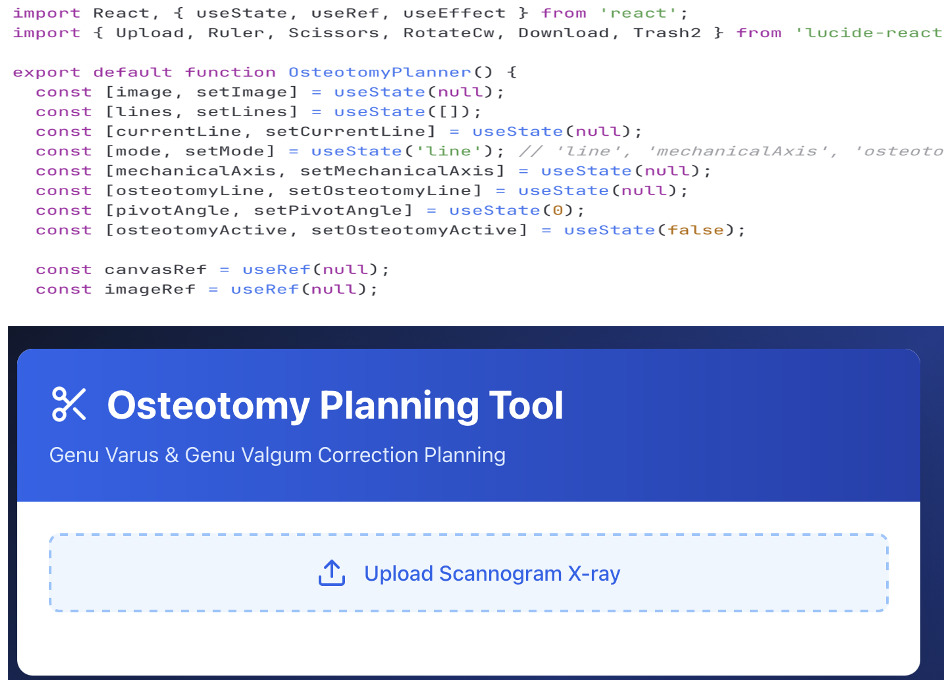
This code can be obtained in various formats, such as HTML or Java, and can be copied to a compiler available online or built into the LLM to display the results.
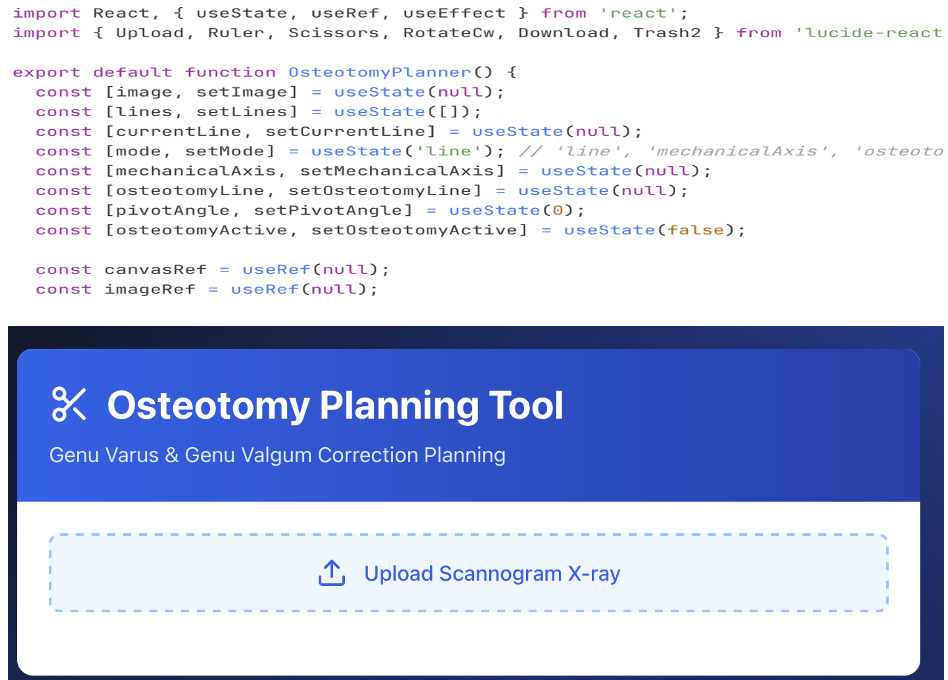
There is room for customization and error correction, as the required changes can be typed out in the prompts rather than modifying the base code, which requires coding expertise.
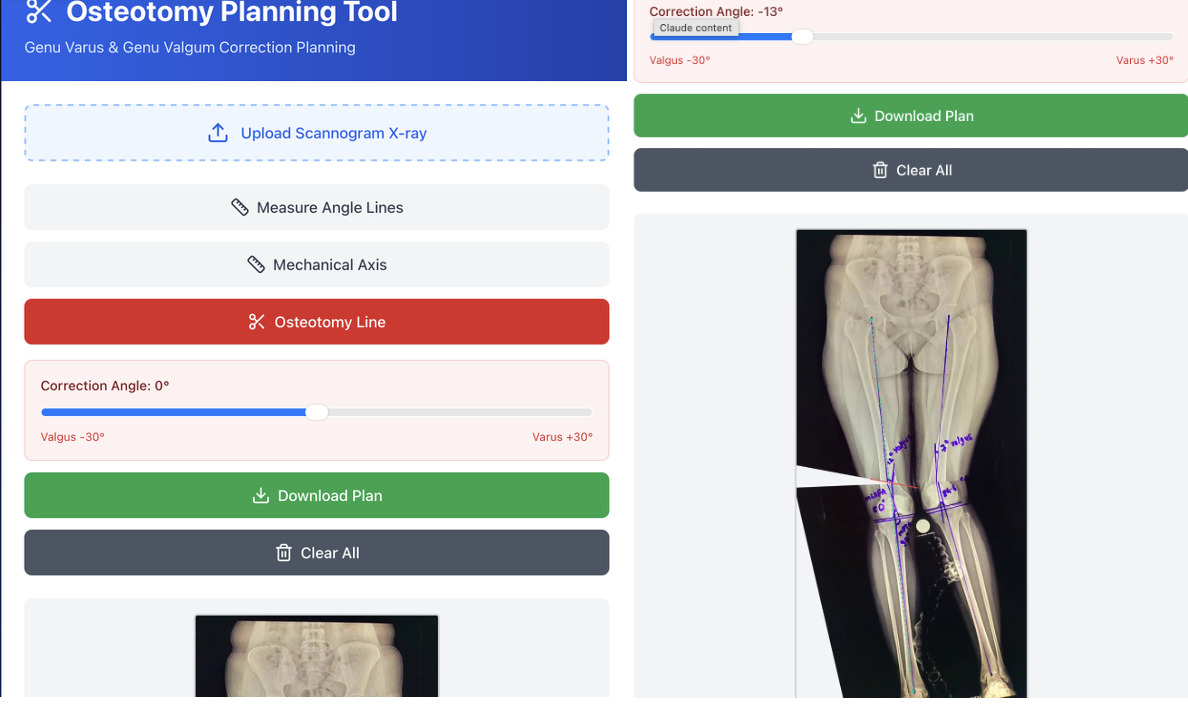
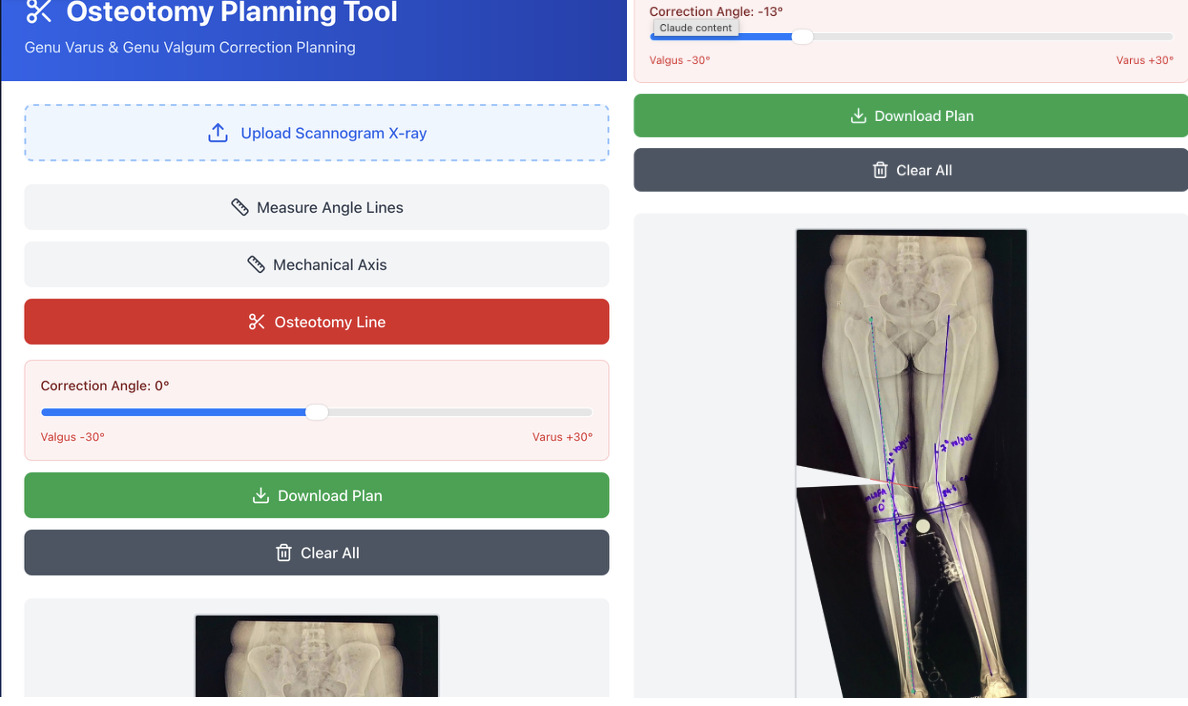
The final product is a tool that can be utilized for precise planning of distal femur osteotomy. The process has been simplified to upload a standing scannogram, determine the osteotomy level, and employ a slider to adjust until the mechanical axis is aligned normally and the required correction is achieved.
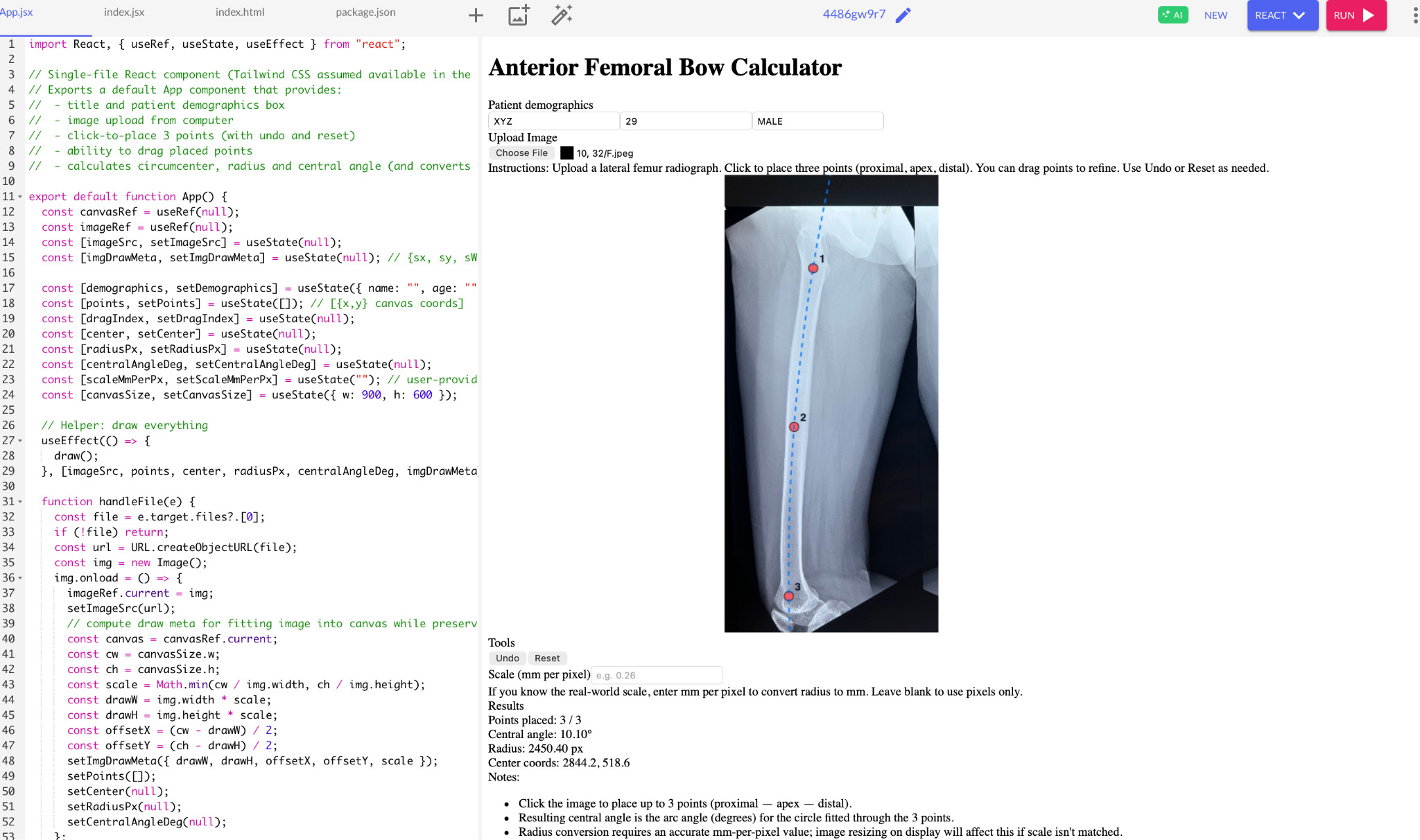
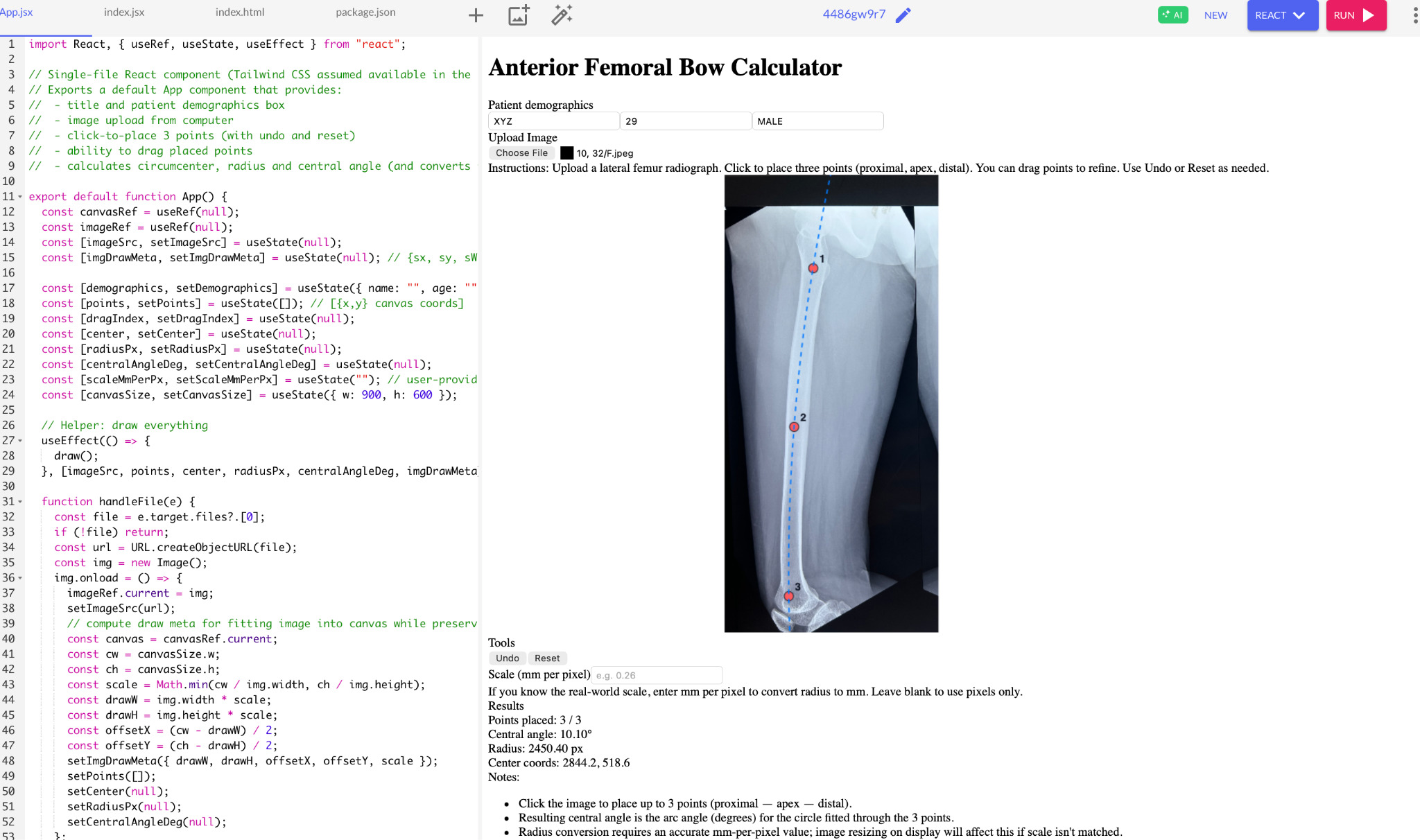
There are many such applications where the surgeon takes the lead seat of visionary, designer, and planner; the AI will produce the vision. Another example is shown in Fig 5 where a tool to measure anterior bowing of femur is developed for the radiological analysis.
DISCUSSION
This article discusses the application of our no code app development in use for orthopedic surgeons and to show working prototypes. This is a cost-effective and accessible method for creating tools tailored to orthopedic needs. Similar tools or applications can be conceptualized and developed by simply typing them out. This eliminates the need for a code developer or expensive subscriptions for applications. The utilization of no-code app/tool development presents a solution for orthopedic surgeons and residents to have access to custom-made tools. It will enable them to plan, create unique models, and share ideas and solutions. By lowering reliance on specialized IT staff, these solutions save money and allow limited budgets to go further. In effect, surgeons become their own “developer” simply by defining problem statements or data relationships in natural language. This democratization of app-building has been likened to the “democratization of AI”: enabling clinicians to create and deploy AI applications without extensive technical overhead (Lee et al. 2024). The No-code app development increase accessibility. Clinicians with minimal computer skills can harness advanced technologies. For example, cloud-based no-code systems handle computational tasks remotely, so the surgeon only needs an internet connection, computer and browser. In effect, orthopedic clinicians can iterate on app designs by simply describing the functionality, which bridges the gap between clinical insight and digital implementation (Hoseini and Dewar 2024).
These platforms thus bridge the gap between domain knowledge and software (Paul 2024). Traditionally, an orthopedic surgeon with an idea (say, a novel risk score calculation) would need to convey it to a software team via specifications or wait for funding to build it. With no-code AI, the surgeon can prototype it directly. For instance, to analyze research data, one might prompt “correlate patient BMI with implant loosening,” and the platform could generate regression analyses or graphs. The tool translates medical language into data queries and code behind the scenes. This tight linkage ensures that the tools closely reflect clinical needs and reduces miscommunication (Dittrich et al. 2023).
All these are developed under human oversight and essentially extend the expertise of the surgeon into an app. While no-code AI tools simplify creation, the resulting models and apps are only as good as the data and prompts provided. AI systems can err or exhibit bias if not properly trained (Langerhuizen et al. 2020). The AI facilitates the expression of the surgeon’s vision into a functional application. Surgeons must validate these AI outputs against their judgment and evidence (Hashimoto et al. 2018). Regulatory bodies have also emphasized that AI in healthcare should be used under professional supervision. Any clinical decision support app built without code still needs to be evaluated like a medical device and be used with proper clinical knowledge. In summary, no-code does not obviate expert oversight; it merely relocates it to the app-design phase, where the surgeon must carefully specify criteria, review AI logic, and monitor outputs.
CONCLUSION
No code AI assisted app development holds great promise for orthopedic surgeons and residents by empowering them to rapidly create specialized clinical and analytical tools using simple language prompts. They leverage the latest in machine learning and generative AI while removing the traditional coding barrier. In practical terms, orthopedists can build custom tools for image interpretation, surgical planning, data management, and patient engagement that closely match their workflow. This democratization of digital innovation has the potential to reduce development costs, accelerate research, and spread AI benefits to resource-limited settings.
However, this new paradigm also underscores the need for education and governance. Orthopedic surgeons should receive training on AI fundamentals and no-code tools, and institutions should develop protocols for validation and quality control. By coupling clinician expertise with accessible AI tools, the field can achieve more rapid innovation while maintaining patient safety. With prudent oversight, no-code AI can bridge the gap between clinical insight and digital solutions, ultimately advancing personalized orthopedic care.