This website uses cookies

We use cookies to enhance your experience and support COUNTER Metrics for transparent reporting of readership statistics. Cookie data is not sold to third parties or used for marketing purposes.

Skip to main content
null
J Orthopaedic Experience & Innovation
  • Menu
  • Articles
    • Brief Report
    • Case Report
    • Case Series
    • Conference Proceedings
    • Data Paper
    • Editorial
    • Meeting Reports/Abstracts
    • Methods Article
    • Product Review
    • Research Article
    • Review Article
    • Review Articles
    • Systematic Review
    • All
  • For Authors
  • Editorial Board
  • About
  • Issues
  • Blog
  • "Open Mic" Topic Sessions
  • Advertisers
  • Recorded Content
  • CME
  • JOEI KOL Connect
  • Resident Research League
  • search
  • RSS feed (opens a modal with a link to feed)

RSS Feed

Enter the URL below into your favorite RSS reader.

https://journaloei.scholasticahq.com/feed
ISSN 2691-6541
Review Article
Vol. 7, Issue 2, 2026November 18, 2026 EDT

Shoulder Arthroplasty After Prior Ipsilateral Shoulder Arthroscopy: A Systematic Review of Clinical Outcomes, Complications, and Revision Rates

Garrett R. Jackson, M.D., Colton C. Mowers, M.D., Justin T. Childers, M.D., Jaxon S. Boley, B.S., Steven F. DeFroda, M.D., Matthew J. Smith, M.D., Keith Kenter, M.D.,
Total shoulder arthroplastyshoulder arthroscopyclinical outcomessurgical complicationsrevision surgery
Copyright Logoccby-nc-nd-4.0 • https://doi.org/10.60118/001c.171321

Articles in Vol. 7, Issue 2, 2026

Vol. 7, Issue 2, 2026
  • A Human Factors Analysis of Personal Electronic Device Use and Cognitive Distractions in Orthopedic Surgery
    Asfand KhanAlbert Boquet
  • Does Preoperative Suzetrigine Impact ASC Opioid Consumption For Total Joint Arthroplasty?
    Louis BattistaAndrew Wickline
  • Pickleball Pains: A 10-year Epidemiologic Analysis of Rising Upper Extremity Injuries
    Kevin ValdesAghdas MovassaghiJehad Feras AlSamhoriXiomara OrtizJocelyn LubertVani J. Sabesan
  • From Innovation to Inaccuracy: The Impact of ChatGPT on Orthopaedic Surgery Research Citations in Sports Medicine
    Calista StevensAlexander HahnGregory ConnorsShiraz MumtazMartinus MegallaZachary GraceJohn CorviMatthew PartanKatherine Coyner
  • Does CMS Hate Specialists?
    Benjamin Schwartz, MD
  • Voices in Orthopaedics™...The Residency Programs: The Unionized Orthopod: Apprenticeship, Labor, and the Changing Identity of Orthopedic Residency at Jefferson
    Eric R. TecceJalen N. BroomeTyler W. HenryGabriel I. Onor Jr.Daniel A. NemirovDaniel E. DavisJames J. Purtill
  • Cerclage Fixation in Total Hip Arthroplasty: Anatomy, Surgical Options and Clinical Outcomes
    Zuhdi AbdoZachary FullerThomas ChristensenAhmed Siddiqi
  • In My Experience™...Orthopaedics: Then, Now, and Tomorrow: Reflections on a Half Century of Change
    Richard Conn, MD
  • Genicular artery embolization for symptomatic knee osteoarthritis: A narrative review
    Junaid MakdaAhmed SiddiqiKhalid YousufOsman Ahmed
  • Simplifying Orthopedic Patient Education: A ChatGPT-Based Readability Analysis
    Mendel ShloushKlaudia GreerJonathan BruttiBrayden TolmanJacob RosenthalRafael Aldaya BourricaudyMarcia VarellaFernando Aran
  • Digital Fatigue and Orthopedic Injuries: The Postural Burden of the Digital Era - A Narrative Review
    Ambrose Loc NgoNiki Gharavi AlkhansariTruong HoRachana TadakamallaLinda NguyenJared Nichols
  • Concurrent Floating Hip and Open Knee Dislocation: Damage-Control Management
    Sara LowVladislav MuldiiarovMark AyzenbergGermanuel LandfairGene Shaffer
  • Higher Pain Catastrophizing Scores are Associated with Increased Pre-operative Anxiety in Ambulatory Hand Surgery that is not Impacted by Watching a High-Quality Pre-Operative Video
    Christopher G. LarsenMichael J. SayeghAmr TawfikCaroline ApriglianoChloe HeitingKate W. Nellans
  • MOTIV™ and the Next Frontier of Orthopaedic Evidence Generation: A New Model for Physician-Led Clinical Research
    John Mercuri, MDAndrew Wickline, MD
  • Evidence on Demand: OpenEvidence versus Established LLMs on the Orthopaedic In-Training Examination
    Asim A. KhanShaan S. LalvaniSam PourarbabLord J. HyeamangRyan M. LewZaamin B. HussainGregory P. NicholsonGrant E. Garrigues
  • Beyond BMI: Surgical Readiness in the Age of GLP-1 Therapy
    Thomas Meade, MDReza Jazayeri
  • From My Perspective… Medial or Lateral? The Native Knee Pivot Controversy and Its Implant Consequences
    Stephen Howell
  • Trends in Orthopedic Surgeons Signing Medicare Opt-Out Affidavits
    Thriaksh RajanAndre RevnewJoshua PortoMonish LavuComron SaifiAtul Kamath
  • Voices in Orthopaedics™...The Residency Programs: Training for the Future of Orthopaedic Surgery: Residents’ Perspective on the UT Austin Dell Medical School Orthopaedic Surgery Residency
    Cassidy ShieldsSemran ThamerAmanda SeymourAlec Giron
  • Preoperative GLP-1 Receptor Agonist Use Improves Thromboembolic, Infectious, and Wound-Related Outcomes Following Unicompartmental Knee Arthroplasty
    Zachary FullerManjot SinghAbhiram DawarJeremiah ThomasAlan H DanielsZuhdi E Abdo
  • Beyond the Breaking Point: Solutions for Burnout in Orthopaedic Surgery
    Aghdas MovassaghiCamryn McIntyreSamir SakariaMitchell J. ChristiansenJocelyn LubertMary MulcaheyVani Sabesan
  • Utilization of a 3D Printed Customized Knee Extender Device and An At-Home Video Rehabilitation Program on Patient Outcomes in Rural Areas Following ACL Surgery
    Kevin P. FeltzBrooklyn VanDerWoldeKyle CochranEleanor GibbonsBenjamin C. NoonanNathan Wm. Skelley
  • Reclaiming the Continuum of Care: A Physician-Owned Capital Platform for Aligning Care Delivery, Risk, and Financial Infrastructure
    Marty NicholsJohn MilesThomas Chambers
  • Feasibility and Early Experience of Custom Stemmed Tibial Trays in Revision Total Ankle Arthroplasty: A Case Series
    Grant M. ThomasKush S. ModyJoydeep BaidyaCorinne SommiDavid I. PedowitzSelene G. Parekh
  • Postoperative Outcomes by Timing of Total Hip and Knee Arthroplasty Following Coronary Revascularization
    Zachary FullerManjot SinghThomas ChristensenJeremiah J ThomasAlan H DanielsZuhdi E Abdo
  • Tibial Plafond Fractures and the Impact of Social Media Support Groups on Patient Perceptions
    Alexandra F. FlahertyDana PerimAnnie WaiteAlvarho GuzmanErnest N. Chisena
  • Retained Male Component After Intra-operative Dissociation of a Tibial Magnetic Lengthening Nail: A Case Report covering Technical Challenges and Management Strategies
    Eunice Anastasia WiliantoNeeraj MishraDerrick Jun Liang LamKenneth Pak Leung WongBenny Kai Guo LooAshik Mohammad
  • A physician led consensus building intervention at a multi-specialty practice results in meaningful reduction of opioid prescriptions for post-operative patients
    Jenna M. GodfreyJohn Paul BigouetteConnor FitzpatrickJohn W. OverHeather A. CampionErin C. Owen
  • Voices in Orthopaedics™...The Residency Programs...The Role of Networking and Interconnectivity in Building an Orthopedic Career
    Gabriel I. Onor Jr.Terence L. Thomas, MDDaniel Nemirov, MDJalen Broome, MDDaniel E. Davis, MDChristopher C. Dodson, MDJames J. Purtill, MD
  • From My Perspective… The Consent Discussion: The Robot Demands
    Stephen Howell
  • Changes in Oral and Gut Microbiome Diversity in Patients undergoing Total Joint Arthroplasty and Receiving Perioperative Antibiotics, a Pilot Case Series
    Mary Bayers-TheringNadir HaiderSonja PavlesenKaren FalknerMatthew Phillips
  • How to Assemble a Well-Fitting, Patient-Specific Antibiotic Cement Hip Spacer for Infection Management
    Ahmed Nageeb MahmoudNicholas BruleCatherine Mary DoyleGabriel MakarDaniel Horwitz
  • At The Conference™...How to Handle Severe Bone Defects in Knee Arthroplasty
    Christopher Grayson, MD
  • From My Perspective...Triple-Tapered Collared Stems: Are They All Equal—and How Have They Changed Primary Hip Arthroplasty?
    David Rodriguez-Quintana, MD
  • On How I Do It™...Attachment Preserving Hinge Arthroplasty vs. ORIF for Complex Periarticular Knee Fractures
    Michael Langworthy, MD
  • About The Innovation™...Arthrolense: Where the Idea Began
    Russell Nevins, MD
  • Voices in Orthopaedics™...The Residency Programs: From the University of Washington- The Paradox of Healing
    Sean PirkleKevin ZhaiSarah PirkleJessi ForeHoward Chansky
  • Subscapularis Repair in Reverse Shoulder Arthroplasty: Does Implant Design Matter?
    Nathan GilmoreAghdas MovassaghiAntonio Da CostaElisheva KnopfJacob CalpeyJocelyn LubertVani J. Sabesan
  • On How Do I do This™...Knee Fusion Arthroplasty
    Richard Buch, MD
  • In My Experience™...Biointegrative Collagen Implant Use in Complex Hip and Knee Arthroplasty: Early Clinical Experience and Second-Look Observations
    Chris Hoedt, MD
  • The Process of Customization in Shoulder Arthroplasty: Advancements in 3D Design and Manufacturing
    Benjamin R. WesorickAghdas MovassaghiLana SmithLexi LewisVani J. Sabesan
  • From My Perspective... The Quadriceps Malalignment Question: No Evidence to Externally Rotate the Femoral Component in Kinematic Alignment
    Stephen Howell
  • The Case for Reforming VSLO Eligibility and ERAS Screening to Address the Declining Representation of US Citizen International Medical Graduates in Orthopaedic Surgery
    Jaxon S. BoleyRobert B. AtkinsonGarrett R. Jackson
  • Specialist-Led Care in Hand Surgery: Matching Clinical Complexity to the Future of Care Delivery
    Marney ReidBrian ChristieDamon AdamanyDana Jacoby
  • A Novel System for Validating 3D Mapping for Patients with Rotator Cuff Arthropathy
    Ashley IsenbergAman ChopraEliana S. LeMasterAnand M. MurthiMelissa A. WrightTyler Hwang
  • Value-Based Care: Orthopaedic Surgeons Are a Paradigm Shift Away From Enabling a Specialist-Led Care Model
    Marney ReidJason ScaliseRina C. VertesDana Jacoby
  • Force-Modulating Tissue Bridges in Sports Medicine Incision Management: A First 100-Case Experience Evaluating Allergic Reactions and Postoperative Complications
    John A GrottingEge Karadag
  • The Hidden Curriculum of Orthopaedic Residency: Lessons No One Teaches but Everyone Learns
    Seleem H. Elkadi, MDLaura M. Krivicich, MDOrett C. Burke, Jr., MDKevin R. Cuneo, MDScott P. Ryan, MDTaryn E. LeRoy, MD
  • Concordance of ChatGPT with a Fellowship-Trained Orthopaedic Surgeon in Detecting Periprosthetic Osteolysis Following Total Shoulder Arthroplasty
    Colton C. MowersJustin T. ChildersAlexander L. HornungAmelia HummelArden ShenGregory P. NicholsonGrant E. Garrigues
  • A Hyaluronic Acid-Based Patch for Use in Rotator Cuff Repair: Short-Term Clinical Exam-Based Outcomes
    David A. PorterWilliam S. Pietrzak
  • Beyond MIC: Biofilm Eradication, MBEC, and Sustained Intra-articular Antibiotic Delivery in Periprosthetic Joint Infection
    Jared R.H. ForanPeter NoymerCharles De CookSpencer Albert
  • In My Experience™...Limb Salvage- What is Possible? From Total Femur Replacement to Rescue Sleeves
    John Stammers, MD
  • Zero by Zero: The Patient Supply Chain- Delivering Every Surgical Patient Prepared, Supported, and On Time
    Charles DeCook, MDAnuj Gupta, MDThomas Bradbury, MD
  • Shoulder Arthroplasty After Prior Ipsilateral Shoulder Arthroscopy: A Systematic Review of Clinical Outcomes, Complications, and Revision Rates
    Garrett R. JacksonColton C. MowersJustin T. ChildersJaxon S. BoleySteven F. DeFrodaMatthew J. SmithKeith Kenter
J Orthopaedic Experience & Innovation
Jackson, Garrett R., Colton C. Mowers, Justin T. Childers, et al. 2026. “Shoulder Arthroplasty After Prior Ipsilateral Shoulder Arthroscopy: A Systematic Review of Clinical Outcomes, Complications, and Revision Rates.” Journal of Orthopaedic Experience & Innovation 7 (2). https://doi.org/10.60118/001c.171321.
Save article as...▾
Download all (1)
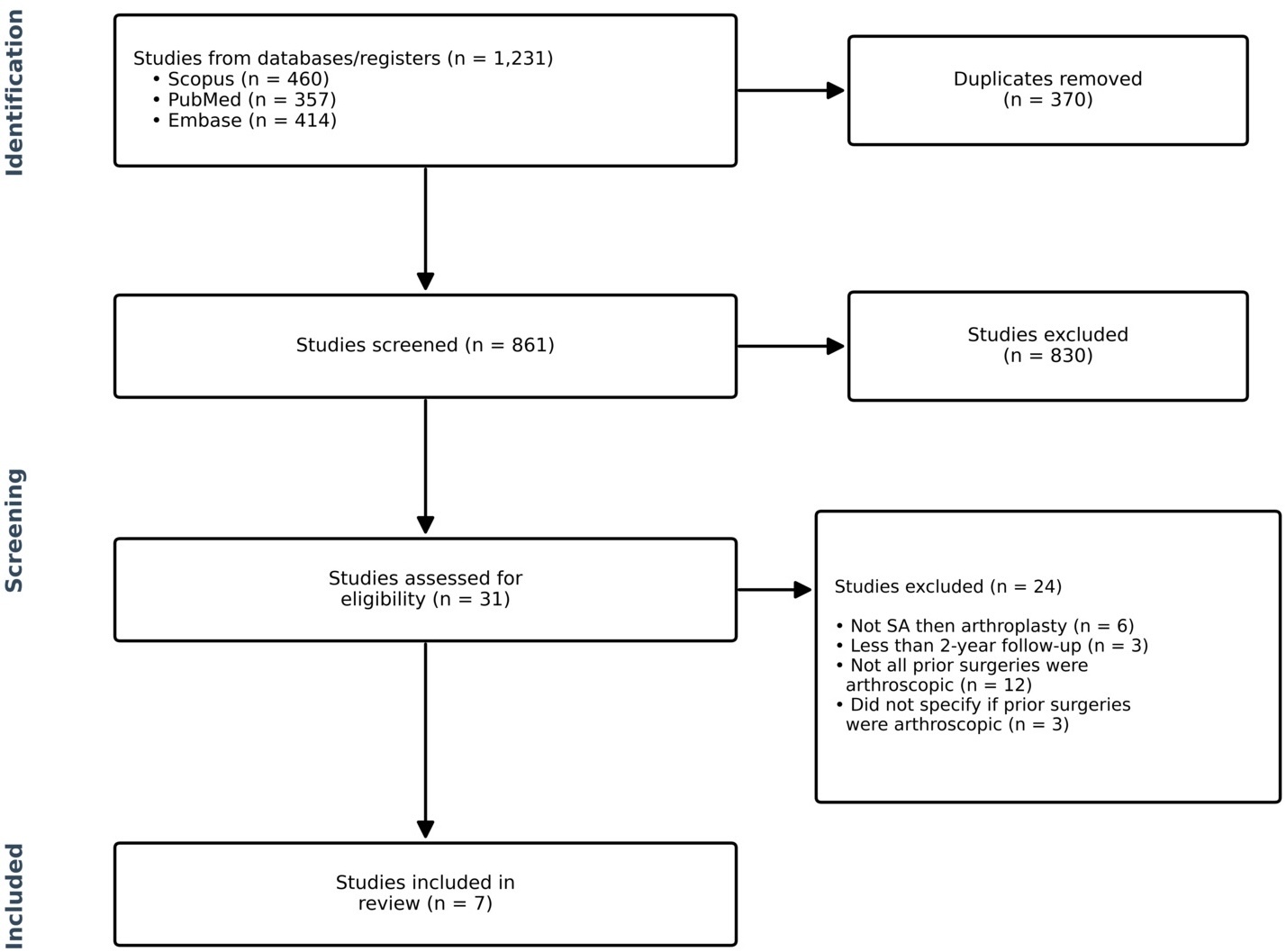
  • Fig. 1. PRISMA 2020 flow diagram of study identification, screening, and inclusion
    Download

Error

Sorry, something went wrong. Please try again.

If this problem reoccurs, please contact Scholastica Support

Error message:

undefined

View more stats

Abstract

Introduction

Shoulder arthroscopy is among the most frequently performed procedures in orthopaedic surgery, and a growing number of patients treated arthroscopically ultimately progress to total shoulder arthroplasty (TSA). Whether prior ipsilateral arthroscopy compromises the outcome of subsequent arthroplasty remains unclear, and the existing literature is dominated by studies of prior open surgery. The purpose of this study was to systematically review the clinical outcomes, complications, and revision rates of anatomic and reverse TSA after prior ipsilateral arthroscopy.

Methods

PubMed, Scopus, and Embase were searched from database inception through February 2026 in accordance with the 2020 Preferred Reporting Items for Systematic Reviews and Meta-Analyses (PRISMA) statement, under a prospectively registered protocol (PROSPERO 1299705). Level I–IV studies reporting outcomes or complications of anatomic or reverse TSA after prior ipsilateral arthroscopic shoulder surgery were included. Studies were excluded if only a portion of prior surgeries were arthroscopic or if arthroscopic outcomes were not reported separately. Methodological quality was assessed using the Methodological Index for Non-Randomized Studies (MINORS). Complication and revision rates were pooled descriptively, with a sensitivity analysis excluding the largest contributing cohort.

Results

Seven studies comprising 927 patients met inclusion criteria: six comparative cohort studies and one single-arm series, all Level III or IV. One administrative-database study contributed 788 patients (85%) and reported no patient-reported outcome measures (PROMs). Among the six studies reporting PROMs, patients improved from pre- to postoperatively on every instrument reported, including the American Shoulder and Elbow Surgeons (ASES) score, with postoperative means ranging from 42.1 to 89.9. Across the six studies reporting complications (881 shoulders), 55 complications (6.2%) and 33 revisions (3.7%) occurred, with study-level revision rates ranging from 0% to 11.1%. In a sensitivity analysis excluding the dominant database study, the complication rate rose to 9.7% (9/93) and the revision rate to 6.5% (6/93). The mean MINORS score among comparative studies was 18.5 of 24.

Conclusion

Patients undergoing shoulder arthroplasty after prior ipsilateral arthroscopy improved on all reported outcome measures. However, among the comparative studies, most internal comparisons favored the group without prior arthroscopy, most consistently in the rotator cuff repair to reverse arthroplasty population, although several differences fell below established clinical thresholds. The evidence is limited to retrospective Level III and IV studies of moderate quality, is clinically heterogeneous, and is dominated by a single database cohort. These findings suggest that prior arthroscopy does not preclude a satisfactory arthroplasty outcome but may be associated with modestly inferior results relative to primary arthroplasty, and should be interpreted as an absence of demonstrated major harm rather than as evidence of equivalence.

Introduction

The success of arthroscopic shoulder procedures for conditions such as rotator cuff disease and glenohumeral instability has enabled patients to return to high levels of activity for longer durations following treatment (Akhtar et al. 2023; Fails and Popchak 2025). Despite this success, many patients ultimately develop chronic, end-stage shoulder pathology such as glenohumeral osteoarthritis or rotator cuff tear arthropathy. Total shoulder arthroplasty (TSA), including anatomic TSA (aTSA) and reverse TSA (rTSA), is a reliable means of relieving pain and restoring function across a wide range of shoulder pathologies (Huddleston et al. 2021). As the number of shoulder arthroscopies performed annually continues to rise, the population of patients with prior arthroscopic surgery who progress to arthroplasty is anticipated to increase substantially (Farley et al. 2021).

Understanding how prior procedures influence the risk profile and outcomes of subsequent surgery is important for surgeons and patients during shared decision-making. Prior surgical intervention may alter anatomy, compromise soft-tissue integrity, affect bone stock, and create intra-articular adhesions or scarring that increase technical complexity at the time of arthroplasty (Aibinder et al. 2021; Willemot et al. 2018). Prior procedures may also reflect more advanced pathology, which itself could influence postoperative expectations and outcomes.

Previous literature has demonstrated inferior patient-reported outcome measures (PROMs), higher complication rates, and increased revision risk in patients undergoing shoulder arthroplasty after prior non-arthroplasty shoulder surgery—predominantly open procedures—compared with those without a history of surgery (Frank et al. 2018; Mirghaderi et al. 2024). However, open procedures are often associated with greater soft-tissue disruption, altered deltoid mechanics, and more extensive scarring than arthroscopic techniques, limiting the generalizability of these results to patients with prior arthroscopy (Cho et al. 2017; Kholinne et al. 2020). In contrast, arthroscopic procedures are typically less invasive and may preserve critical soft-tissue planes, suggesting that their effect on subsequent arthroplasty outcomes may differ meaningfully from that of prior open surgery (Peng et al. 2025; Zhang et al. 2021).

Despite the growing clinical relevance of this population, relatively few studies have specifically evaluated outcomes of TSA following prior shoulder arthroscopy, and available reports are limited by small sample sizes, heterogeneous procedures, and variable follow-up (Hirakawa et al. 2025; J. C. Levy et al. 2008; Nolte et al. 2021; Ode et al. 2020; Sadoghi et al. 2011; Sharma et al. 2024; Shimada et al. 2025). Consequently, the true impact of prior arthroscopic intervention on clinical outcomes, complication rates, and revision risk after TSA remains incompletely defined. The purpose of this study was to systematically review the available literature on clinical outcomes and complications of patients undergoing TSA following ipsilateral arthroscopic shoulder surgery. We hypothesized that patients undergoing TSA after prior ipsilateral shoulder arthroscopy would demonstrate improvement in PROMs with complication and revision rates comparable to primary arthroplasty populations.

Methods

This systematic review was prospectively registered with the International Prospective Register of Systematic Reviews (PROSPERO; registration number 1299705) and conducted in accordance with the 2020 Preferred Reporting Items for Systematic Reviews and Meta-Analyses (PRISMA) statement (Page et al. 2021).

Search Strategy and Study Selection

A literature search was performed by two independent reviewers on February 7, 2026, using the PubMed, Scopus, and Embase databases from database inception through February 2026. Search terms were combined with Boolean operators across three concept blocks (shoulder arthroplasty; prior arthroscopic or non-arthroplasty shoulder surgery; and clinical outcomes, complications, or revision). The full search string for each database was as follows:

PubMed

(“shoulder”[tiab] AND (arthroplast*[tiab] OR “replacement”[tiab])) AND (arthroscop*[tiab] OR “prior surgery”[tiab] OR “previous surgery”[tiab] OR “rotator cuff repair”[tiab] OR “Bankart”[tiab] OR “capsular release”[tiab] OR “debridement”[tiab] OR “instability surgery”[tiab]) AND (outcome*[tiab] OR complication*[tiab] OR revision*[tiab] OR reoperation*[tiab])

Scopus

TITLE-ABS-KEY( shoulder AND ( arthroplast* OR replacement ) AND ( arthroscop* OR “prior surgery” OR “previous surgery” OR “rotator cuff repair” OR Bankart OR “capsular release” OR debridement OR “instability surgery” ) AND ( outcome* OR complication* OR revision* OR reoperation* ) )

Embase

(shoulder:ab,ti AND (arthroplast*:ab,ti OR replacement:ab,ti) AND (arthroscop*:ab,ti OR ‘prior surgery’:ab,ti OR ‘previous surgery’:ab,ti OR ‘rotator cuff repair’:ab,ti OR bankart:ab,ti OR ‘capsular release’:ab,ti OR debridement:ab,ti OR ‘instability surgery’:ab,ti) AND (outcome*:ab,ti OR complication*:ab,ti OR revision*:ab,ti OR reoperation*:ab,ti)) AND [english]/lim

Inclusion criteria were Level I–IV human clinical studies reporting outcomes and/or complications of anatomic or reverse TSA in the setting of prior ipsilateral arthroscopic shoulder surgery. Case reports, cadaveric and animal studies, studies with overlapping cohorts, studies without a reported follow-up period or PROMs, studies of nonoperative management, editorial letters, review articles, and non-English studies were excluded. Studies that included TSA patients with prior shoulder surgery but did not report outcomes separately for arthroscopic procedures—or in which only a portion of prior surgeries were arthroscopic—were excluded, because an arthroscopy-specific effect could not be isolated. Title and abstract screening was performed by two independent reviewers, followed by full-text screening (Fig. 1).

The initial search yielded 1,231 records (Scopus, 460; PubMed, 357; Embase, 414), of which 861 remained after duplicate removal and underwent title and abstract screening. Thirty-one full-text articles were assessed for eligibility; 24 were excluded and 7 met the final inclusion criteria (Fig. 1).
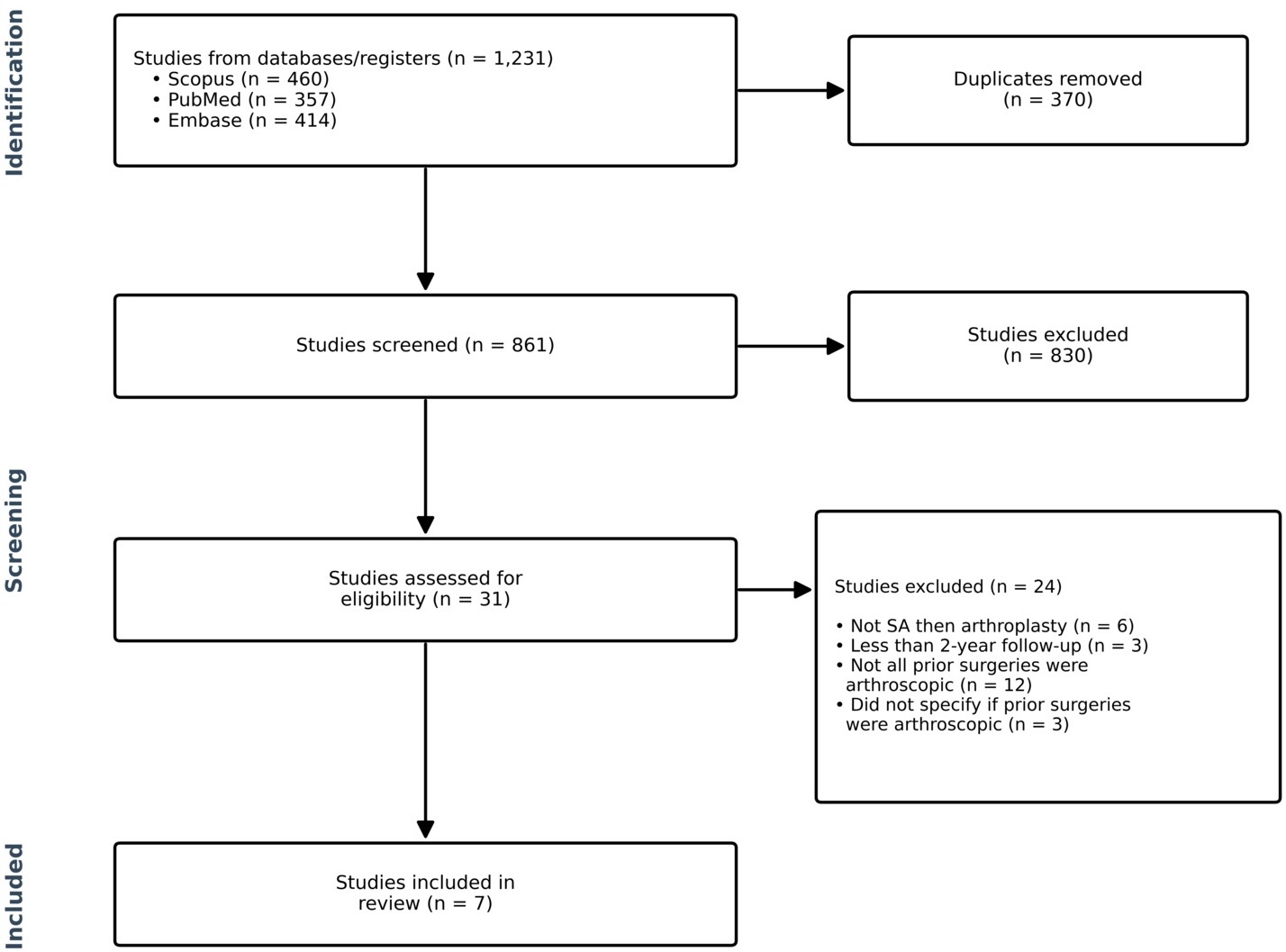
Fig. 1
Fig. 1.PRISMA 2020 flow diagram of study identification, screening, and inclusion

Data Extraction

Data were extracted independently by two reviewers using a standardized spreadsheet and included article title, year of publication, first author, level of evidence (Wright et al. 2003), number of patients, mean age, sex, prior arthroscopic procedure, time from arthroscopy to arthroplasty, mean follow-up, outcome scores, complications, and revisions. Means, standard deviations, and ranges were recorded when available. When a source study reported open and arthroscopic cohorts together, only data attributable to the arthroscopic subgroup were extracted.

Patient-Reported Outcome Measures

When available, the following PROMs were recorded: American Shoulder and Elbow Surgeons (ASES) score; shortened Disabilities of the Arm, Shoulder, and Hand (QuickDASH) score; Simple Shoulder Test (SST); Single Assessment Numeric Evaluation (SANE); Short Form-12 Physical Component Summary (SF-12 PCS); visual analog scale (VAS) or numeric rating scale (NRS) for pain; Constant–Murley score; and University of California, Los Angeles (UCLA) shoulder score. Range of motion and postoperative complications were also evaluated.

Risk of Bias Assessment

Methodological quality was assessed independently by two reviewers using the Methodological Index for Non-Randomized Studies (MINORS) (Slim et al. 2003). Each item was scored 0 (not reported), 1 (reported but inadequate), or 2 (reported and adequate). Non-comparative studies have a maximum score of 16 and comparative studies a maximum of 24. Six included studies were comparative and were scored on the 24-point instrument; the single non-comparative single-arm series (J. C. Levy et al. 2008) was scored on the 16-point instrument and analyzed separately.

Statistical Analysis

All included studies were Level III or IV and demonstrated substantial heterogeneity in reported outcome measures and treatment-arm composition; no Level I or II studies were identified. Accordingly, no quantitative meta-analysis was performed, and a qualitative synthesis of the extracted evidence was undertaken. Complication and revision rates were pooled descriptively across studies that reported them. Because one administrative-database study contributed the large majority of patients, a sensitivity analysis was performed in which the pooled complication and revision rates were recalculated with that study excluded.

Results

Study Characteristics

Seven studies comprising 927 patients met the inclusion criteria: six Level III studies and one Level IV study (Table 1) (Hirakawa et al. 2025; J. C. Levy et al. 2008; Nolte et al. 2021; Ode et al. 2020; Sadoghi et al. 2011; Sharma et al. 2024; Shimada et al. 2025). Across the six studies reporting age, the sample-size–weighted mean age was approximately 67 years, with study means ranging from 39 to 77.7 years. A mean follow-up was reported in four studies and ranged from 33 to 52.8 months (weighted average, approximately 41 months); all seven studies required a minimum follow-up of 24 months. One administrative-database study contributed 788 of the 927 patients (85%) and reported complications and revisions only, without PROMs.

Prior arthroscopic procedures varied by study. Comprehensive arthroscopic management (CAM) was performed in one study (Nolte et al. 2021); arthroscopic rotator cuff repair (ARCR) in three (Hirakawa et al. 2025; Sadoghi et al. 2011; Shimada et al. 2025); and arthroscopic instability or capsulolabral procedures—including Bankart repair, superior labrum anterior to posterior (SLAP) repair, capsular release, and thermal capsulorrhaphy—in two (J. C. Levy et al. 2008; Ode et al. 2020). The remaining database study did not characterize the specific arthroscopic procedure (Sharma et al. 2024). Anatomic TSA was performed in three studies (J. C. Levy et al. 2008; Nolte et al. 2021; Ode et al. 2020) and reverse TSA in three (Hirakawa et al. 2025; Sadoghi et al. 2011; Shimada et al. 2025); the database study included both anatomic and reverse TSA and could not distinguish between them (Sharma et al. 2024). Indications for arthroplasty included glenohumeral osteoarthritis, rotator cuff (tear) arthropathy, glenohumeral chondrolysis, instability arthropathy, and massive or irreparable rotator cuff tear. Where reported, the interval from arthroscopy to arthroplasty ranged from approximately 2.2 to 3.4 years across the cohort studies; by design, the database study included only patients whose arthroscopy occurred within 1 year before arthroplasty (Sharma et al. 2024).

Table 1.Study characteristics and patient demographics
Author (Year) LOE No. Sex (M/F) Mean age, yr Mean F/U, mo Prior arthroscopy TSA type TSA indication Internal comparison
Nolte (2021) III 19 13/6 57.8 (38.8–66.7) 52.8 (25.2–126) CAM aTSA GHOA No difference
Ode (2020) III 9 NR 59.6 (33–77)a 33 (24–60) Arthroscopic anterior stabilization (Bankart/capsulolabral) aTSA Instability arthropathy Disfavored prior arthroscopy
Sadoghi (2011) III 29 13/16 66 (52–83) 42 (24–96) ARCR rTSA Cuff tear arthropathy No difference (PROMs); higher complications
Levy (2008) IV 11 6/5 39 (16–64) 37 (24–66) Arthroscopic instability (Bankart, SLAP, capsular release, thermal) aTSA Glenohumeral chondrolysis Non-comparative
Shimada (2025) III 25 11/14 77.7 24 (min) ARCR rTSA CTA or irreparable MRCT Disfavored prior arthroscopy
Hirakawa (2025) III 46 18/28 75 24 (min) ARCR rTSA MRCT or CTA Disfavored prior arthroscopy
Sharma (2024) III 788 352/436 NR 24 (min) NR (unspecified) aTSA & rTSA Primary GHOA Disfavored prior arthroscopy

a LOE, level of evidence; No., number of patients; M/F, male/female; F/U, follow-up; TSA, total shoulder arthroplasty; aTSA, anatomic TSA; rTSA, reverse TSA; CAM, comprehensive arthroscopic management; ARCR, arthroscopic rotator cuff repair; SLAP, superior labrum anterior to posterior; GHOA, glenohumeral osteoarthritis; CTA, cuff tear arthropathy; MRCT, massive rotator cuff tear; NR, not reported; min, minimum. Internal comparison summarizes the direction of each comparative study’s internal finding for the prior-arthroscopy group relative to its comparator (favored, disfavored, or no difference); Levy et al. was a single-arm series without a comparator. a Age reported for the full instability cohort; not reported separately for the arthroscopic subgroup.

Risk of Bias Assessment

The six comparative studies demonstrated a mean MINORS score of 18.5 (range, 16 to 22) (Table 2). The single non-comparative single-arm series (J. C. Levy et al. 2008) had a MINORS score of 15 of 16. Both correspond to “moderate” methodological quality based on previously established benchmarks (Harris et al. 2017).

Table 2.Risk of bias assessment using the MINORS criteria
Author (Year) 1 2 3 4 5 6 7 8 9 10 11 12 Total
Nolte (2021) 2 1 0 2 1 2 1 1 2 2 2 2 18
Ode (2020) 2 1 2 2 1 2 1 0 2 2 2 1 18
Sadoghi (2011) 2 2 2 2 1 2 1 2 2 2 2 2 22
Shimada (2025) 2 1 0 2 0 2 1 2 2 2 2 2 18
Hirakawa (2025) 2 1 1 2 1 2 0 1 2 2 1 1 16
Sharma (2024) 2 2 0 2 2 2 2 0 2 2 2 1 19
Levy (2008)a 2 2 2 2 2 2 2 1 – – – – 15

MINORS = Methodological Index for Non-Randomized Studies. Items: 1, clearly stated aim; 2, inclusion of consecutive patients; 3, prospective data collection; 4, endpoints appropriate to the aim; 5, unbiased endpoint assessment; 6, appropriate follow-up period; 7, loss to follow-up <5%; 8, prospective sample-size calculation; 9, adequate control group; 10, contemporary groups; 11, baseline equivalence; 12, adequate statistical analysis. Each item scored 0 (not reported), 1 (reported but inadequate), or 2 (reported and adequate). Maximum score 16 for non-comparative and 24 for comparative studies. a Levy et al. is a single-arm (non-comparative) case series scored on the 16-point instrument; dashes indicate items not applicable to a non-comparative design.

Postoperative Outcomes

Six of the seven studies reported postoperative PROMs (Tables 3 and 4); the database study reported none (Sharma et al. 2024). Every instrument reported improved from pre- to postoperatively. Postoperative ASES was reported in four studies (mean range, 42.1 to 89.9) (Hirakawa et al. 2025; J. C. Levy et al. 2008; Nolte et al. 2021; Ode et al. 2020); Constant score in two (54 to 60.3) (Hirakawa et al. 2025; Sadoghi et al. 2011); QuickDASH in one (9) (Nolte et al. 2021); SST in one (7.2) (J. C. Levy et al. 2008); UCLA in two (27.4 to 29.7) (Sadoghi et al. 2011; Shimada et al. 2025); SANE in one (84) (Nolte et al. 2021); and SF-12 PCS in two (35.8 to 53.8) (Nolte et al. 2021; Ode et al. 2020). Postoperative pain scores (VAS or NRS) were reported in three studies (mean range, 0 to 2.1) (Hirakawa et al. 2025; Nolte et al. 2021; Shimada et al. 2025). Postoperative forward flexion was reported in four studies (mean range, 116° to 129.1°) (Hirakawa et al. 2025; J. C. Levy et al. 2008; Sadoghi et al. 2011; Shimada et al. 2025) and abduction in two (118° to 123°) (J. C. Levy et al. 2008; Sadoghi et al. 2011). To address the direction of each study’s internal comparison, the six comparative studies were examined for whether outcomes favored, disfavored, or did not differ for the prior-arthroscopy group relative to the comparator (Table 1). One study reported no significant between-group difference (Nolte et al. 2021), while four reported one or more outcomes that favored the group without prior arthroscopy (Hirakawa et al. 2025; Ode et al. 2020; Sharma et al. 2024; Shimada et al. 2025), and one reported comparable patient-reported scores but a higher complication rate in the prior-arthroscopy group (Sadoghi et al. 2011). The studies disfavoring the prior-arthroscopy group were concentrated among those examining reverse arthroplasty after prior arthroscopic rotator cuff repair (Hirakawa et al. 2025; Sadoghi et al. 2011; Shimada et al. 2025), in which the comparator (primary arthroplasty) group achieved higher postoperative ASES and Constant scores; several of these differences, however, were small and in some instances below reported minimal clinically important difference thresholds.

Table 3.Preoperative and postoperative outcomes (pain, motion, ASES, Constant)
Author (Year) VAS/NRS Pre VAS/NRS Post Δ FF Pre FF Post Δ Abd Pre Abd Post Δ ASES Pre ASES Post Δ Constant Pre Constant Post Δ
Nolte (2021) 4 (3–5.5) 0 (0–2) 4.0 NR NR NR NR NR NR 48.3 (42.9–61.2) 89.9 (74.9–96.6) 41.6 NR NR NR
Ode (2020) NR NR NR NR NR NR NR NR NR NR 42.1 NR NR NR NR
Sadoghi (2011) NR NR NR 36 127 91 38 118 80 NR NR NR 32.7 (14–63) 60.3 (19–90) 27.6
Levy (2008) NR NR NR 110 ± 34 126 ± 33 16 89 ± 39 123 ± 36 34 37 ± 16.2 77.5 ± 19.8 40.5 NR NR NR
Shimada (2025) 8.2 0.9 7.3 75.0 129.1 54.1 NR NR NR NR NR NR NR NR NR
Hirakawa (2025) 3.9 2.1 1.8 81 116 35 NR NR NR 48 64 16 37 54 17
Sharma (2024) NR NR NR NR NR NR NR NR NR NR NR NR NR NR NR

Values are means with range or standard deviation when available. VAS, visual analog scale; NRS, numeric rating scale (Shimada); FF, forward flexion; Abd, abduction; ASES, American Shoulder and Elbow Surgeons score; Constant, Constant–Murley score; Pre, preoperative; Post, postoperative; Δ, change (improvement); NR, not reported. Pain Δ expressed as reduction (improvement). Nolte values are medians (interquartile range). Ode value is the 2-year postoperative score for the arthroscopic stabilization subgroup.

Table 4.Preoperative and postoperative outcomes (QuickDASH, SST, UCLA, SANE, SF-12 PCS)
Author (Year) QuickDASH Pre QuickDASH Post Δ SST Pre SST Post Δ UCLA Pre UCLA Post Δ SANE Pre SANE Post Δ SF-12 PCS Pre SF-12 PCS Post Δ
Nolte (2021) 35.2 (25–39.7) 9 (3.4–27.3) 26.2 NR NR NR NR NR NR 59 (49–69) 84 (74–94) 25 41.1 (35.2–45.3) 53.8 (50.1–57.1) 12.7
Ode (2020) NR NR NR NR NR NR NR NR NR NR NR NR NR 35.8 NR
Sadoghi (2011) NR NR NR NR NR NR 15.1 (6–22) 27.4 (11–44) 12.3 NR NR NR NR NR NR
Levy (2008) NR NR NR 2.8 ± 1.9 7.2 ± 3.6 4.4 NR NR NR NR NR NR NR NR NR
Shimada (2025) NR NR NR NR NR NR 9.4 29.7 20.3 NR NR NR NR NR NR
Hirakawa (2025) NR NR NR NR NR NR NR NR NR NR NR NR NR NR NR
Sharma (2024) NR NR NR NR NR NR NR NR NR NR NR NR NR NR NR

Values are means with range or standard deviation when available. QuickDASH, shortened Disabilities of the Arm, Shoulder and Hand; SST, Simple Shoulder Test; UCLA, University of California, Los Angeles shoulder score; SANE, Single Assessment Numeric Evaluation; SF-12 PCS, Short Form-12 Physical Component Summary; Pre, preoperative; Post, postoperative; Δ, change (improvement); NR, not reported. Shimada et al. additionally reported JOA and NRS scores, and Hirakawa et al. reported Constant and muscle-strength data, which are not tabulated here because no other included study reported them.

Complications and Revisions

Six studies reported complications and revisions; one study did not assess complications (Hirakawa et al. 2025). Pooling these six studies (881 shoulders), 55 complications occurred (6.2%), with study-level complication rates ranging from 4.0% to 13.8%. A total of 33 revisions occurred (3.7%), with study-level revision rates ranging from 0% to 11.1% (Table 5). Time to revision was reported in three studies; across the six revisions with reported timing, the mean time to revision was 29 months (range, 3 to 52 months).

Because one administrative-database study (Sharma et al. 2024) contributed 788 shoulders (46 complications and 27 revisions), a sensitivity analysis was performed excluding it. Among the remaining six studies (93 shoulders), the complication rate was 9.7% (9/93) and the revision rate was 6.5% (6/93)—higher than the rates obtained when the database study was included. Periprosthetic joint infection was uncommon overall; the database study reported 20 infections among 788 shoulders (2.5%) (Sharma et al. 2024).

Table 5.Complications and revisions
Author (Year) Complication rate Complications Revision rate Reasons for revision Time to revision, mo
Nolte (2021) 10.5% (2/19) Aseptic humeral stem loosening (n=1); irreparable subscapularis tear after fall (n=1) 10.5% (2/19) Aseptic humeral stem loosening (n=1); fall with irreparable subscapularis tear (n=1) 9, 52
Ode (2020) 11.1% (1/9) Atraumatic subscapularis rupture (n=1) 11.1% (1/9) Atraumatic subscapularis rupture, revised to rTSA (n=1) 3
Sadoghi (2011) 13.8% (4/29) Humeral stem loosening (n=3); radial nerve paresthesia (n=1) 10.3% (3/29) Humeral stem loosening (n=3) 33, 35, 42
Levy (2008) 9.1% (1/11) Persistent stiffness requiring arthroscopic capsular release (n=1) 0% N/A N/A
Shimada (2025) 4.0% (1/25) Postoperative dislocation treated with closed reduction (n=1) 0% N/A N/A
Hirakawa (2025) NR NR NR NR NR
Sharma (2024) 5.8% (46/788) Aseptic loosening (n=17); periprosthetic fracture (n=9); periprosthetic infection (n=20) 3.4% (27/788) NR NR

Revision defined as return to the operating room with implant exchange or removal; a complication is any adverse event related to the index arthroplasty. rTSA, reverse total shoulder arthroplasty; NR, not reported; N/A, not applicable. Hirakawa et al. did not assess postoperative complications. Pooled across the six studies reporting these outcomes (881 shoulders): 55 complications (6.2%) and 33 revisions (3.7%); excluding the database study (Sharma et al. 2024), 9 complications (9.7%) and 6 revisions (6.5%) among 93 shoulders.

Discussion

The principal finding of this systematic review was that, among seven studies comprising 927 patients, TSA after prior ipsilateral shoulder arthroscopy was associated with improvement in patient-reported outcomes and with complication and revision rates broadly comparable to primary arthroplasty populations. Heterogeneity and the limited number of studies precluded quantitative meta-analysis. Importantly, one administrative-database study contributed 85% of the pooled patients and no PROMs, and a sensitivity analysis excluding it yielded higher complication (9.7%) and revision (6.5%) rates. These findings are therefore best interpreted as an absence of demonstrated harm rather than as evidence of equivalence.

Across the six studies reporting PROMs, patients improved from pre- to postoperatively on every instrument reported, including ASES, Constant, QuickDASH, SST, UCLA, SANE, and SF-12 PCS. Where thresholds were reported, improvements generally exceeded published minimal clinically important difference (MCID), substantial clinical benefit (SCB), and patient acceptable symptom state (PASS) values for the respective instruments (Berglund et al. 2019; Gowd et al. 2019; Sciascia et al. 2017; Simovitch et al. 2018; Su et al. 2021; Tashjian et al. 2017; Thigpen et al. 2018; Torrens et al. 2016; Werner et al. 2016; Wong et al. 2016). Postoperative functional scores were broadly similar to those reported in contemporary primary aTSA and rTSA series without a specific history of prior arthroscopy (Simovitch et al. 2018; Sershon et al. 2014). It should be noted, however, that PROM instruments varied across studies, follow-up periods differed, and preoperative data were incomplete in several cohorts; these results are therefore best regarded as descriptive observations rather than evidence of equivalence.

Pain relief is a primary indication for TSA. Among the included studies, Nolte et al. reported a postoperative median VAS of 0 (from a preoperative median of 4) (Nolte et al. 2021); Shimada et al. reported an NRS improvement from 8.2 to 0.9 (Shimada et al. 2025); and Hirakawa et al. reported a VAS improvement from 3.9 to 2.1 (Hirakawa et al. 2025). For context, Huddleston et al. reported preoperative VAS scores ranging from 5.2 to 8.0 in a systematic review of outpatient TSA (Huddleston et al. 2021). These data indicate that patients undergoing arthroplasty after prior arthroscopy experience pain reduction comparable in magnitude to primary arthroplasty populations.

Restoration of motion is another key objective of arthroplasty. Postoperative forward flexion across the four reporting studies ranged from 116° to 129.1°, consistent with contemporary primary TSA and rTSA series and exceeding established thresholds (Huddleston et al. 2021; Simovitch et al. 2018; Bryant et al. 2005; Charles et al. 2019; Gartsman et al. 2000; Lo et al. 2005; Sandow et al. 2013). Postoperative abduction of 118° (Sadoghi et al [Sadoghi et al. 2011].) and 123° (Levy et al [J. C. Levy et al. 2008].) aligned closely with values reported in primary populations (Simovitch et al. 2018). Overall, motion gains after arthroplasty following prior arthroscopy appeared clinically meaningful.

Study-level revision rates ranged from 0% to 11.1%, comparable to published revision rates for primary shoulder arthroplasty (Aibinder et al. 2021). By contrast, studies of TSA after prior open shoulder surgery—particularly open reduction and internal fixation of proximal humeral fractures—have reported revision rates as high as 28% (J. Levy et al. 2007). The comparatively lower revision rates observed after prior arthroscopy may reflect the minimally invasive nature of arthroscopic procedures, which generally preserve soft-tissue planes and deltoid integrity relative to open approaches.

The timing of arthroscopy relative to arthroplasty may be more clinically relevant than the mere history of prior arthroscopy. Prior work has demonstrated an increased risk of periprosthetic joint infection after arthroplasty in patients with recent arthroscopy, with the highest risk when arthroplasty is performed within 3 months of arthroscopy (Malik et al. 2021; Seok et al. 2022; Wright-Chisem et al. 2021). In the present review, the cohort studies generally involved intervals of 2 to 3.4 years and reported low infection and revision rates. In contrast, Sharma et al. specifically studied patients whose arthroscopy occurred within 1 year before arthroplasty and reported higher revision (3.4% vs. 1.4%) and aseptic loosening (2.2% vs. 0.8%) rates than matched controls (Sharma et al. 2024). Taken together, these observations suggest that a short interval between arthroscopy and arthroplasty, rather than a history of arthroscopy per se, may be the more important determinant of outcome.

Similarly, Mirghaderi et al. reported that TSA after prior shoulder surgery—predominantly open procedures—was associated with inferior patient-reported outcomes and higher complication rates than primary TSA (Mirghaderi et al. 2024). The present review, restricted to arthroscopic procedures, did not identify inferior outcomes of the magnitude reported after prior open surgery. Nonetheless, when the internal comparisons of the included studies are considered individually, most favored the group without prior arthroscopy, and this pattern was most consistent among studies of reverse arthroplasty performed after prior arthroscopic rotator cuff repair. This is clinically relevant because reverse arthroplasty is frequently the salvage procedure for failed rotator cuff repair. Because prior surgery is non-modifiable at the time of arthroplasty, the more actionable decision may occur earlier—at the time of the index rotator cuff repair—in patients at high risk of repair failure who might ultimately require reverse arthroplasty. Taken together, these findings suggest that a history of prior arthroscopy should be weighed in that earlier decision rather than regarded as inconsequential, while surgical approach, tissue disruption, and interval timing likely contribute more than a history of arthroscopy alone.

Arthroplasty in the Conversion Population

A distinct and clinically important subset comprises patients who progress from arthroscopic rotator cuff repair to reverse total shoulder arthroplasty, in whom the arthroplasty functions as a salvage procedure after cuff-repair failure. Three of the included studies specifically examined reverse arthroplasty after prior arthroscopic rotator cuff repair (Hirakawa et al. 2025; Sadoghi et al. 2011; Shimada et al. 2025). In each, patients improved substantially from baseline. In two, the comparator group without prior arthroscopy achieved higher postoperative ASES and Constant scores (Hirakawa et al. 2025; Shimada et al. 2025), and one of these additionally reported less recovery of muscle strength in the prior-repair group (Hirakawa et al. 2025); in the third, patient-reported scores were comparable between groups but the prior-repair group had a higher complication rate (Sadoghi et al. 2011). Whether these differences reflect the prior repair itself, the more advanced cuff pathology that necessitated it, or altered soft-tissue quality cannot be determined from the available data. For patients considered at high risk of rotator cuff repair failure, these observations support incorporating the possibility of eventual arthroplasty, and its potentially attenuated outcomes, into the initial treatment discussion.

This study has several limitations. Although seven studies met the inclusion criteria, the overall body of evidence remains limited and consists exclusively of Level III and IV studies of moderate methodological quality. One administrative-database study accounted for 788 of 927 patients (85%), disproportionately weighting the pooled complication and revision estimates while contributing no PROM or range-of-motion data; as the sensitivity analysis demonstrates, the pooled rates rise substantially when this study is removed, so the favorable pooled rates should be interpreted with caution. Anatomic and reverse TSA were combined despite differing indications, implant designs, and expected outcomes, and prior arthroscopic procedures were heterogeneous (CAM, rotator cuff repair, instability and capsulolabral procedures, including thermal capsulorrhaphy). Pooling procedures of differing biologic impact—for example, thermal capsulorrhaphy, which is now largely abandoned owing to poor efficacy, alongside contemporary rotator cuff repair—may obscure procedure-specific differences, and the available data did not permit separate analysis by index procedure. Likewise, the ideal comparison would stratify by both arthroplasty type (anatomic vs. reverse) and specific prior procedure, yielding multiple subgroups; the number and size of the available studies did not support such stratification. PROM instruments and follow-up varied across studies and could not be pooled quantitatively; several instruments were reported by only a single study. Finally, no quantitative synthesis, subgroup, or meta-regression analysis was possible given the heterogeneity, and the review is therefore a descriptive summary. Future multi-institutional prospective studies that separate anatomic from reverse arthroplasty and characterize the arthroscopy-to-arthroplasty interval are needed to better define expectations for this growing population.

Conclusion

Patients undergoing shoulder arthroplasty after prior ipsilateral arthroscopy consistently improved in pain and function. However, among the comparative studies most internal comparisons favored the group without prior arthroscopy, most consistently in the rotator cuff repair to reverse arthroplasty population, although several of these differences were modest and at times below established clinical thresholds. The evidence is limited to retrospective Level III–IV studies of moderate quality, is clinically heterogeneous, and is dominated by a single database cohort; when that cohort is excluded, complication and revision rates are higher. Prior arthroscopy therefore does not preclude a satisfactory arthroplasty outcome but may be associated with modestly inferior results relative to primary arthroplasty. This history should be considered during shared decision-making—including at the time of an index procedure such as rotator cuff repair in patients who may later require arthroplasty—rather than regarded as an absence of any effect.


Funding

No external funding was received for this study.

Institutional Review Board Approval

This study was exempt from institutional review board approval because it is a systematic review of previously published literature and did not involve human subjects, human experimentation, or identifiable patient data.

Data Availability

All data analyzed in this review are available in the cited published articles.

Submitted: July 18, 2026 EDT

Accepted: September 20, 2026 EDT

References

Aibinder, W., B. Schoch, and M. Parsons. 2021. “Risk Factors for Complications and Revision Surgery after Anatomic and Reverse Total Shoulder Arthroplasty.” J Shoulder Elbow Surg 30: e689–701. https:/​/​doi.org/​10.1016/​j.jse.2021.04.029.
Google Scholar
Akhtar, M., J. Wen, and D. Razick. 2023. “Mid- to Long-Term Outcomes of Arthroscopic Shoulder Stabilization in Athletes: A Systematic Review.” J Clin Med 12: 5730. https:/​/​doi.org/​10.3390/​jcm12175730.
Google Scholar
Berglund, D. D., T. Y. Law, and S. Rosas. 2019. “The Procedure Value Index: A New Method for Quantifying Value in Shoulder Arthroplasty.” J Shoulder Elbow Surg 28: 335–40. https:/​/​doi.org/​10.1016/​j.jse.2018.07.031.
Google Scholar
Bryant, D., R. Litchfield, M. Sandow, G. M. Gartsman, G. Guyatt, and A. Kirkley. 2005. “A Comparison of Pain, Strength, Range of Motion, and Functional Outcomes after Hemiarthroplasty and Total Shoulder Arthroplasty in Patients with Osteoarthritis of the Shoulder: A Systematic Review and Meta-Analysis.” J Bone Joint Surg Am 87: 1947–56. https:/​/​doi.org/​10.2106/​JBJS.D.02854.
Google Scholar
Charles, M. D., G. Cvetanovich, S. Sumner-Parilla, G. P. Nicholson, N. Verma, and A. A. Romeo. 2019. “Outpatient Shoulder Arthroplasty: Outcomes, Complications, and Readmissions in 2 Outpatient Settings.” J Shoulder Elbow Surg 28: S118–23. https:/​/​doi.org/​10.1016/​j.jse.2019.04.006.
Google Scholar
Cho, C. H., D. H. Kim, and K. S. Song. 2017. “Reverse Shoulder Arthroplasty in Patients with Rheumatoid Arthritis: A Systematic Review.” Clin Orthop Surg 9: 325–31. https:/​/​doi.org/​10.4055/​cios.2017.9.3.325.
Google Scholar
Fails, A., and A. Popchak. 2025. “Return to Competitive Sport after Anterior Shoulder Stabilization: A Scoping Review of Current Outcomes and Clearance Decision-Making Criteria.” Int J Sports Phys Ther 20. https:/​/​doi.org/​10.26603/​001c.143184.
Google Scholar
Farley, K. X., J. M. Wilson, A. Kumar, M. B. Gottschalk, C. Daly, J. Sanchez-Sotelo, et al. 2021. “Prevalence of Shoulder Arthroplasty in the United States and the Increasing Burden of Revision Shoulder Arthroplasty.” JB JS Open Access 6: e20.00156. https:/​/​doi.org/​10.2106/​JBJS.OA.20.00156.
Google Scholar
Frank, R. M., S. Lee, and S. Sumner. 2018. “Shoulder Arthroplasty Outcomes after Prior Non-Arthroplasty Shoulder Surgery.” JBJS Open Access 3: e0055. https:/​/​doi.org/​10.2106/​JBJS.OA.17.00055.
Google Scholar
Gartsman, G. M., T. S. Roddey, and S. M. Hammerman. 2000. “Shoulder Arthroplasty with or without Resurfacing of the Glenoid in Patients Who Have Osteoarthritis.” J Bone Joint Surg Am 82: 26–34. https:/​/​doi.org/​10.2106/​00004623-200001000-00004.
Google Scholar
Gowd, A. K., M. D. Charles, and J. N. Liu. 2019. “Single Assessment Numeric Evaluation (SANE) Is a Reliable Metric to Measure Clinically Significant Improvements Following Shoulder Arthroplasty.” J Shoulder Elbow Surg 28: 2238–46. https:/​/​doi.org/​10.1016/​j.jse.2019.04.041.
Google Scholar
Harris, J. D., J. C. Brand, M. P. Cote, and A. Dhawan. 2017. “Research Pearls: The Significance of Statistics and Perils of Pooling. Part 3: Pearls and Pitfalls of Meta-Analyses and Systematic Reviews.” Arthroscopy 33: 1594–602. https:/​/​doi.org/​10.1016/​j.arthro.2017.01.055.
Google Scholar
Hirakawa, Y., T. Manaka, K. Nakazawa, Y. Ito, S. Taniguchi, A. Ogura, et al. 2025. “Impact of Prior Arthroscopic Rotator Cuff Repair on Postoperative Outcomes of Reverse Shoulder Arthroplasty: A Comparative Analysis of Muscle Strength Recovery and Clinical Results.” JSES Int 9: 1339–44. https:/​/​doi.org/​10.1016/​j.jseint.2025.04.021.
Google Scholar
Huddleston, H. P., N. Mehta, and E. M. Polce. 2021. “Complication Rates and Outcomes after Outpatient Shoulder Arthroplasty: A Systematic Review.” JSES Int 5: 413–23. https:/​/​doi.org/​10.1016/​j.jseint.2020.11.005.
Google Scholar
Kholinne, E., J. M. Kwak, Y. Sun, H. Kim, K. H. Koh, and I. H. Jeon. 2020. “Evaluation of Deltoid Origin Status Following Open and Arthroscopic Repair of Large Rotator Cuff Tears: A Propensity-Matched Case-Control Study.” Clin Shoulder Elb 23: 11–19. https:/​/​doi.org/​10.5397/​cise.2020.00017.
Google Scholar
Levy, J. C., N. A. Virani, M. A. Frankle, D. Cuff, D. R. Pupello, and J. A. Hamelin. 2008. “Young Patients with Shoulder Chondrolysis Following Arthroscopic Shoulder Surgery Treated with Total Shoulder Arthroplasty.” J Shoulder Elbow Surg 17: 380–88. https:/​/​doi.org/​10.1016/​j.jse.2007.11.004.
Google Scholar
Levy, J., M. Frankle, M. Mighell, and D. Pupello. 2007. “The Use of the Reverse Shoulder Prosthesis for the Treatment of Failed Hemiarthroplasty for Proximal Humeral Fracture.” J Bone Joint Surg Am 89: 292–300. https:/​/​doi.org/​10.2106/​JBJS.E.01310.
Google Scholar
Lo, I. K. Y., R. B. Litchfield, S. Griffin, K. Faber, S. D. Patterson, and A. Kirkley. 2005. “Quality-of-Life Outcome Following Hemiarthroplasty or Total Shoulder Arthroplasty in Patients with Osteoarthritis: A Prospective, Randomized Trial.” J Bone Joint Surg Am 87: 2178–85. https:/​/​doi.org/​10.2106/​JBJS.D.02198.
Google Scholar
Malik, A. T., J. Morris, J. Y. Bishop, A. S. Neviaser, S. N. Khan, and G. L. Cvetanovich. 2021. “Undergoing an Arthroscopic Procedure Prior to Shoulder Arthroplasty Is Associated with Greater Risk of Prosthetic Joint Infection.” Arthroscopy 37: 1748-54.e1. https:/​/​doi.org/​10.1016/​j.arthro.2020.12.226.
Google Scholar
Mirghaderi, P., A. Azarboo, A. Ghaseminejad-Raeini, N. Eshraghi, H. Vahedi, and S. Namdari. 2024. “Shoulder Arthroplasty after Previous Nonarthroplasty Surgery: A Systematic Review and Meta-Analysis of Clinical Outcomes and Complications.” JBJS Rev 12: e23.00239. https:/​/​doi.org/​10.2106/​JBJS.RVW.23.00239.
Google Scholar
Nolte, P. C., B. P. Elrick, and J. W. Arner. 2021. “Total Shoulder Arthroplasty after Previous Arthroscopic Surgery for Glenohumeral Osteoarthritis: A Case-Control Matched Cohort Study.” Am J Sports Med 49: 1839–46. https:/​/​doi.org/​10.1177/​03635465211006479.
Google Scholar
Ode, G. E., D. Ling, and A. Finocchiaro. 2020. “Clinical Characteristics and Patient-Reported Outcomes of Total Shoulder Arthroplasty after Anterior Stabilization: A Retrospective Matched Control Study.” J Shoulder Elbow Surg 29: S59–66. https:/​/​doi.org/​10.1016/​j.jse.2020.04.003.
Google Scholar
Page, M. J., J. E. McKenzie, P. M. Bossuyt, I. Boutron, T. C. Hoffmann, C. D. Mulrow, et al. 2021. “The PRISMA 2020 Statement: An Updated Guideline for Reporting Systematic Reviews.” BMJ 372: n71. https:/​/​doi.org/​10.1136/​bmj.n71.
Google Scholar
Peng, Z., J. Li, Z. Liu, and G. Wang. 2025. “Effects of Previous Arthroscopic Knee Surgery on the Outcomes of Primary Total Knee Arthroplasty: A Systematic Review and PRISMA-Compliant Meta-Analysis.” J Orthop Surg Res 20: 219. https:/​/​doi.org/​10.1186/​s13018-024-05348-w.
Google Scholar
Sadoghi, P., P. Vavken, and A. Leithner. 2011. “Impact of Previous Rotator Cuff Repair on the Outcome of Reverse Shoulder Arthroplasty.” J Shoulder Elbow Surg 20: 1138–46. https:/​/​doi.org/​10.1016/​j.jse.2011.01.013.
Google Scholar
Sandow, M. J., H. David, and S. J. Bentall. 2013. “Hemiarthroplasty vs Total Shoulder Replacement for Rotator Cuff Intact Osteoarthritis: How Do They Fare after a Decade?” J Shoulder Elbow Surg 22: 877–85. https:/​/​doi.org/​10.1016/​j.jse.2012.10.023.
Google Scholar
Sciascia, A. D., B. J. Morris, C. A. Jacobs, and T. B. Edwards. 2017. “Responsiveness and Internal Validity of Common Patient-Reported Outcome Measures Following Total Shoulder Arthroplasty.” Orthopedics 40: e513–19. https:/​/​doi.org/​10.3928/​01477447-20170327-02.
Google Scholar
Seok, H. G., J. J. Park, and S. G. Park. 2022. “Risk Factors for Periprosthetic Joint Infection after Shoulder Arthroplasty: Systematic Review and Meta-Analysis.” J Clin Med 11: 4245. https:/​/​doi.org/​10.3390/​jcm11154245.
Google Scholar
Sershon, R. A., G. S. Van Thiel, and E. C. Lin. 2014. “Clinical Outcomes of Reverse Total Shoulder Arthroplasty in Patients Aged Younger than 60 Years.” J Shoulder Elbow Surg 23: 395–400. https:/​/​doi.org/​10.1016/​j.jse.2013.07.047.
Google Scholar
Sharma, S., P. Z. Berger, S. C. Fassihi, A. Gu, M. Stadecker, O. H. Tarawneh, et al. 2024. “Increased Revision Rates in Shoulder Arthroplasty Following Shoulder Arthroscopy.” Shoulder Elbow 16: 501–6. https:/​/​doi.org/​10.1177/​17585732231176269.
Google Scholar
Shimada, N., J. Inoue, R. Takei, K. Saita, and H. Inui. 2025. “Clinical Results of Reverse Shoulder Arthroplasty after Failed Arthroscopic Rotator Cuff Repair Compared to Primary Cases: A Case-Control Study.” Arthroplasty 7: 38. https:/​/​doi.org/​10.1186/​s42836-025-00323-0.
Google Scholar
Simovitch, R., P. H. Flurin, T. Wright, J. D. Zuckerman, and C. P. Roche. 2018. “Quantifying Success after Total Shoulder Arthroplasty: The Minimal Clinically Important Difference.” J Shoulder Elbow Surg 27: 298–305. https:/​/​doi.org/​10.1016/​j.jse.2017.09.013.
Google Scholar
Slim, K., E. Nini, D. Forestier, F. Kwiatkowski, Y. Panis, and J. Chipponi. 2003. “Methodological Index for Non-Randomized Studies (MINORS): Development and Validation of a New Instrument.” ANZ J Surg 73: 712–16. https:/​/​doi.org/​10.1046/​j.1445-2197.2003.02748.x.
Google Scholar
Su, F., S. Allahabadi, D. N. Bongbong, B. T. Feeley, and D. A. Lansdown. 2021. “Minimal Clinically Important Difference, Substantial Clinical Benefit, and Patient Acceptable Symptom State of Outcome Measures Relating to Shoulder Pathology and Surgery: A Systematic Review.” Curr Rev Musculoskelet Med 14: 27–46. https:/​/​doi.org/​10.1007/​s12178-020-09684-2.
Google Scholar
Tashjian, R. Z., M. Hung, and J. D. Keener. 2017. “Determining the Minimal Clinically Important Difference for the American Shoulder and Elbow Surgeons Score, Simple Shoulder Test, and Visual Analog Scale (VAS) Measuring Pain after Shoulder Arthroplasty.” J Shoulder Elbow Surg 26: 144–48. https:/​/​doi.org/​10.1016/​j.jse.2016.06.007.
Google Scholar
Thigpen, C. A., E. Shanley, and A. M. Momaya. 2018. “Validity and Responsiveness of the Single Alpha-Numeric Evaluation for Shoulder Patients.” Am J Sports Med 46: 3480–85. https:/​/​doi.org/​10.1177/​0363546518807924.
Google Scholar
Torrens, C., P. Guirro, and F. Santana. 2016. “The Minimal Clinically Important Difference for Function and Strength in Patients Undergoing Reverse Shoulder Arthroplasty.” J Shoulder Elbow Surg 25: 262–68. https:/​/​doi.org/​10.1016/​j.jse.2015.07.020.
Google Scholar
Werner, B. C., B. Chang, J. T. Nguyen, D. M. Dines, and L. V. Gulotta. 2016. “What Change in American Shoulder and Elbow Surgeons Score Represents a Clinically Important Change after Shoulder Arthroplasty?” Clin Orthop Relat Res 474: 2672–81. https:/​/​doi.org/​10.1007/​s11999-016-4968-z.
Google Scholar
Willemot, L. B., B. T. Elhassan, J. W. Sperling, R. H. Cofield, and J. Sánchez-Sotelo. 2018. “Arthroplasty for Glenohumeral Arthritis in Shoulders with a Previous Bristow or Latarjet Procedure.” J Shoulder Elbow Surg 27: 1607–13. https:/​/​doi.org/​10.1016/​j.jse.2018.02.062.
Google Scholar
Wong, S. E., A. L. Zhang, J. L. Berliner, C. B. Ma, and B. T. Feeley. 2016. “Preoperative Patient-Reported Scores Can Predict Postoperative Outcomes after Shoulder Arthroplasty.” J Shoulder Elbow Surg 25: 913–19. https:/​/​doi.org/​10.1016/​j.jse.2016.01.029.
Google Scholar
Wright, J. G., M. F. Swiontkowski, and J. D. Heckman. 2003. “Introducing Levels of Evidence to the Journal.” J Bone Joint Surg Am 85: 1–3. https:/​/​doi.org/​10.2106/​00004623-200301000-00001.
Google Scholar
Wright-Chisem, J., J. M. Apostolakos, and J. S. Dines. 2021. “The Impact of Prior Ipsilateral Arthroscopy on Infection Rates after Shoulder Arthroplasty.” J Shoulder Elbow Surg 30: 1596–602. https:/​/​doi.org/​10.1016/​j.jse.2020.12.014.
Google Scholar
Zhang, L. Y., C. M. Cui, J. K. Min, Y. Q. Cao, and J. Y. Cai. 2021. “Does Prior Arthroscopic Procedure Impact Outcomes of Knee Arthroplasty? A Systematic Review and Meta-Analysis.” Eur Rev Med Pharmacol Sci 25: 4459–69.
Google Scholar

Attachments

Powered by Scholastica, the modern academic journal management system