
Introduction
Pre-operative anxiety has been associated with inferior outcomes following surgery (Kazmers et al. 2017; Darnall 2016; Bailey 2010; Nixon et al. 2019). Similarly, pain catastrophizing may lead to greater reported pain intensity post-operatively, decreased function, and lower quality of life (Nixon et al. 2019; Vranceanu et al. 2010; Mosegaard et al. 2020; Dunn et al. 2018). These findings may be even more apparent during routine outpatient elective hand surgery, a setting where relatively short contact with health care providers can create heightened anxiety and stress for patients (Alacadag and Cilingir 2018).
Appropriate patient education by qualified medical professionals can lead to decreased levels of pre-operative anxiety (Bailey 2010; Jlala et al. 2010; Ng et al. 2004; Batuman et al. 2016; Fernandes et al. 2014; Dias et al. 2016; Noben et al. 2019; Platto et al. 2019). However, patients commonly seek out information on the internet without guidance. Videos posted on YouTube are utilized by some patients and have been shown to be a poor source of high-quality medical information (Akpolat and Kurdal 2020; Cassidy et al. 2018; Celik et al. 2020; Jones and Wiberg 2017; Kunze et al. 2020; Kuru and Erken 2020; MacLeod et al. 2015; Ranade et al. 2020; Villafañe et al. 2018; Wong et al. 2019). Given the poor quality of evidence found in these videos, misinformation from the internet may leave patients with a poor understanding of their condition and the procedure they are about to undergo, potentially aggravating pre-operative anxiety.
Despite evidence of poor-quality medical information throughout YouTube, it is unknown how many patients undergoing elective hand surgery are using it as a resource. Additionally, no studies have investigated the impact of providing high-quality, physician-made videos with content targeted to pre-operative patients undergoing routine elective hand surgical procedures, such as carpal tunnel release and trigger finger release. An example of screened “high-quality” videos are those that are produced by the American Society for Surgery of the Hand (ASSH). Contents of these videos include descriptions about the patient’s condition, treatment options, basic surgical steps, and expected post-operative course.
Pain catastrophizing has been shown in hand surgery to be associated with increased post-operative pain and opioid use, and decreased physical function and satisfaction (Mosegaard et al. 2020; Sacks et al. 2019; London et al. 2014). The impact of watching pre-operative videos may be different in patients with high amounts of pain catastrophizing compared to patients who do no exhibit pain catastrophizing. This has not been reported in the ambulatory hand surgery setting, and presents an important possible intervention in the field of hand surgery.
We hypothesize that watching a high-quality, physician-made video (produced by the ASSH) pre-operatively prior to elective hand surgery decreases pre-operative anxiety. The primary aim of this study was to compare pre-operative anxiety in patients randomized to either watch a high-quality pre-operative video versus controls who were not shown a video, and assess the effect of the video on pre-operative anxiety. Pre-operative and short-term post-operative pain and function, pain catastrophizing, and patient activation are also assessed.
Methods
This study was approved by the Institutional Review Board under guidance by the Office of the Human Research Protection Program at Feinstein Institutes for Medical Research at Northwell Health on June 29, 2020. Institutional approval was acquired on July 10, 2020. This protocol was registered under the title Effect of High-quality Pre-operative Videos on Patient Anxiety Levels Prior to Ambulatory Hand Surgery under the number NCT04424810, with the identification 20-0516, available at https://clinicaltrials.gov/. All patients provided written informed consent and agreed to share their data for research purposes.
Type and location of the study
This study was a randomized controlled trial (RCT) evaluating two options for patients undergoing either carpal tunnel release (CTR) or trigger finger release (TFR): watching a short a short, high-quality video about their procedure pre-operatively or no video pre-operatively. This study followed the CONSORT (Consolidated Standards of Reporting Trials) statement standards (http://www.consort-statement.org) and was developed by the Hand and Wrist division at the Orthopaedic Institute, North Shore University Hospital at Northwell Health, Schwartz Ambulatory Surgery Center, Manhasset, New York, 11030, United States.
Participants
Inclusion criteria: This study included adult patients 18 years of age or older undergoing an isolated primary CTR or TFR in an ambulatory setting.
Patients were excluded for the following reasons: less than 18 years of age; revision CTR or TFR; additional procedures performed; bilateral CTR; TFR on more than one finger; prior debilitating upper extremity injury; prior minor hand surgery including CTR or TFR; surgery not being performed in an ambulatory setting; pregnant patients; prisoners; institutionalized patients; patients with a cognitive impairment. No attempt was made to exclude or stratify patients by onset, nature, or duration of their symptoms related to carpal tunnel syndrome or trigger finger.
Randomization and allocation concealment: Patients were screened for eligibility based on the attending surgeon’s upcoming schedule for surgery. For patients meeting inclusion criteria, recruitment was performed by a member of the research team in the pre-operative area. Participants were included in the study if they provided written informed consent with clear understanding of study procedures. Participants were then randomized to either the intervention group (video group) or the control group (no video group). Participants were assigned a number identifier that was used for all subsequent documentation and further study analyses. Randomization sequencing was generated by Northwell’s Biostatistics Randomization Management System (BRMS) and stratified with a 1:1 allocation. To ensure equal group size, a block randomization scheme was used, with block sizes varying at random to reduce foreknowledge of future group assignments.
Intervention
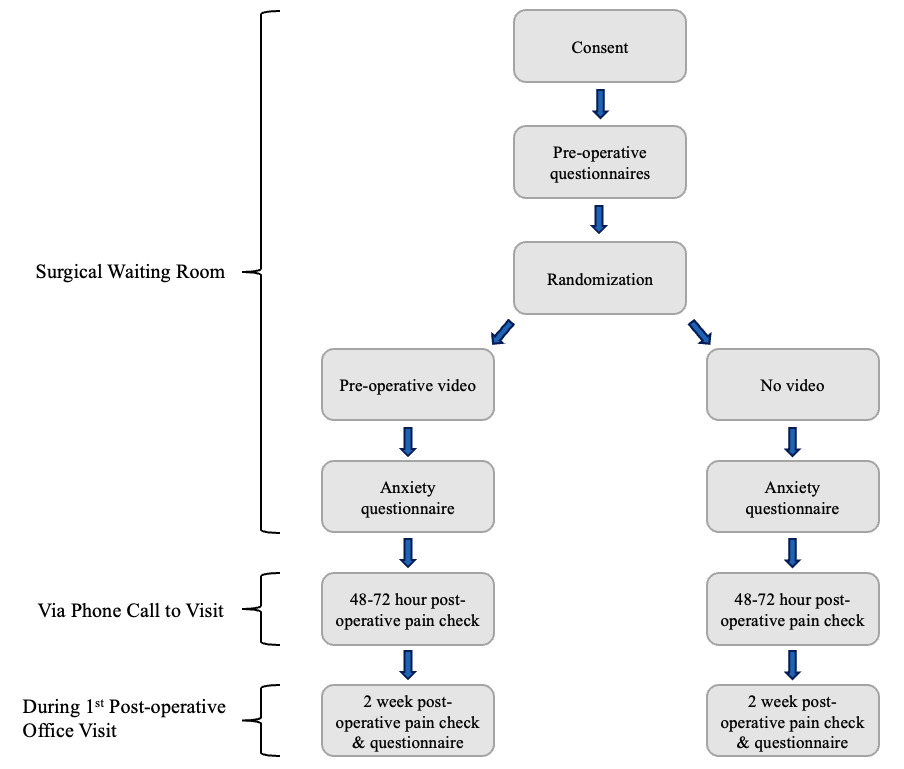
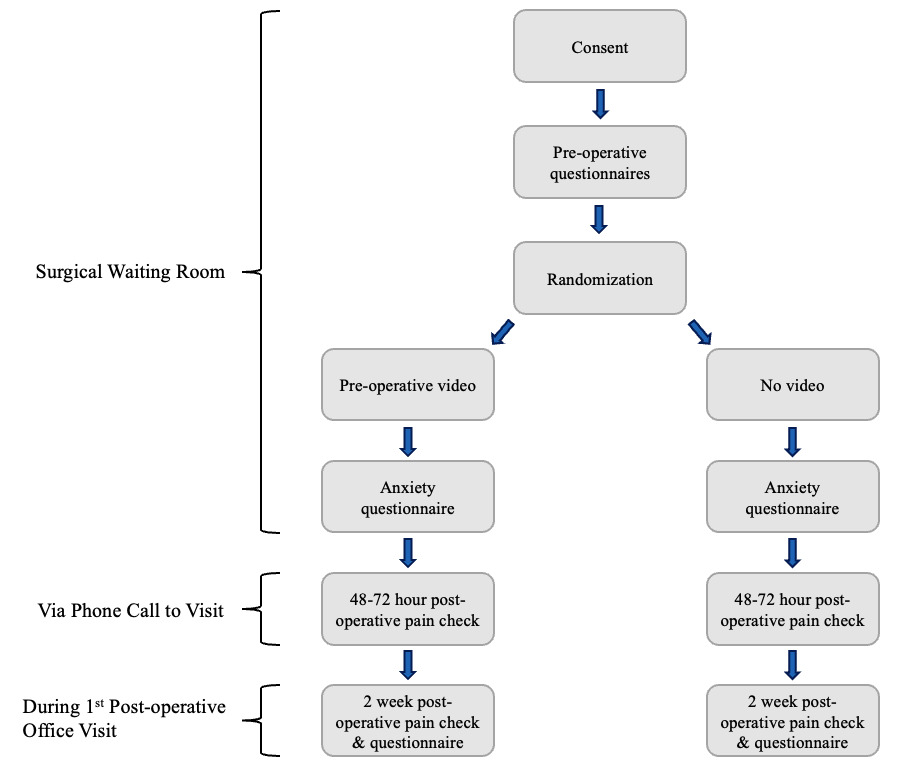
Participants were administered pre-operative pain and function, pain catastrophizing, and patient activation questionnaires prior to randomization (i.e., prior to watching the video in the intervention group) (Figure 1). After completion of the questionnaire, patients were randomized to the intervention or control group.
Pre-operative Video: Participants allocated to the intervention group watched a high-quality video shown by a member of the research team. This video provided information about their condition and the surgery they were about to undergo. These videos are available through the ASSH YouTube channel (https://www.youtube.com/watch?v=YX574UFlS-Q, https://www.youtube.com/watch?v=WZ3LlLCsNic&t=213s,) and provide a representation of the surgeries from pre-operative sterilization and opening incision to closing using real surgical video clips. Instrumentation such as a scalpel are displayed, and relevant anatomy is identified and explained in relation to the procedures. The videos are approximately 2 minutes (carpal tunnel) and 5 minutes (trigger finger) long. Pre-operative measures of anxiety were obtained only after watching the high-quality video in those randomized to the video group
No Video: Participants allocated to the control group did not watch a high-quality video pre-operatively. Pre-operative measures of anxiety were the last measures collected in the pre-operative questionnaire.
Questionnaires
All participants were asked to complete questionnaires immediately before surgery (in the pre-operative area), at 48-72 hours post-operatively (via a phone call by a member of the research team), and at 2 weeks post-operatively (first follow up appointment with the surgeon) (Figure 1).
All patients were evaluated for a minimum follow-up period of 2 weeks after the intervention by one of three hand surgeons (JMI, LBL, KWN) involved in the study who were blinded to which arm of the study the patient was randomized. Data was managed using REDCap (Research Electronic Data Capture) 9.5.3 electronic data secure capture tools hosted at Northwell Heath (Harris et al. 2019, 2009).
Pre-operative Measures: In the surgical waiting room, all participants answered a questionnaire about whether they previously sought out and watched videos about their surgery on the Internet, and if so, their perceived changes in anxiety. Also, all participants filled out the State-Trait Anxiety Inventory (STAI) 6-question short form, visual analog scale (VAS) pain score, the Quick Disabilities of the Arm, Shoulder, and Hand (qDASH), Patient Activation Measure-13 (PAM-13), and the Pain Catastrophizing Scale (PCS) (Tluczek et al. 2009; Gummesson et al. 2006; Moljord et al. 2015; Osman et al. 1997). STAI-6 is a validated measure of anxiety. VAS is a visually guided scale for pain using a continuous scale of 0-100. qDASH is a validated outcome measure of function of the upper extremity. PAM-13 is a validated measure of patient engagement and may correlate to better self-management and higher involvement in treatment decisions. PCS is a validated measure of how individuals experience pain.
Post-operative Measures: During the period of 48-72 hours post-operatively, a member of the research team, unaware of which arm of the study the patient was randomized to, called each participant, and asked them to give a pain score based on a Likert scale of 0-100. During the participant’s 2-week post-operative follow up appointment with their surgeon, the patient was asked to complete the VAS for pain and the qDASH questionnaires by a member of the research team, also unaware of the group the patient belonged to.
Statistical Analysis
For each procedure, quantitative variables (age, VAS, qDASH, PCS, STAI-6 scores, PAM-13) were compared using two-tailed T-tests. PCS <30 and >30 were dichotomized for analysis based on clinical relevance according to previous studies (Darnall 2016). Categorical variables (sex and pre-operative video watching) were compared using Chi-Squared tests. Significance was set at p < 0.05.
Sample Size Calculation
An a priori analysis sample size calculation for STAI scores (primary endpoint) was performed to determine the number of study participants required. We set the clinically meaningful difference at 8 points with a standard deviation of 10 points, p < 0.05 and a power of 0.8, which yielded a desired sample size of 33. This was based on previous validation studies showing a clinically meaningful difference at 8 points and standard deviations ranging from 6.2 – 15.8 (Marteau and Bekker 1992; Corsaletti et al. 2014). To sufficiently detect differences in the primary endpoint of pre-operative anxiety, we set out to recruit 40 patients per group for each procedure (CTR or TFR), for a total of 160 patients.
Results
Demographic information and subjective reaction to videos
No patients who were asked to participate in the study, declined. 167 patients were enrolled in the study: 41 in CTR control group, 44 in the TFR control group, 42 in the CTR video group, and 40 in the TFR video group. No patients were lost to follow up.
Seven patients (17.1%) in the CTR control group reported that they sought out and watched videos on the internet to learn about their surgery pre-operatively, compared to 8 patients (19.0%) in the video group (p=0.82); of the 7 patients in the control group who sought out videos, 3 responded that this subjectively made them more anxious, 3 responded less anxious, and 1 said it had no effect, while of the 8 patients in the CTR video group, 3 responded that watching videos made them more anxious, 3 responded less anxious, and 2 said it had no effect. Of the 42 patients randomized into the CTR video group who watched a high-quality, physician-made video in the pre-operative holding area, 3 patients responded that it subjectively made them more anxious, 16 responded that it made them less anxious, and 23 said it had no effect (Table 1).
Five patients (11.4%) in the TFR control group reported that they sought out and watched videos on the internet pre-operatively, compared to 4 patients (10.0%) in the video group (p=0.84); of the 5 patients in the control group who sought out videos, 1 responded that this subjectively made them more anxious, 3 responded less anxious, and 1 responded that it had no effect, while of the 4 patients in the TFR video group, 2 responded that watching videos made them more anxious, and 2 said it had no effect. Of the 40 patients randomized into the TFR video group who watched a video in the pre-operative holding area, 5 responded that this video subjectively made them more anxious, 17 responded that it made them less anxious, and 18 said it had no effect (Table 2).
Pre-operative Questionnaires
Pre-operatively, patients in the CTR control group reported significantly higher VAS pain scores than patients in the CTR video group (p=0.049), however there were no significant differences for qDASH (p=0.05), STAI (p=0.51), PCS (p=0.35), or PAM-13 (p=0.12) scores between the groups (Table 3). No significant differences were found between the TFR control and TFR video groups pre-operatively for qDASH (p=0.41), VAS pain scores (p=0.96), STAI (p=0.51), PCS (p=0.10), or PAM-13 (p=0.92) (Table 4).
Short Term Post-operative Outcomes
No differences were found between the CTR control and video groups for the 48–72-hour pain check (p=0.85), or for 2-week post-operative qDASH (p=0.58) and VAS pain scores (p=0.75) (Table 3). Similarly, there were no differences between the TFR control and video groups for 48–72-hour pain check (p=0.89), or 2-week post-operative qDASH (p=0.41) and VAS pain scores (p=0.80) (Table 4).
Analysis of patients who sought out videos on their own pre-operatively
In total, 24 of the patients (14.4%) reported that they had sought out and watched videos on the internet to learn about their conditions and upcoming surgery prior to their enrollment in the study. When these 24 patients were compared to the 143 patient who did not seek out videos pre-operatively, no differences in pre-operative qDASH (p=0.08), VAS pain scores (p=0.64), PCS (0.34), STAI (0.48), and PAM-13 (p=0.14) were identified (Table 5). 15 of 83 patients who underwent CTR (18.1%) reported watching videos, while only 9 of 84 patients who underwent TFR (10.7%) reported it, which was not a significantly different percentage (p=0.18).
Impact of Pain Catastrophizing on Pre-operative Questionnaires and Short Term Post-operative Outcomes
Of the 167 patients enrolled in the study, 26 patients reported PCS ≥ 30 (Table 6). When compared to the 141 patients with PCS < 30, patients with PCS ≥ 30 reported significantly higher pre-operative qDASH (p<0.05) and VAS pain scores (p<0.05). No differences were found for 48–72-hour pain check scores (p=0.06), or 2-week qDASH (p=0.12) and VAS pain scores (p=0.08). PCS ≥ 30 was associated with higher pre-operative STAI (p<0.05), and there was no effect of PCS on patient engagement in their care [PAM-13] (p=0.18).
Discussion
In this study, we found that 14.4% of patients undergoing CTR and TFR seek out videos on the internet pre-operatively as a source of medical information. There was no correlation between video-seeking behavior and pre-operative qDASH and VAS scores, levels of pain catastrophizing, patient activation, or pre-operative anxiety levels. No difference in pre-operative anxiety was found between patients randomized to watch a high-quality, physician-made video pre-operatively versus those who did not watch a video. Among patients undergoing CTR, patients in the video group reported significantly lower pre-operative VAS scores compared to the control group. No other differences between video and control groups were found for patients undergoing CTR or TFR with regards to pre- and short-term post-operative outcome scores, pain catastrophizing, or patient activation. Among all patients, PCS ≥ 30 was independently associated with significantly higher pre-operative anxiety levels and significantly worse pre-operative qDASH and VAS pain scores.
Of the patients who sought out and watched videos on the internet prior to their enrollment in the study, an equal number of patients reported that watching these videos made them more anxious (9 patients) and less anxious (9 patients). On the other hand, most patients who were randomized to watch a high-quality pre-operative video in our study reported that the video had no effect on their anxiety (54.8% for CTR and 45.0% for TFR), while a lesser number of patients reported a subjective decrease in anxiety (38.1% for CTR and 42.5% for TFR), and relatively few patients reported increased anxiety (7.1% for CTR and 12.5% for TFR). This indicates that while our study found no significant reduction in pre-operative anxiety scores for patients randomized to the video group, there was a subset of patients who subjectively found the video to decrease their perceived pre-operative anxiety. Furthermore, the percentage of patients who reported that the high-quality video made them more anxious (7.1% for CTR and 12.5% for TFR) was lower than for patients who sought out videos on their own prior to the study (50% for both CTR and TFR). This data, although not significant, suggests that there is a subset of patients who not only seek informative videos prior to surgery but also benefit from reduction in their perceived anxiety after watching them. Organizations such as the ASSH should continue to produce high-quality, physician-made surgical videos for this subset of patients.
We did not find any significant differences for patients who sought out videos pre-operatively with regards to pre-operative outcome measures, pain catastrophizing, anxiety levels, or patient activation that might help to define the subset of patients who are more likely to exhibit this behavior. This may be because they do not exist, or because only 24 of the 167 patients (14.4%) in our study reported video seeking, therefore making the sample size too small to detect factors that contribute to this behavior. Interestingly, a higher proportion of patients undergoing CTR reported video seeking behavior compared to TFR (18.1% and 10.7%, respectively), but this difference was not statistically significant.
With regards to the intervention of showing patients a high-quality, physician-made video pre-operatively, the only significant finding in our study was that CTR patients who watched the pre-operative video subsequently reported lower pre-operative VAS pain scores compared to their counterparts in the CTR control group. We hypothesize that this may be the result of patients better understanding their condition and their upcoming surgery, which may put their pain into perspective. This may alternatively reflect imbalance despite randomization of patients after enrollment in the study, which is an important consideration given the complex interplay between anxiety and pain. Future studies with a larger cohort of patients are needed to investigate and identify the factors that led to the observed decrease in pain scores in the CTR video group.
A prior study of carpal tunnel patients showed that increased pre-operative anxiety is associated with significantly worse pain and physical function at 6 weeks post-operatively, but this no longer holds true at 6 months (Hobby et al. 2005). We were unable to confirm our hypothesis that providing patients a high-quality pre-operative video would reduce pre-operative anxiety levels and improve short-term outcomes in ambulatory hand surgery. Other studies have reported similar findings in other fields of medicine. Eijlers et al. and Noben et al. found that a pre-operative virtual reality simulation did not reduce anxiety levels in children undergoing elective ambulatory surgery or patients undergoing elective cesarean section, respectively (Noben et al. 2019; Eijlers et al. 2019). Platto et al. reported that providing patients with an educational video prior to dermatologic surgery did not significantly reduce anxiety levels (Platto et al. 2019). Conversely, other authors have shown that video interventions can effectively reduce anxiety in the perioperative setting. Batuman et al. and Fernandez et al. both found that showing children an informational pre-operative video prior to elective surgery reduced pre-operative anxiety (Batuman et al. 2016; Fernandes et al. 2014). In a study similarly designed to the present one, Jlala et al. reported that for upper and lower extremity surgery performed under regional anesthesia, providing patients with an educational pre-operative video resulted in significantly lower pre-operative anxiety levels compared to a control group (Jlala et al. 2010). Ultimately, there is conflicting data regarding the effectiveness of informational pre-operative videos as an anxiety relief tool, suggesting that the effectiveness of pre-operative videos may be dependent on the procedure, surgical specialty, or targeted patient population. Our study does not show a significant impact in ambulatory hand surgery, but there was still a substantial subset of patients who found the pre-operative videos to decrease pre-operative anxiety. Further studies are needed to compare anxiety and pain scores when videos are shown to non-surgical patients to further validate their effects and potential integration in a surgical setting.
Although prior studies have shown that pre-operative patient education can reduce pain catastrophizing, we did not find a significant difference in PCS with introduction of a pre-operative video (Gibson and Sabo 2018). It has been found that higher pre-operative PCS in hand surgery is associated with increased post-operative pain and opioid use, and decreased physical function and satisfaction (Mosegaard et al. 2020; Sacks et al. 2019; London et al. 2014). In our study, we determined that PCS ≥ 30 is associated with significantly higher pre-operative qDASH, VAS, and STAI scores in ambulatory hand surgery, however there was no impact on short-term post-operative outcomes. Pain catastrophizing, given its negative effects in multiple facets of hand surgery, is an intriguing therapeutic target for future interventions. Interventions such as cognitive-behavioral therapy and immediate post-operative pregabalin treatment have been shown to reduce PCS in other fields of surgery (Gibson and Sabo 2018).
This study has some limitations. Patients randomized to watch a high-quality video were shown the video in the pre-operative area, usually within 1 hour of their surgery. Also, patients answered all questionnaires in the pre-operative area. There may have been a difference in questionnaire results if these videos were shown in the clinic or at home rather than the pre-operative area, a time where patients may already feel a heightened level of anxiety. However, patients may experience heightened anxiety elsewhere, such as at home, and the surgical waiting area was a standardized location for all enrolled patients. It is also possible that showing the videos in the pre-operative environment influenced patient reporting of pain or anxiety, but given that they were enrolled in the study only after consent for the procedure had been obtained, we believe that answering these surveys would not have influenced their decision to proceed with the surgery. These surveys are frequently administered perioperatively in research studies, and all patients underwent pre-surgical testing and screening prior to the operation. No surgeries were cancelled for enrolled patients. Another limitation of this study is that STAI, PAM-13 and PCS were administered at a single time point, pre-operatively. It is not clear how valid a single score at one point in time is and if these scores change over time, especially when administered in the pre-operative area.
Conclusions
The primary aim of this study was to determine if providing patients with a high-quality pre-operative video reduces pre-operative anxiety in ambulatory hand surgery. Although the video did not reduce anxiety as measured by STAI-6 scores, many patients subjectively perceived the video as helpful or neutral. Interestingly, high pre-operative pain catastrophizing levels were found to be associated with high pre-operative anxiety and worse pre-operative patient-reported pain and function. While introducing a pre-operative video in this study did not impact PCS, other interventions aimed at decreasing pain catastrophizing would be interesting to study in the field of hand surgery.
Ethical Approval
This study was conducted in accordance with the World Medical Association (WMA) Declaration of Helsinki and was approved by the Institutional Review Board on June 29, 2020. Institutional approval was acquired on July 10, 2020. This protocol was registered under the title Effect of High-quality Pre-operative Videos on Patient Anxiety Levels Prior to Ambulatory Hand Surgery under the number NCT04424810, with the identification 20-0516, available at https://clinicaltrials.gov/.
Statement of Human and Animal Rights
Humans and Animals were not harmed in the completion of this manuscript or in the collection of data.
Statement of Informed Consent
All patients provided written informed consent and agreed to share their data for research purposes.