
1. Introduction
The modern operating room (OR) is a complex socio-technical system where precision, coordination, and uninterrupted attention are essential to ensure patient safety (Carayon 2006). However, the pervasive use of personal electronic devices (PEDs) poses a novel and under-addressed threat to surgical workflow and situational awareness.
Originally designed for communication, smartphones and PEDs have evolved into multifunctional tools that integrate social, commercial, and entertainment applications. This expansion has led to habitual use across settings, including those where attentional demands are high and error tolerance is low. One such situation is driving, where the use of a personal electronic device (PED) can pose serious risks not only to the user but also to those nearby. Studies have shown that from the population who own a PED, above 60% of them will use it during driving tasks (Meshi et al. 2015). Inattention to driving significantly increases the risk of being involved in a crash, as it changes the process of perceiving hazards and can lead to a loss in sensitivity to a hazard, with a shift in response bias (Burge and Chaparro 2018). In 2022 alone, distracted driving was responsible for 3,300 fatalities and nearly 290,000 injuries in motor vehicle accidents, which can be linked to PED use and simply removing PEDs as a distraction factor on the road could remove up to 22% of yearly crashes in the U.S (Johari 2022; Wright et al. 2024).
From a human factors perspective, PED usage competes for limited cognitive resources. Theories of signal detection and cognitive absorption suggest that PED engagement may reduce environmental awareness, impair hazard recognition, and increase the likelihood of misses (Macmillan 2002). These cognitive failures are especially dangerous during surgical procedures, where momentary lapses can cascade into system-wide disruptions.
In surgical environments, the intrusion of PED-related distractions is particularly concerning. Khan et al, showed how interruptions involve distractions for critical team members, such as personal electronic device use (phone calls/texting), vendors, and staff using mobile devices, which posed significant problems (Khan, Cohen, et al. 2025). Prior studies in cardiovascular surgery found that PEDs were used for non-clinical purposes in up to 9% of total procedure time, even during critical phases such as cardiopulmonary bypass (Cohen et al. 2016). Tooker et al. found that 67% of disruptions in orthopedic surgery are affected by the use of personal electronic devices (Tooker et al. 2023).
As personal electronic devices (PEDs) have become deeply integrated into both personal and professional life, their influence on attention and task prioritization in safety-critical environments warrants serious concern. The concept of cognitive absorption where an individual’s mental resources become fully consumed by one activity raises the question of whether surrounding stimuli, including patient cues or auditory alarms, are increasingly being “missed” during clinical care. Prior research in cardiovascular surgery has illustrated this risk, particularly in prolonged procedures like bypass surgery, where the extended operative time presents numerous opportunities for distraction (Cohen et al. 2018). This study extends those findings to shorter-duration orthopedic procedures, such as hip and knee replacements, which typically last around two hours but remain vulnerable to similar attentional failures.
This study systematically examined workflow disruptions related to personal electronic devices (PEDs) in orthopedic surgery by analyzing the frequency, duration, and impact of these events based on team member roles. By quantifying both the frequency and contextual relevance of PED usage across distinct surgical team roles, this study enhances our understanding of human-system interaction within the orthopedic surgery. The findings inform the development of targeted human factors and ergonomics interventions, spanning training, policy formulation, and workflow redesign, aimed at mitigating distraction and fostering safer, more resilient healthcare systems.
2. Methods
2.1. Setting and Study Design
This observational study was conducted at a 678-bed community hospital in East Central Florida. Over a four-month period, researchers observed 40 elective orthopedic procedures, 15 total hip replacements and 25 total knee replacements, totaling 145.03 hours of real-time observation. This study was submitted for IRB consideration and was determined to be exempt, as it involved no patient-specific or identifiable data. Therefore, full ethical approval was not required. Written consent was not required as no patient-identifiable data were collected, and the study involved non-interventional observations of routine clinical practice. All team members were made aware that the research team was collecting data related to workflow and human performance in the operating room. This approach was intended to minimize targeted behavior modification while maintaining ethical transparency.
2.2. Participants
Surgical teams included eight orthopedic surgeons and various support roles: first assist, surgical technologist, circulating nurse, certified registered nurse anesthetist (CRNA), anesthesiologist, vendor representative, and radiology technician. While some staff members participated in multiple procedures, team composition varied case to case.
Observations were conducted by trained human factors researchers from Embry-Riddle Aeronautical University. Each case was observed by a single researcher to minimize observer influence. Observation began in the preoperative holding area, continued through patient transport and the full surgical procedure, and concluded upon patient handoff to the post-anesthesia care unit (PACU). Observations were guided by a structured human factors framework adapted from aviation industry, where it is used to systematically capture workflow disruptions, task interruptions, and human–system interactions in high-risk environments. This framework was tailored to the surgical setting to enable real-time identification and classification of PED-related disruptions within complex clinical workflows.
PED-related behavior was documented in real time, including device interaction type, user role, timestamp, and estimated duration. All observations were non-intrusive, with the observer positioned outside of the sterile field. Personal electronic devices (PEDs) disruption was defined as: Any event that delayed or diverted attention from a team member’s task using a personal electronic devices, affecting the continuity or efficiency of surgical workflow. Each disruption involving PEDs was categorized using a validated framework that identifies contributing factors across multiple system levels of human error. Event attributes included: team member role, task phase during occurrence, disruption duration, and contextual narrative when applicable. Additionally, PED use was categorized as clinically relevant (e.g., communication related to patient care or hospital operations) or non-clinical/personal based on observed context and interaction purpose, enabling differentiation within the broader hospital communication environment.
2.3. Data Analysis
Frequencies and total time of PED usage were computed across team roles. PED use was analyzed both by event count and cumulative time, allowing for comparison of frequency and severity. Where applicable, between role differences were tested for statistical significance using appropriate non-parametric methods.
3. Results
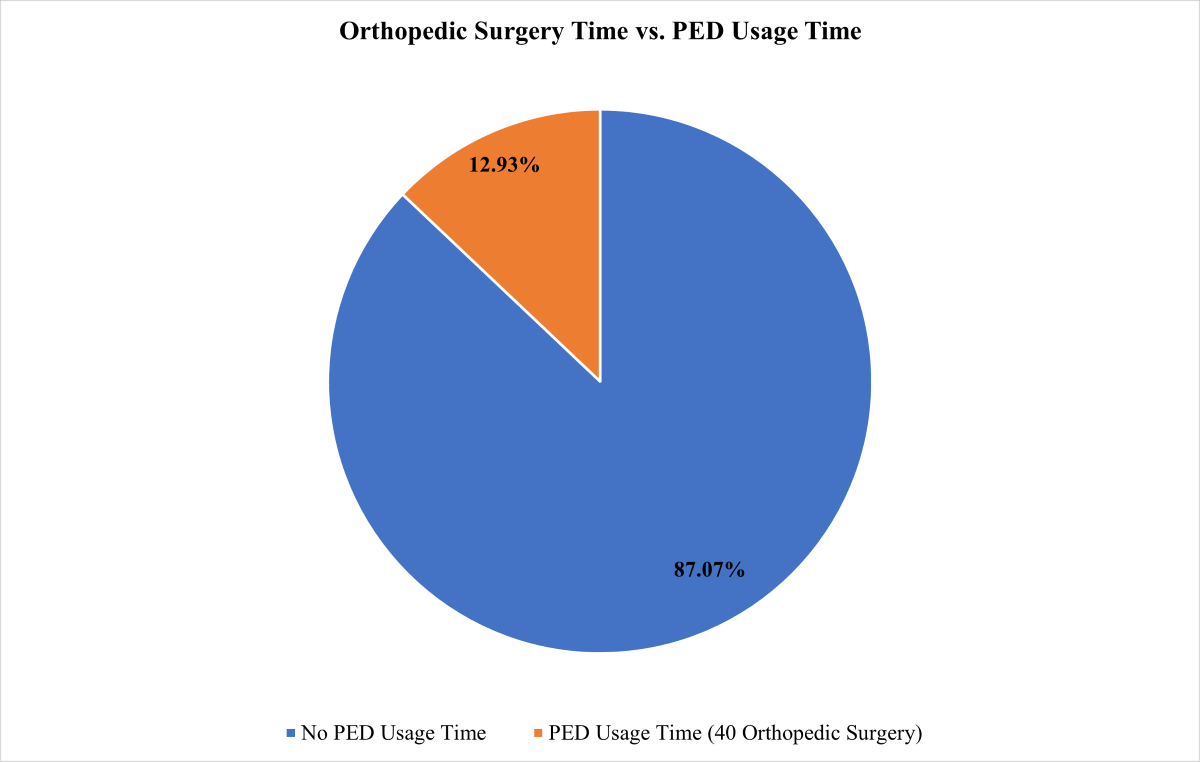
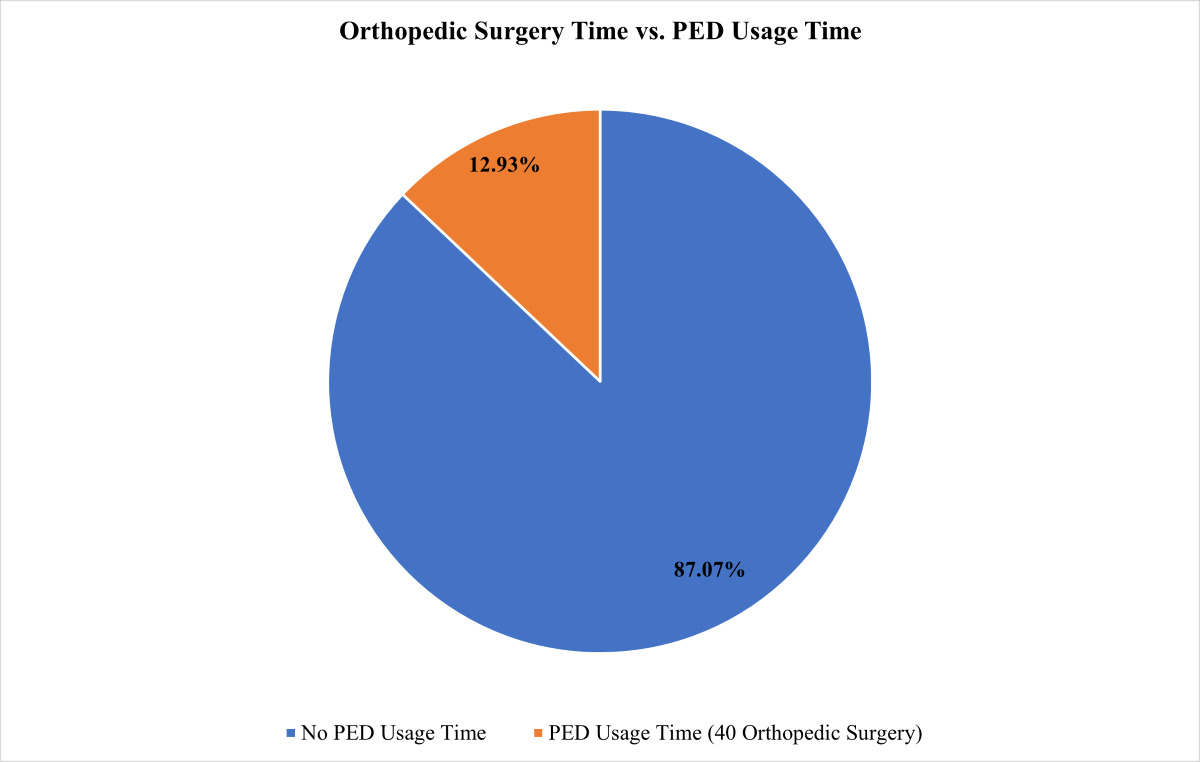
Across 40 orthopedic procedures totaling 145.03 hours of observation, total of 487 personal electronic device (PED)-related events was recorded during observed orthopedic procedures, with a cumulative PED usage time of 18 hours, 46 minutes, and 44 seconds, accounting for 12.93% of total surgical observation time (Figure 1). PED use varies notably by team member role. Vendors accounted for the highest proportion of events (n = 148, 30.39%) and spent a total of 4 hours, 30 minutes, and 52 seconds attending to PEDs. Circulating nurses followed, with 115 events (23.61%) and 4 hours, 3 minutes, and 53 seconds of total usage.
Despite fewer events (n = 99, 20.33%), CRNAs exhibited the longest cumulative PED engagement at 5 hours, 52 minutes, and 25 seconds. The CRNA had the highest cumulative duration of PED engagement despite fewer events than the vendor, suggesting more prolonged individual interactions. Other roles with lower frequencies and durations included surgical technologists (7.80%), anesthesiologists (6.37%), radiology technicians (5.54%), first assists (3.70%), and surgeons (2.26%). These role-specific differences highlight varying patterns of PED engagement and potential exposure to distraction during critical perioperative phases (see Table 1).
A proportion of observed PED interactions were directly related to clinical care or operational coordination, while others were non-clinical; this distinction highlights the dual role of PEDs in both supporting and potentially disrupting workflow. Many PED interactions were brief (e.g., checking a text message), but a subset involved extended disengagement. These longer interactions often overlapped with high-risk or transitional phases of the operation, such as: Patient positioning, Implant preparation, Physiologic monitoring (e.g., anesthesia alarms), Intraoperative communication and instrument handoffs, Narrative observations revealed instances in which PED use coincided with lapses in patient safety or surgical efficiency. For example: A CRNA was observed watching a video with audio on, failing to respond promptly to a soft alarm on the anesthesia machine. A circulating nurse missed the verbal relay of implant lot numbers due to attention on a mobile device, leading to delay and confusion. A vendor engaged with their phone failed to assist the surgical team when an implant-related issue arose. Table 2 summarizes representative PED-related disruptions.
4. Discussion
This observational study highlights a pervasive, yet often underestimated, threat to orthopedic operating room performance: the inappropriate use of personal electronic devices (PEDs) by orthopedic surgical team members during live procedures. While PEDs have become essential in healthcare for communication and clinical reference, their non-clinical use introduces a significant cognitive burden and poses risks to situational awareness, team coordination, and patient safety (Khan, Shappell, et al. 2025).
Our findings demonstrate clear role-based patterns in PED usage. Vendors and circulating nurses accounted for the highest number of observed PED events, frequently during critical moments that required their immediate attention. The circulating nurse’s role responsible for sterile-to-non-sterile communication, equipment readiness, and intraoperative documentation makes any lapse in availability consequential to surgical flow. Similarly, the prolonged engagement with PEDs observed among CRNAs, some exceeding 20 minutes, is particularly concerning given their continuous monitoring responsibilities and need for rapid response to changes in patient physiology.
From a human performance perspective, these findings align with Multiple Resource Theory (Wickens 2002), which posits that tasks drawing on the same cognitive resources, such as PED use for visual and auditory stimuli, compete with primary clinical tasks, increasing the risk of missed alarms, overlooked cues, and degraded team communication. These attentional conflicts, if unmitigated, introduce latent conditions that can precipitate active failures in high-risk environments like surgery.
Importantly, the widespread normalization of PED use reflects deeper systemic issues in safety culture and work system design (Tooker et al. 2023). While organizational policies may restrict non-essential use, enforcement alone is insufficient. Effective intervention requires a human factors-informed approach that addresses the interaction between individuals, tasks, tools, and the environment.
To reduce the risk of PED-related distraction in the OR, the following human factors and ergonomics interventions are recommended. Introduce designated, physically separated zones for PED use outside the surgical suite, minimizing ambient distraction while preserving access during appropriate clinical breaks. Integrate clear role-based expectations regarding PED use into standard workflows. Reinforcing accountability for attention-critical roles (e.g., CRNAs, circulating nurses) can reduce ambiguity and disengagement.
Develop unobtrusive monitoring systems (e.g., attention dashboards or behavioral cues) to identify lapses in attention among team members with critical patient-monitoring responsibilities. Embed distraction management and attentional control strategies into team-based simulation training. This reinforces cognitive resilience and promotes shared awareness of PED-related risks.
These interventions reflect human factors principles that emphasize system-level design over individual fault, aiming to reduce cognitive overload and enhance task engagement in high-stakes clinical settings.
In sum, understanding the role of PED-related distraction in the OR is not only a matter of policy enforcement but of redesigning systems to support sustained attention and clinical vigilance.
5. Limitation
The data were collected through direct, real-time observations without the use of video recording, which may have limited the ability to capture brief or subtle instances of PED use. As a result, the true frequency and duration of PED-related distractions may be underreported. Second, observers did not hold clinical roles, which could have influenced their interpretation of contextual factors or the clinical relevance of certain events, despite standardized training and use of a structured observation tool. Additionally, The presence of an in-room observer may have influenced participant behavior (Hawthorne effect), potentially reducing the frequency of observed PED use and associated distractions. As such, the reported incidence may represent a conservative estimate.
Lastly, the study was conducted within a single surgical specialty (orthopedics) and at a single institution, which may limit the generalizability of the findings across different surgical disciplines or healthcare settings. Also, The use of a single observer in a dynamic, multi-actor environment may have limited the ability to capture all simultaneous or brief PED interactions, potentially leading to underestimation. Future research incorporating multi-site, multi-specialty analyses and mixed-method approaches may offer a more comprehensive understanding of PED-related distraction and its implications for patient safety and team performance.
6. Conclusion
Personal electronic devices are embedded in modern life, offering convenience, connectivity, and utility. However, their unregulated presence in high-reliability environments such as operating rooms presents a growing patient safety concern. This study demonstrates that PED use is not only frequent but also consequential, with role-dependent patterns of engagement that can disrupt team coordination and compromise situational awareness.
To address this issue, organizations must approach PED usage not simply as a matter of individual behavior, but as a systems-level vulnerability. Through a combination of design, training, policy, and culture shift, healthcare systems can better balance the advantages of digital connectivity with the uncompromising need for vigilance and safety in surgical care.
7. Implications
This study offers actionable insights for improving safety and reliability in orthopedic surgical care through applied human factors and ergonomics (HFE) principles. Guided by HFE methodology, these findings support the development of context-aware policies that clearly define role-based expectations for device use, as well as the redesign of physical and cognitive workflows to minimize attentional competition. Future work should continue to explore the integration of behavioral, technological, and organizational strategies to mitigate distraction and improve safety in surgical care.
8. Key Points
-
This study reveals critical role-specific patterns in personal electronic device (PED) use, with vendors, CRNAs, and circulating nurses showing the highest engagement during active orthopedic procedures often at the cost of attention-critical duties.
-
Findings illustrate how non-clinical PED use creates visual and auditory cognitive load that competes with primary surgical tasks, degrading situational awareness, team coordination, and response to patient cues.
-
PED-related distractions reflect broader systemic design and safety culture gaps. Addressing this challenge requires human factors-informed strategies beyond behavioral policies, targeting task design, environmental structure, and cultural norms.
-
Proposed interventions include digital-free zones, role-based PED expectations, unobtrusive attention-monitoring tools, and simulation-based distraction management advancing attentional resilience and system reliability in high-risk surgical environments.