
Introduction
The proliferation of smartphones, laptops, and virtual workstations has substantially altered daily movement patterns and postural behaviors. With average daily screen time increasing across multiple age demographics, clinicians increasingly encounter “digital fatigue,” a term used to describe physical, cognitive, and visual strain associated with prolonged device engagement (Devi and Singh 2023). This phenomenon has been linked to behavioral patterns characterized by sustained forward head positioning, rounded shoulders, and prolonged static sitting (Jung et al. 2016).
Socioeconomic shifts, including remote work and virtual education, have further increased these postural demands (Oakman et al. 2020). Adults now average more than seven hours of daily screen time, frequently blurring the boundaries between work and rest (Toko et al. 2025). Emerging epidemiologic studies suggest associations between prolonged screen exposure and musculoskeletal or postural alterations; for example, a 2025 cross-sectional study involving 1,231 adolescents reported an association between excessive after-school screen time and suspected scoliosis (Chen et al. 2025). Concurrent increases in neck pain, carpal tunnel symptoms, and forward head posture have drawn greater attention to the orthopedic implications of screen-based lifestyles (Green 2008; Waersted et al. 2010). However, the current body of evidence spans multiple disciplines, including occupational health, biomechanics, rehabilitation, and public health, and remains heterogeneous in both methodology and outcome measures. This narrative review synthesizes available evidence regarding digital fatigue, posture-related biomechanical adaptations, and musculoskeletal injury risk while highlighting opportunities for clinical prevention and future research.
Methods
Literature Search Strategy
This narrative review integrates behavioral, physiologic, biomechanical, and orthopedic perspectives on screen-based musculoskeletal disorders. A literature search was conducted using PubMed, Google Scholar, and ScienceDirect to identify peer-reviewed studies evaluating digital ergonomics, screen exposure, posture-related adaptations, and musculoskeletal outcomes. Search terms included combinations of “digital fatigue,” “screen time and posture,” “forward head posture,” “sedentary behavior,” and “musculoskeletal pain.” Reference lists of relevant articles were additionally reviewed to identify supplemental studies.
Study Selection
Eligible studies included English-language clinical studies, observational cohorts, biomechanical analyses, randomized or interventional studies, systematic reviews, and narrative reviews published between January 2000 and March 2025. Greater emphasis was placed on literature published between 2015 and 2025 to reflect recent changes in remote work, virtual education, and mobile technology use. Studies were included if they examined biomechanical or physiologic adaptations associated with prolonged digital device use or evaluated musculoskeletal outcomes related to screen-based behaviors. Non-human studies, opinion articles, and occupational studies unrelated to digital device exposure were excluded.
Given the narrative design of this review, studies were synthesized qualitatively rather than through formal meta-analytic methods. Evidence was interpreted within the context of study design and methodological limitations, recognizing that much of the available literature is cross-sectional and demonstrates association rather than causation. The synthesis aimed to contextualize proposed relationships between digital exposure, postural behavior, and musculoskeletal symptoms while highlighting areas requiring further longitudinal investigation. Because this review includes heterogeneous study designs ranging from experimental biomechanics to epidemiologic analyses, findings should be interpreted within the context of varying evidence strength. No formal quality assessment tool was applied because of the narrative design of the review.
Review
Translational Mechanisms: From Digital Behavior to Physical Injury
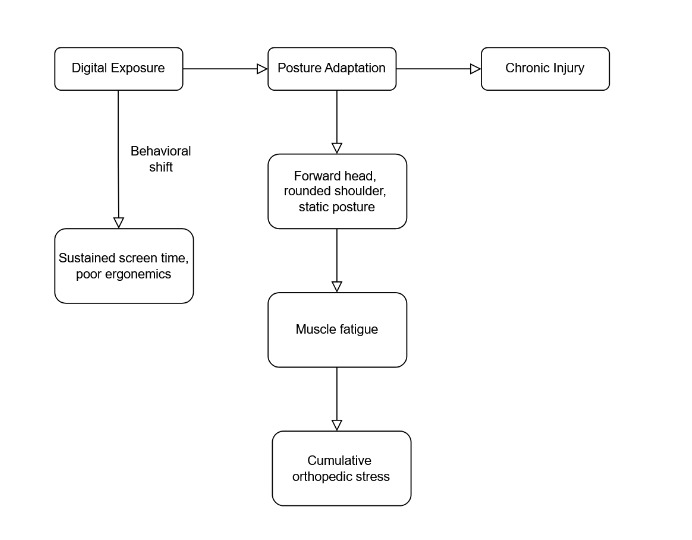
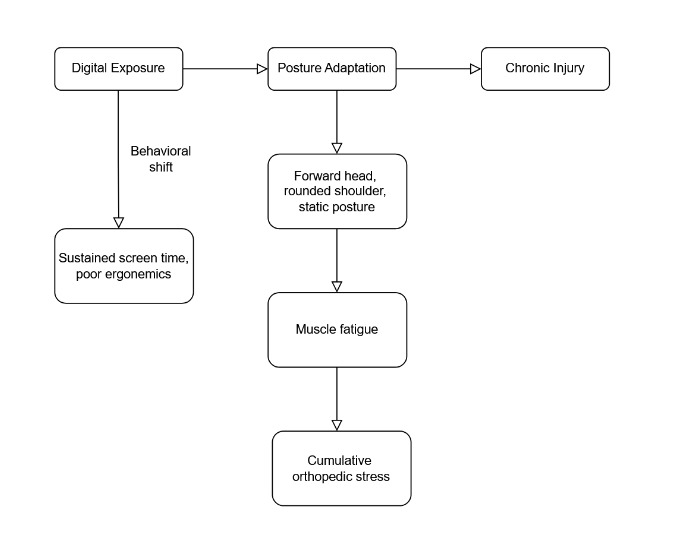
Habitual screen engagement has been associated with biomechanical and postural adaptations that may contribute to musculoskeletal strain (Jung et al. 2016; Green 2008; Waersted et al. 2010). Prolonged device use is commonly linked to sustained neck flexion, rounded shoulders, and static sitting positions, which may increase cervical and lumbar loading. A 2021 study reported that children using smartphones for more than four hours daily demonstrated significantly greater head and neck flexion angles compared with shorter-duration users (Abdel-Aziem et al. 2022). At the physiologic level, prolonged static postures have been associated with muscle fatigue, altered proprioception, and changes in spinal loading mechanics. Electromyographic studies demonstrate that individuals with forward head posture exhibit reduced activation of deep neck flexors alongside compensatory overactivation of superficial cervical musculature (Lee et al. 2015a). These neuromuscular patterns may contribute to altered stabilizer recruitment and broader kinetic-chain dysfunction, although longitudinal evidence establishing causality remains limited. Interventions targeting posture modification, including standing desk implementation, have shown improvements in spinal alignment, perceived discomfort, and muscle fatigue in selected populations (Lee and Lee 2024).
Pathophysiology and Biomechanics of Digital Posture-Related Injuries
Posture-related musculoskeletal complaints in the digital era are commonly associated with sustained, low-grade mechanical loading rather than acute trauma (Devi and Singh 2023; Green 2008). Repetitive or prolonged postural behaviors may contribute to chronic biomechanical adaptations within the musculoskeletal system.
Cervical Spine: Forward head posture shifts the head’s center of gravity anteriorly, potentially increasing compressive and shear forces across the lower cervical spine, particularly at C5–C7. Repetitive loading of the levator scapulae and upper trapezius, combined with reduced deep neck flexor activation, has been associated with altered cervical mechanics and may contribute to degenerative changes over time (Almutairi et al. 2024).
Thoracic and Lumbar Spine: Sustained flexion during prolonged sitting may reduce lumbar lordosis and alter the spine’s load-distribution capacity. These postural adaptations are associated with increased paraspinal muscle fatigue and altered spinal loading mechanics. Biomechanical modeling studies suggest that slumped postures may increase stress on the annulus fibrosus and nucleus pulposus (Tsantili et al. 2022).
Shoulder Complex and Upper Limb: Prolonged typing and screen viewing are frequently associated with scapular protraction and altered scapulohumeral mechanics. These changes may reduce subacromial space and contribute to shoulder discomfort, impingement symptoms, or rotator cuff strain in susceptible individuals (Cho et al. 2023).
Neuromuscular Adaptations: These regional postural changes are often described within the framework of Upper Crossed Syndrome (tight pectorals and upper trapezius with weak deep neck flexors and rhomboids) and Lower Crossed Syndrome (tight hip flexors and lumbar extensors with weak abdominals and gluteals). Kinematic and electromyographic studies report delayed stabilizer activation and altered proprioceptive control in individuals with chronic postural dysfunction, although the long-term clinical significance of these findings remains incompletely understood (De Carvalho and Callaghan 2022).
Epidemiology of Digital-Related Pain
Digital posture-related musculoskeletal symptoms are commonly reported in both occupational and academic settings. Observational studies suggest that between 50% and 70% of office workers report neck or shoulder discomfort associated with prolonged computer or device use (Green 2008). Among students, musculoskeletal pain, particularly involving the cervical region, has been reported at similarly high rates (Almutairi et al. 2024; Kett et al. 2021; El Shunnar et al. 2024).
The transition to remote work during the COVID-19 pandemic was associated with increased screen exposure and reduced ergonomic optimization across multiple professions (Lucka et al. 2024). Similar trends have been observed in pediatric populations, where prolonged screen exposure has been associated with increased reports of neck and shoulder discomfort (Janwantanakul et al. 2008).
Certain populations, including students, healthcare professionals, and information technology workers, may be at elevated risk because of prolonged daily screen exposure and repetitive postural loading (Walankar et al. 2021). Healthcare professionals represent a particularly relevant high-risk group because of prolonged electronic medical record use, telehealth demands, and extended static postures during clinical and administrative tasks. In addition to individual health effects, these symptoms may contribute to reduced productivity, increased healthcare utilization, and broader occupational burden (Hoy et al. 2014).
Clinical Manifestations of Digital Fatigue
Clinical presentations range from transient discomfort to chronic musculoskeletal pain syndromes. Symptoms commonly localize to regions subjected to prolonged static loading or repetitive postural stress (Kazeminasab et al. 2022). Frequently reported symptoms include neck stiffness, trapezius tenderness, and occipital headaches (Tsantili et al. 2022).
Forward head posture has been associated with increased loading across the lower cervical spine and may contribute to referred pain involving the shoulders or upper thoracic region (Rahimian et al. 2024). In more severe cases, foraminal narrowing and cervical irritation may produce radicular symptoms such as paresthesia or upper-extremity weakness (Lee et al. 2015b).
The shoulder complex may also be affected through repetitive reaching and prolonged forward-leaning postures, which can alter scapulohumeral rhythm and contribute to impingement-related symptoms (Spanhove et al. 2021). Lower-back discomfort has similarly been associated with sustained sitting postures, reduced lumbar lordosis, and diminished core activation (De Carvalho and Callaghan 2022).
Distally, poor wrist positioning during keyboard use has been linked to carpal tunnel symptoms (Al Shahrani et al. 2019), while repetitive thumb motion during smartphone use may contribute to De Quervain’s tenosynovitis (Banadaki et al. 2024). Prolonged sitting with limited lower-extremity activation may additionally contribute to hip flexor tightness and gluteal inhibition, potentially influencing broader postural mechanics (Tsantili et al. 2022).
Diagnostic and Assessment Tools
Clinical evaluation begins with visual postural assessment to identify deviations from neutral alignment, including forward head carriage, shoulder asymmetry, and pelvic tilt (Vieira et al. 2019). This is followed by range-of-motion testing and palpation to identify areas of muscular tension or myofascial tenderness. Quantitative tools, including digital photogrammetry, can quantify angular postural deviations (Marimon et al. 2023), while surface electromyography (EMG) may identify altered muscle recruitment profiles (Nishikawa et al. 2022).
Validated patient-reported outcome measures, such as the Nordic Musculoskeletal Questionnaire (NMQ), Neck Disability Index (NDI), and Visual Analog Scale (VAS), are commonly used to assess pain and functional impairment. Reduced craniovertebral angle measurements have been associated with higher NDI and VAS scores (Subbarayalu and Ameer 2017). Imaging modalities, including radiographs, magnetic resonance imaging (MRI), and ultrasound, are generally reserved for persistent or severe presentations to evaluate disc pathology, neural compression, or tendinopathy.
Management and Prevention of Digital Fatigue and Injuries
Effective management strategies integrate ergonomic modification, rehabilitation, manual therapy, and behavioral interventions (Devi and Singh 2023; Cho et al. 2023). Proper workstation setup—including monitor positioning at eye level, neutral wrist alignment, lumbar support, and appropriate lower-extremity positioning—may help reduce prolonged static spinal loading (Lee et al. 2021). Sit-stand workstations have also been associated with improvements in circulation, posture variability, and perceived discomfort. The “20-20-20” rule (looking 20 feet away for 20 seconds every 20 minutes) encourages periodic movement and may help reduce sustained muscular strain (Radas et al. 2013).
Rehabilitation approaches frequently focus on postural re-education through interventions such as chin-tuck exercises and scapular stabilization training. Stretching tight anterior musculature while strengthening weakened posterior stabilizers may help improve postural mechanics and functional alignment (Ruivo et al. 2017; Argyrou et al. 2025). Osteopathic manipulative treatment (OMT) and physical therapy modalities, including myofascial release and muscle energy techniques, may complement active rehabilitation programs. Combined manual therapy and stabilization exercises have demonstrated improvements in neck pain and forward head posture in selected patient populations (Fathollahnejad et al. 2019).
Wearable posture-monitoring devices are emerging as adjunctive tools for behavioral feedback and ergonomic awareness, although adherence and long-term efficacy remain variable (Figueira et al. 2024). At the institutional level, workplace ergonomics programs and school-based posture education initiatives have been associated with reductions in musculoskeletal symptom burden (Santos et al. 2025).
Long-Term Orthopedic Implications
Persistent postural strain and prolonged sedentary behavior may contribute to chronic musculoskeletal dysfunction over time. Forward head posture and sustained cervical loading have been associated with degenerative cervical findings in observational and biomechanical studies (Hong et al. 2021). Similarly, prolonged lumbar flexion may contribute to altered spinal mechanics and chronic low-back discomfort (Donnally et al. 2025).
Some authors have proposed that chronic postural maladaptations may influence broader kinetic-chain mechanics, including compensatory changes involving the pelvis, hips, and lower extremities (Cho et al. 2023). However, longitudinal evidence directly linking digital posture behaviors to these downstream orthopedic outcomes remains limited.
Chronic musculoskeletal discomfort may additionally contribute to sleep disruption, fatigue, and psychosocial stress, factors that can amplify pain perception and disability. Proposed mechanisms include central sensitization and neuroinflammatory pathways, although these relationships remain incompletely characterized in the context of digital fatigue specifically (Ji et al. 2018). These findings underscore the importance of early ergonomic and rehabilitative interventions aimed at reducing cumulative musculoskeletal strain (Kazeminasab et al. 2022).
Discussion
Modern digital behaviors appear to be associated with observable changes in postural habits and musculoskeletal symptom patterns (Table 1). Prolonged screen exposure and suboptimal ergonomics have been linked to chronic, low-grade mechanical stress involving the cervical spine, shoulders, and lumbar region (Mahmoud et al. 2019). Over time, repetitive postural loading may contribute to muscular imbalance, discomfort, and functional limitation in susceptible individuals (Lee and Son 2025). Psychological and behavioral factors, including attention fatigue, stress, and reduced movement variability, may further influence symptom severity and pain perception (Devi and Singh 2023).
The orthopedic and public health implications of these trends may be substantial, particularly given the increasing prevalence of chronic musculoskeletal complaints and associated healthcare utilization (Mahmoud et al. 2019). Current management strategies are often reactive rather than preventive. Although ergonomic and rehabilitative interventions demonstrate promising short-term benefits, high-quality longitudinal intervention studies remain limited. A more comprehensive approach may involve integrated prevention models incorporating ergonomic redesign, structured movement breaks, postural education, and digital health literacy (Gorce and Jacquier-Bret 2023). Emerging technologies, including AI-assisted posture monitoring and virtual rehabilitation platforms, represent promising adjunctive tools for improving ergonomic awareness and facilitating remote musculoskeletal rehabilitation, although additional long-term outcome data are needed (Nilmart et al. 2025).
Limitations and Future Directions
This narrative review has several limitations. Much of the current literature on digital fatigue and posture-related musculoskeletal symptoms consists of cross-sectional or observational studies, limiting the ability to establish causal relationships. Additionally, variability in study populations, exposure definitions, ergonomic assessments, and outcome measures contributes to substantial methodological heterogeneity, making direct comparisons across studies difficult. The absence of a universally accepted definition of “digital fatigue” further complicates standardization and interpretation of findings. Many proposed biomechanical and physiologic mechanisms are supported primarily by experimental or associative evidence rather than longitudinal clinical data. As a result, the long-term orthopedic consequences of sustained digital device use remain incompletely characterized.
Future research would benefit from prospective longitudinal studies incorporating objective biomechanical assessment tools, including motion analysis, surface electromyography (EMG), wearable posture-monitoring systems, and advanced imaging modalities, to better evaluate musculoskeletal adaptations over time. Additionally, the development and validation of standardized assessment frameworks, such as a potential Digital Posture Index integrating biomechanical metrics with patient-reported symptom measures, may help improve consistency across future investigations.
Conclusion
Prolonged screen exposure and sustained postural behaviors are increasingly associated with muscular imbalance, joint strain, and musculoskeletal discomfort in the digital era. Although the long-term orthopedic consequences of these behaviors require further longitudinal investigation, current evidence suggests that repetitive postural loading and poor ergonomics may contribute to reduced functional capacity and chronic pain syndromes in susceptible populations. Many of these effects may be modifiable through preventive strategies such as ergonomic optimization, structured movement, targeted rehabilitation, and postural education. Clinicians should consider posture within the broader context of behavior, repetitive mechanical loading, occupational demands, and environmental factors when evaluating patients with digital-related musculoskeletal complaints. As screen-based activities continue to expand across occupational, educational, and healthcare settings, proactive musculoskeletal prevention and early intervention may play an increasingly important role in reducing symptom burden and improving long-term functional outcomes.