
The central question should no longer be cemented versus cementless fixation. In older osteoporotic bone, success increasingly depends on choosing a stem whose collar, proximal geometry, distal profile, and broach philosophy work together allow for low stress bone preparation and implantation.
A new chapter in cementless fixation
For decades, the debate over femoral fixation in total hip arthroplasty, particularly for femoral neck fractures, has often been framed as cemented versus cementless. Cemented stems have compelling unrelenting data in elderly patients and poor-quality bone, especially when compared with older cementless designs such as blade-type and dual-tapered uncollared stems. Yet that comparison may no longer capture the full clinical landscape in today’s practice.
Modern triple-tapered, collared stems represent a meaningful evolution in cementless fixation. Their aim is not merely to add another taper. They combine three-dimensional tapering, proximal metaphyseal geometry, anteroposterior bone-preserving compression broaching, and collar support to improve initial stability while limiting subsidence and reducing the stresses that can contribute to early periprosthetic fractures.
In my practice, the evolution of this implant design has been transformative. As surgeons, we are often given new implants “better” implants by companies without being able to truly test them against other options in a controlled way. However, my personal experience with this specific design highlights how a change in engineering can directly alter surgical technique and patient outcomes. Before I adopted a contemporary triple-tapered collared stem in 2022, I cemented approximately one fifth of my total hip arthroplasties for femoral neck fracture. After the transition, I have used cementless fixation for most if not all total hip fracture patients, while continuing to cement a mild proportion of hemiarthroplasties in older patients with poorer bone. The patients and technique utilized did not change; the stem design did.
What problem did the triple taper solve?
The recurring problem with earlier cementless stems was the inability of deficient proximal bone to provide dependable axial and rotational support. A surgeon could increase stem size until medial-lateral fill was achieved yet still lack meaningful anteroposterior metaphyseal support. In a Dorr C femur, that moment often prompted an immediate switch to cement.
Triple-tapered collared stems address this by matching the proximal femur more anatomically. A trapezoidal or rectangular proximal body engages bone in the anteroposterior dimension, while compression broaches preserve and densify cancellous bone rather than removing it. With more stable proximal fixation, the collar provides a mechanical check against early subsidence. This marks a key departure from historic dual-tapered collarless stems, which fell out of favor among surgeons who correctly recognized the need for early subsidence to achieve stability, a concept that does not apply to modern triple-tapered designs. Their conforming proximal geometry eliminates the need to settle, and the collar’s role is central to this shift. Rather than simply placing metal on the calcar, the contemporary design creates a coordinated proximal fit in which the collar and stem geometry share the load, supporting the construct before settling can progress to instability or fracture. Together, these features create a pathway to cementless fixation in femora that previously seemed unsuitable.
Early clinical experience in femoral neck fracture
My colleagues and I recently compared our experience with a triple-tapered collared stem against my historical cohort of cemented total hips performed for femoral neck fracture. We compared 416 fracture cases treated with the cementless design with 105 historical cemented cases. Importantly, both groups included substantial numbers of Dorr C femora: 107 in the cementless cohort and 99 in the cemented cohort.
After adequate cohort matching, we observed a lower periprosthetic fracture rate with the newer cementless design than in the matched historical cemented cohort. I find this provocative because it challenges the assumption that poor bone quality automatically requires cement. I do not interpret it as proof that cement is obsolete, nor as a head-to-head verdict applicable to every surgeon or patient. Rather, it suggests that decision of adequate stem design within cementless fixation matters, that modern collared triple-tapered stems warrant direct, prospective comparison with well-performed cementation.
Are all triple-tapered stems equal?
No. The stems may look broadly similar on a tray or radiograph, and all three designs discussed here—Stryker Insignia, DePuy Synthes Actis, and Zimmer Biomet Z1—can provide effective fixation. But small geometric differences can alter how each stem advances, where it engages, whether it seats fully, and how reliably the collar contacts the calcar. Those differences become most consequential in anatomies with limited proximal support.
Insignia: size-specific collar and proximal matching with distal relief
The Insignia uses a trapezoidal proximal geometry designed to engage the anteroposterior metaphysis, in contrast to rectangular counterparts that rely on four-point fixation proximally. As the stem sizes increase, it preferentially expands in the mediolateral dimension—particularly medially—while other designs typically grow symmetrically. This allows for ML fit before AP fit and avoids the proximal-distal mismatch that leads to potting. Its distal profile is comparatively relieved; as sizes increase, the stem does not enlarge distally as much as competing designs. This matters because premature distal engagement, or “potting,” can stop advancement before the proximal body achieves the intended metaphyseal fill. Distal relief permits continued sizing for proximal fixation rather than being constrained by the diaphysis.
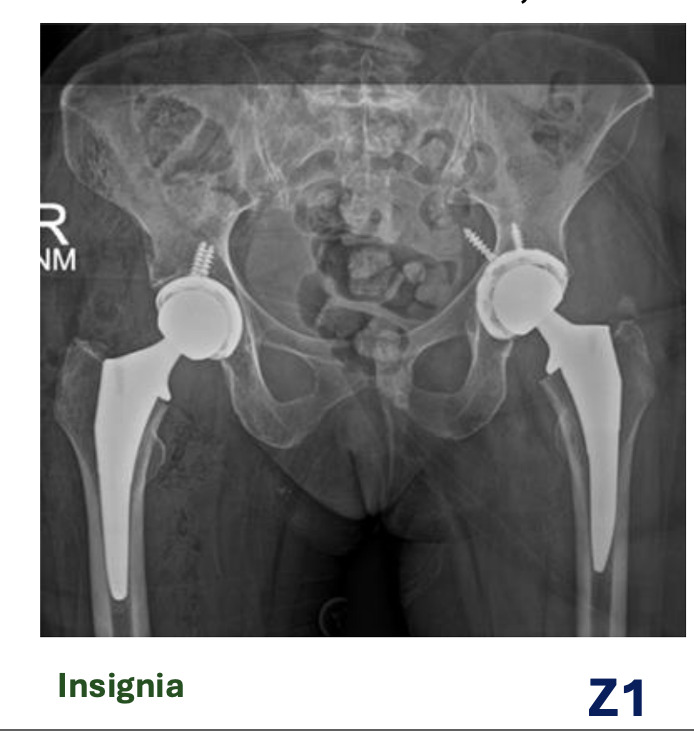
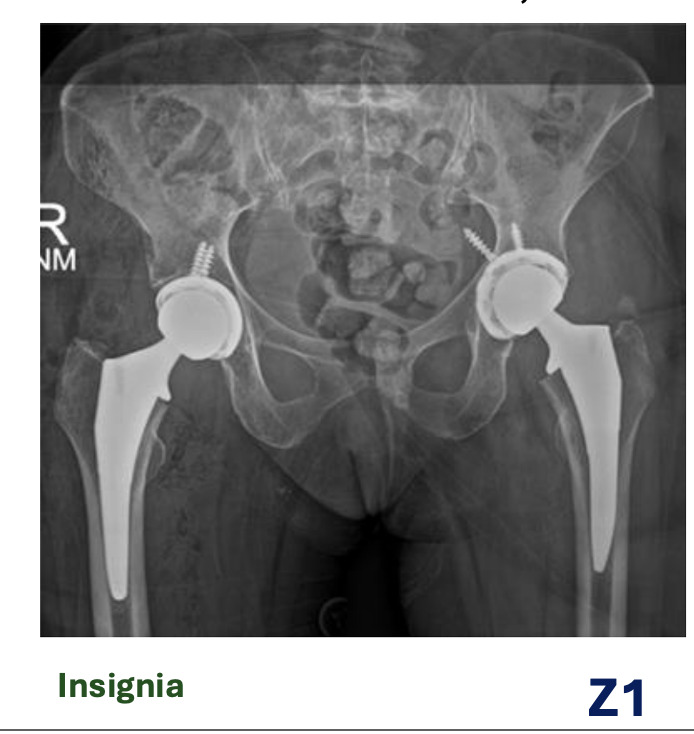
The collar also scales with stem size—approximately 5 to 7 mm across the sizes reviewed—and its design improves anteroposterior contact without creating excessive medial overhang. I see this as a practical advantage: the collar can engage the anterior or posterior calcar where bone is adequate, while reducing the potential for prominent medial metal to irritate the iliopsoas. Figure 1 illustrates how proximal stem anatomy, adequate calcar seating, and avoidance of distal potting work together to optimize uncemented fixation.
Actis: constant medially engaging collar with symmetric distal growth
The Actis uses a constant approximately 8-mm medial collar across sizes. A broad collar can provide substantial calcar contact and initial support, but it also requires attention to medial overhang. Excessive prominence has been associated with concern for iliopsoas irritation. In my hands, the Actis also feels to grow more distally with each size, which can lead to earlier diaphyseal engagement and a proud stem in certain anatomies without allowing its proximal anatomy to engage the anteroposterior metaphyseal bone.
I do not consider a proud stem automatically to be a failed stem. Biomechanical work from our laboratory suggests that a triple-tapered collared stem that is slightly proud in neutral or modest varus may not overload the bone in the way surgeons once feared. I am more concerned about valgus, which can increase immediate femoral stresses and leave the collar disengaged.
Z1: constant collar, symmetric growth, and rectangular proximal fit
The Z1 uses a constant approximately 5-mm collar. Its shorter medial reach may reduce the likelihood of overhang but sometimes, the collar can fall short of reaching the calcar if orientation and anatomy are not favorable. My usage led me to consider varus placement of the stem to allow for improved medial collar seating. I see its proximal shape as more rectangular than trapezoidal, seeking four-quadrant engagement rather than the more pronounced anteroposterior ‘spikes’ of the previous stem.
In my side-by-side assessment, the Z1 also grows more substantially in the distal anteroposterior dimension than the Insignia. If distal engagement occurs too early, surgeon may be unable to increase stem size enough to obtain the desired proximal engagement. Surgeons accustomed to rectangular stems may find that the predictable geometry fits their technique well. Familiarity and disciplined execution remain important components of success.
The distinctions that matter
-
Collar geometry: size-specific versus constant; adequate anteroposterior support versus predominantly medial reach to avoid iliopsoas irritation; reliable calcar contact versus risk of overhang or undershoot.
-
Proximal shape: trapezoidal engagement that emphasizes anteroposterior bone versus a more rectangular four-quadrant fit on other designs.
-
Distal profile: greater distal relief may permit optimized proximal sizing; greater distal growth may produce early potting in selected anatomies prevention proximal supportive contact.
-
Growth across sizes: asymmetric or anatomy-driven growth may preserve clearance where it is needed, whereas symmetric growth is predictable but may create mismatch in some femora.
-
Broach behavior: compression broaching is a bone-preserving preparation strategy and requires a different feel from aggressive in-and-out broaching.
Technique is inseparable from design
A well-designed implant can still be compromised by a technique imported from a different stem philosophy. I emphasize four practical principles for contemporary triple-tapered collared stems.
1. Let the broach compress
Compression broaches are intended to preserve and compact proximal cancellous bone. With the Insignia system, the distal portion cuts a path while the proximal AP portion compresses bone. I advance sequentially to the intended level rather than repeatedly driving the same broach in and out. If progression stops unexpectedly, I step back a size and reassess instead of forcing the construct.
2. Do not reflexively lateralize
Traditional blade-stem and cemented techniques often emphasized aggressively opening the lateral femur to avoid varus. That instinct can be counterproductive with these triple tapered stems. Their geometry and compression preparation tend to guide them toward neutral or slight varus. Over-lateralization can place the stem in valgus, disengage the collar, and increase femoral stress.
3. Prioritize collar engagement
I want the collar to contribute to the construct. With a size-specific collar, I assess anteroposterior as well as medial contact. With a shorter constant collar, modest varus may sometimes improve calcar engagement. With a broader constant collar, I watch for excessive medial overhang and soft-tissue proximity. My objective is functional contact, not a radiographic ideal applied identically to every design.
4. Respect the orientation envelope
Neutral is desirable, and slight varus appears tolerable for these designs when the collar is engaged. Valgus should be avoided. This is a crucial departure from the idea that every degree of varus is unacceptable: orientation should be judged in the context of the implant’s geometry, its collar, and the pattern of bone contact.
Offset: restore anatomy, do not simply maximize it
Modern stem systems offer standard and high-offset options that can increase lateralization with little or no change in leg length. I value that flexibility when the patient’s anatomy requires it, but I do not believe that more offset is always better. I used high-offset stems in fewer than 10% of the cases in our femur neck fracture series, particularly since moving to an anterior approach.
Excessive offset may exchange one problem for another. Although offset can improve soft-tissue tension and reduce impingement in selected patients, unnecessary lateralization can contribute to persistent lateral hip symptoms, including lateral trochanteric pain. The choice should therefore follow reconstruction of the individual patient’s anatomy, not a habitual preference for the lateralized option.
Can stem design make outcomes more reproducible?
One of the most consequential promises of these stems is not that an expert surgeon can obtain an excellent result, but that a thoughtful design may help a lower-volume arthroplasty surgeon achieve a safer and more reproducible construct. At my institution, my colleagues, who perform high volumes of femoral neck fracture surgery—adopted triple-tapered collared stems after previously moving away from blade stems and toward cement. They have told me that the design has changed their practice and made cementless fixation in fragile bone more manageable.
That does not make technique irrelevant, and it does not rescue indiscriminate stem selection. Poor cementation can lead to a difficult loose-stem revision; an older cementless design placed in deficient bone can predispose to fracture; and a modern stem implanted in valgus or without collar support can still fail. Reproducibility comes from aligning implant design, bone morphology, preparation method, and surgical execution.
A more useful fixation algorithm
In young patients with robust Dorr A bone, many stem designs will perform well in experienced hands. The decision becomes more demanding as the femur transitions through Dorr B and into Dorr C morphology. Here, surgeons should move beyond the broad label of ‘cementless’ and examine how a particular implant achieves fixation.
Cement remains an excellent choice when it is indicated and when the surgical team is proficient in contemporary cementing technique. But when cementless fixation is selected in compromised bone, a modern triple-tapered collared stem should be considered on its specific merits: Can it gain anteroposterior metaphyseal support? Will its distal body allow full proximal sizing? Does the collar match the calcar without excessive medial overhang? Does the broach preserve the bone needed for fixation? And can the surgeon consistently implant it in neutral or slight varus while avoiding valgus?
The next comparison
The cement debate has been shaped by studies in which cemented stems were compared with heterogeneous cementless designs, many of them created around older fixation concepts. The next generation of evidence should compare well-executed cementation or even French paradox techniques directly with contemporary triple-tapered collared stems, stratified by bone morphology, surgical approach, stem geometry, and surgeon experience.
Until those data mature, it is reasonable to conclude that triple-tapered stems are not interchangeable. All may perform well, but their collars, proximal shapes, distal dimensions, size progression, and preparation systems create different intraoperative behaviors. Those differences are small on the table and large inside a compromised femur.
Bottom line Triple-tapered collared stems have expanded the range of femora that can be treated confidently without cement. Their value, however, lies in the details. The best stem is not the one with the most tapers or the largest collar; it is the one whose geometry matches the patient’s bone and whose technique the surgeon understands well enough to reproduce.