
Loading [Contrib]/a11y/accessibility-menu.js

This website uses cookies

We use cookies to enhance your experience and support COUNTER Metrics for transparent reporting of readership statistics. Cookie data is not sold to third parties or used for marketing purposes.

Skip to main content
null
J Orthopaedic Experience & Innovation
  • Menu
  • Articles
    • Brief Report
    • Case Report
    • Case Series
    • Conference Proceedings
    • Data Paper
    • Editorial
    • Meeting Reports/Abstracts
    • Methods Article
    • Product Review
    • Research Article
    • Review Article
    • Review Articles
    • Systematic Review
    • All
  • For Authors
  • Editorial Board
  • About
  • Issues
  • Blog
  • "Open Mic" Topic Sessions
  • Advertisers
  • Recorded Content
  • CME
  • JOEI KOL Connect
  • Resident Research League
  • search
  • RSS feed (opens a modal with a link to feed)

RSS Feed

Enter the URL below into your favorite RSS reader.

https://journaloei.scholasticahq.com/feed
ISSN 2691-6541
Research Article
Vol. 6, Issue 1, 2025May 18, 2025 EDT

Retained bioburden does not pose contamination risk after a full sterile processing cycle

Aaron Leininger, DO, Brian McGrath, MD, Sridhar Rachala, MD, Matthew Phillips, MD, Andrew Stegemann, DO, Mary Bayers-Thering, MS,
bioburdensterile processinginfectionprosthetic joint infection
Copyright Logoccby-nc-nd-4.0 • https://doi.org/10.60118/001c.133635

Articles in Vol. 6, Issue 1, 2025

Vol. 6, Issue 1, 2025
  • “In My Experience.. Innovations in Reverse Shoulder Arthroplasty: The Roles of The Greater Tuberosity and Deltoid”
    Howard Routman, MD
  • “In My Experience…Perisurgical Nutrition”
    Patrick Denard
  • Assessing Concordance in Post-operative Knee Implant Position Analysis Between Automated Image Analysis Algorithm and Human Radiologists
    Arman MoteshareiKevin de SouzaBenjamin HarderRegis Pailhe
  • Diabetes and Untoward Outcomes after ACL Reconstruction
    Dennis SieversHeather A. PrenticeJoanie ChungAnna DavisGregory B. MaletisRonald A. Navarro
  • Association between Social Media Activity and Patient Ratings in Sports Medicine Surgeons
    Payton Yerke HansenAustin Wendell HansenChance ParkerAnna ReddenBenjamin LackAtharva RohatgiAjay DesaiGarrett R. JacksonVani J. Sabesan
  • Artificial Intelligence Large Language Models Are Nearly Equivalent to Fourth-Year Orthopaedic Residents on the Orthopaedic In-Training Examination: A Cause for Concern or Excitement?
    Ashraf NawariJamal ZahirSonal KumarLovingly OcampoOlivia OparaHassan AhmadBenjamin CrawfordBrian Feeley
  • Collagen Co-Braids Demonstrate Equivalent or Superior Physical Properties to Conventional Orthopedic Sutures
    Kyle ChristensenRohith NairRiya PalikondaVictoria StagnaroAmanda CareyAndrew HowellNardos SoriAmrita DasguptaYas Maghdouri-WhiteKevin BonnerGregory DiFeliceNicholas SgaglioneMatthew Havener
  • Exploring 3D Modeling for Enhanced Visualization and Analysis of Pediatric Pelvic Ring Fractures: A Pilot Study
    Sarah Rose PurtellJayme GoodrumRuby MartiniJulia Sanders
  • Integration of Data Across the Episode of Care via a Robotic Knee System, Implanted Tibial Sensor, and Smartphone-based Care Management Platform: A Case Study
    Derek S. YocumRoberta E RedfernJeffrey D. Yergler
  • “In My Experience…The Perplexing Problem of Distal Clavicle Fractures"
    Ronald A. Navarro,, MD
  • Resolution of Fixed Flexion Contracture Following Kinematically Aligned Manual Total Knee Arthroplasty Without Raising the Joint Line
    Whisper GraysonCarlo EikaniNicholas M Brown
  • "In My Experience...Passing Part 1 and Part 2 of the Orthopaedic Boards"
    Bruce Gomberg
  • Reconstruction of chronic acromioclavicular dislocation with subacromial hook plate and reinforced collagen implant: A surgical technique with histological evaluation
    Gregory ColbathEmily GermanWolfgang SchwartzmanJeremy MercuriAmit MomayaSpero KarasStephan PillCooper Stone
  • Immersive Virtual Reality Training for a Junior Orthopaedic Surgery Resident
    Andres D MaesoMichael R McDermottJerrod A Steimle
  • Atraumatic myositis ossificans of the clavicle mimicking malignancy in a paediatric patient: a rare case report & review of literature.
    Darren Hong Wen LimArjandas MahadevMohammad Ashik Bin ZainuddinKenneth Pak Leung Wong
  • “In My Experience…The Arthroscopic Journey of a Lifetime"
    Felix “Buddy” Savoie, MD
  • Opioid Prescription Practices Among Orthopedic Surgeons: An Analysis of the Medicare Part D Database from 2013-2021
    Nithin GuptaNikhil GodboleElliss WahlbergUdit DaveMorgan TurnowHunter PharisTaylor ManesTyler WilliamsonJignesh Patel
  • Early Experience in Collateral Ligament Repair of the Hand with the use of a Novel Bio-Composite Scaffold: Technique and Outcomes
    Devin C PotterZachary HansonGary M Lourie
  • Preoperative Serum Inflammation Markers Should be Routinely Assessed in Patients Undergoing Primary Total Knee Arthroplasty
    Robert Branstetter IVTara KorbalClaudia LeonardiAdam HaydelAmy BronstoneVinod Dasa
  • Adductor Canal Blocks May Result in Long-Term Neuropathy After Total Knee Arthroplasty
    Jade Pei Yuik HoDavid LiuKarolina KantMichael Facek
  • Adoption of a total knee arthroplasty (TKA) multimodal post-operative swelling intervention protocol shows significant reduction in single-frequency bioimpedance (SF-BIA) values: a pilot study
    Andrew WicklineWindy ColeLouis BattistaJacob WielgomasRichard SouthgateSuzanne Ehmann
  • Exploring the Boundaries of AI: ChatGPT’s Accuracy in Anatomical Image Generation & Bone Identification of the Foot
    Simran ShamithNeshal K. KothariSerena K. KothariCarolyn Giordano
  • #Orthopedicsurgery: Analyzing Orthopedic Surgical Content on TikTok
    Hannah I. TraversKiara ThompsonObinna AjahAdam Bitterman
  • Wireless Suture Button Accessory Sensor for Intra- and Post-Operative Monitoring of Suture Loading in Soft Tissue Reconstruction
    Salil S KaripottKaylee MeyersStephen LaffoonMichael McGeehanSamuel AdamsJonathan RibohNicholas StrasserKen GallRobert GuldbergKeat Ghee Ong
  • Ice, Ice, Baby: Cyroneurolysis as a Novel Approach to Facet-mediated Chronic Lower Back Pain, a Case Study
    Clay GuynnSam Bogess, DO
  • Opportunities for Remote Surgeon-to-Surgeon Education : A Novel Use Case for Immersive Virtual Reality
    Danny GoelOmar RahmanDerek OchiaiGeorge AthwalJoaquin Sanchez-SoteloScott SigmanShariff K. BishaiJon WarnerPhil WilliamsRyan LohreLaurie Hiemstra
  • Speed Mentoring: An Innovative Method in Orthopedic Surgery Mentorship
    Papa Abdoulaye DiackLisa K Cannada
  • The Association Between Diagnosed Cannabis Use Disorder and Post-Operative Outcomes in Lower Extremity Trauma Patients: A Retrospective Database Review
    Cole VelikyErum Mir GhaziHania ShahzadYamenah AmbreenEdward BoyerCarmen Quatman
  • Evaluation of Anteroposterior Diameter and Interpedicular Distance for Approximating Spinal Canal Area in Patients with Cervical Central Canal Stenosis- a Computed Tomography Based Study.
    Zachary BrandtKai NguyenIsaac OverfieldPaddington MbumbgwaMark OliinikRohan KubbaJacob RazzoukCarson CummingsDavid ShinJoel D. CarsonOlumide DanisaWayne Cheng
  • Artelon Graft Augmentation in Revision Anterior Cruciate Ligament Reconstruction: A Case Report
    Taylor J ManesMorgan TurnowAnthony PeruginiJohn PeabodyBenjamin C. TaylorJoaquin CastanedaLogan Bushnell
  • Yes We Can! Reducing the Burden of Proximal Humerus Fractures
    Sarah EdwardsHeidi A. IsraelLisa CannadaPaul A. Anderson
  • Open Tibial Shaft Fracture Related Infections: Review of Presentation, Diagnosis, and Treatment
    Michael AndersonDaniel DeGenovaAnthony PeruginiVishvam MehtaPeter SpencerAllison TaylorJolie PylesBen Taylor
  • Environmental Impact of the American Board of Orthopaedic Surgery All-in-person Oral Board Examination
    Emily B. ParkerTenney A. BlumanAlexander HigginsJeremy T. SmithEric M. Bluman
  • Continuation of a Currently Available Primary Total Knee Arthroplasty System Design: 10-Year Follow-Up of Earlier Studies at 2- and 5-Years
    Sridhar DurbhakulaLaura RegoRobert W. Eberle
  • A Novel Percutaneous Device Enabling both Local Anesthetic Delivery and Electrical Stimulation (Neuromodulation) of Peripheral Nerves for Pain Following Orthopaedic Surgery: An Initial Feasibility Technical Report
    Brian M IlfeldSanjay K. SinhaBryan LeekBaharin AbdullahJohn J. Finneran
  • "In My Experience...From the Shadow of Giants, My Journey Through the World of Knee Arthroplasty"
    Giles Scuderi, MD
  • Frequency of Weight Loss Instruction Provision to Patients with Obesity and Hip or Knee Osteoarthritis: A Case-Series
    Benjamin W WongBrian Q HouAlicia HymelWilliam L HollabaughJacquelyn S PenningsSahar K TakkoucheLeon R Scott
  • "In My Experience…The Bugs Stop Here: My Journey Fighting Periprosthetic Joint Infection"
    Jon Minter, MD
  • Prior Ipsilateral Steroid Injections Do Not Compromise Postoperative Outcomes or Increase Risk for Postoperative Complications or Revisions Surgery After Arthroscopic Rotator Cuff Repair
    Vani SabesanAnna ReddenSarah GirshfeldWilliam PallisseryBrandon MacknofskyClyde FomunungGarrett R. JacksonHoward Routman
  • Quality of ChatGPT Responses to Common Patient Questions on Dupuytren Contracture
    Katelyn KaneTaylor RakauskasEmma EngJustin XieSamantha L. ReissPayton Yerke Hansen
  • Utilization of Video-Based Recruitment of Medical Students is Associated with Larger Program Size and Higher Academic Ranking Among Orthopedic Residency Programs
    Benjamin T LackJustin T ChildersAshwin R. GarlapatyGarrett R JacksonConor A. SmithBrett Crist
  • Sex Differences and Publication Rate at Top-Ranked U.S. Orthopaedic Surgery Residency Programs
    Erin L. BrownEli H. TsakirisMia V. RumpsMary Mulcahey
  • Preoperative Joints Education Class Decreases Length of Stay after Total Knee Arthroplasty
    Ali MehaidliNoah HodsonTahsin RahmanMary HennekesPhillip C. McKeggCraig Silverton
  • "In My Experience…Optimizing Medical Education with Human Connection"
    Hafiz F. Kassam, MD
  • Retained bioburden does not pose contamination risk after a full sterile processing cycle
    Aaron LeiningerBrian McGrathSridhar RachalaMatthew PhillipsAndrew StegemannMary Bayers-Thering
  • "In My Experience...Tommy John Surgery- It's evolution, current status, and future"
    Kevin Farmer, MD
  • Optimizing Total Knee Arthroplasty Surgical Wound Healing utilizing a Non-Powered, Negative Pressure Wound Therapy Dressing: First 100 Consecutive Cases in an Outpatient Setting
    Asit ShahRobert W. Eberle
J Orthopaedic Experience & Innovation
Leininger, Aaron, Brian McGrath, Sridhar Rachala, Matthew Phillips, Andrew Stegemann, and Mary Bayers-Thering. 2025. “Retained Bioburden Does Not Pose Contamination Risk after a Full Sterile Processing Cycle.” Journal of Orthopaedic Experience & Innovation 6 (1). https://doi.org/10.60118/001c.133635.
Save article as...▾
Download all (5)
  • Download
  • Download
  • Download
  • Download
  • Download

Error

Sorry, something went wrong. Please try again.

If this problem reoccurs, please contact Scholastica Support

Error message:

undefined

View more stats

Abstract

Introduction

After sterile processing, orthopedic instrument trays are occasionally found to have retained bone from prior procedures. This study aims to assess the effect on heavily contaminated bioburden, adjacent tray, and instrument contamination risk of a standard medical facility sterile processing cycle for orthopedic instruments.

Methods

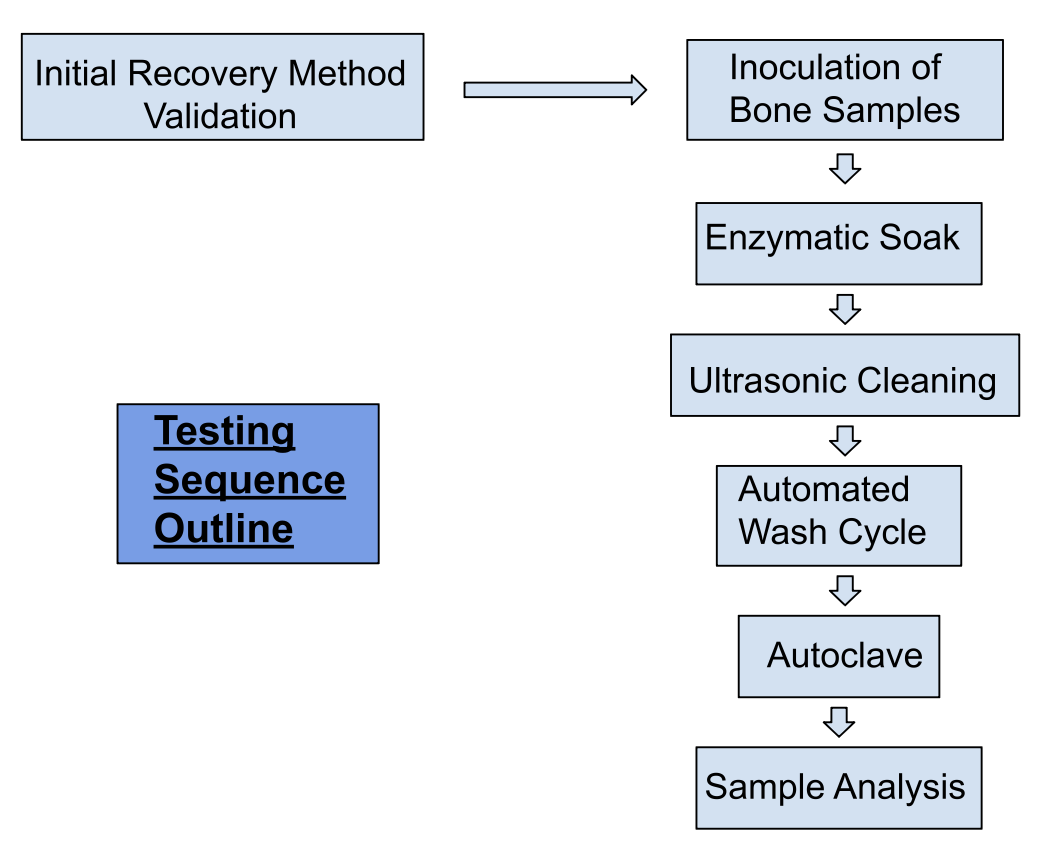
Porcine bone was placed in a wire mesh basket and inoculated with Geobacillus Stearotherophilus (G. stearothermophilus). This was then processed in the standard manner at our medical center, placed into unwrapped trays, and then into a multi-tray sterilization container (Turbett Sterilization Pod) for autoclave sterilization. The study was conducted at a private laboratory specializing in certification of sterile processing, Highpower ValidationTesting and Lab Services, Rochester ,N.Y.(Highpower).The steps of processing included an initial soak, ultrasonic cleaning, rinse, automated wash cycle, and steam sterilization. Following this, all test samples were placed into culture medium and incubated for seven days.

Results

There were no positive test samples following completion of the standard sterile processing steps. These included 36 samples of inoculated bone, 72 samples of simulated adjacent instruments, and 36 spore indicator strips.

Conclusions

This is the first investigation to the authors knowledge that examines bone bioburden in the context of a standard full sterile processing sequence. Similar prior studies have focused on the autoclave only efficacy. This study suggests that bone bioburden that has been through the full sequence of sterile processing is not contaminated and does not cross contaminate adjacent instruments or trays. The methodology used most closely replicated the scenario of freely exposed bone bioburden.

Introduction

The presence of bone bioburden following sterile processing presents a scenario where there is uncertainty regarding sterility of adjacent instruments and trays. Theoretically, all instruments processed within the autoclave itself are at risk due to the circulation of steam during the cycle. The use of a multi tray pod allowed a controlled method of assessing adjacent instrument contamination in the presence of post processing bone bioburden.

Prior studies have investigated the sterility of bioburden that has been processed using an autoclave only process (Resendiz et al. 2020; Smith et al. 2018; Mayer et al. 2016). This is the first study to the authors’ knowledge that investigates bone bioburden in the context of the standard steps used at most medical centers for the processing of orthopedic instruments. The goal was to replicate a real world scenario where each step of the sterile processing has been performed in accordance with standard guidelines (ANSI/AAMI ST79:2017/(R)2022, n.d.). We chose G. stearothermophilus as the contaminating organism due to its thermophilic nature and spore forming properties. This represents a worst case organism and is the species generally chosen for validation and certification of sterile processing systems (ANSI/AAMI ST79:2017/(R)2022, n.d.; ANSI/AAMI/ISO 14937:2009/(R)2013, n.d.; AAMI TIR39:2009/(R)2017, n.d.). The addition of multi-tray processing during this testing allowed for a thorough assessment of adjacent instrument and tray contamination. These are in use currently throughout various medical centers in the United States and the authors institution since 2016. The appeal of the multi tray processing pod is the ability to reduce waste, reduce processing man hours, and reduce turn over time (Bradley et al. 2021). One concern regarding multi-tray processing is the limited experimental data regarding bioburden and adjacent instrument contamination risk. This study was structured by practicing academic orthopedic surgeons and the testing performed at a private laboratory specializing in sterile processing certification.

Methodology

An initial validation was performed using porcine bone and commercially available G. stearothermophilus. A mixture of cortical and cancellous porcine bone was inoculated and 1x10^6 Colony forming units were verified to be recovered using the below listed culture and indicator testing methods (ANSI/AAMI/ISO 11138-7:2019, n.d.). The approximate size of the bone was 4-6 mm in size. The initial validation was to ensure that an appropriate recovery method was selected for the porous and irregular surface of the bone.

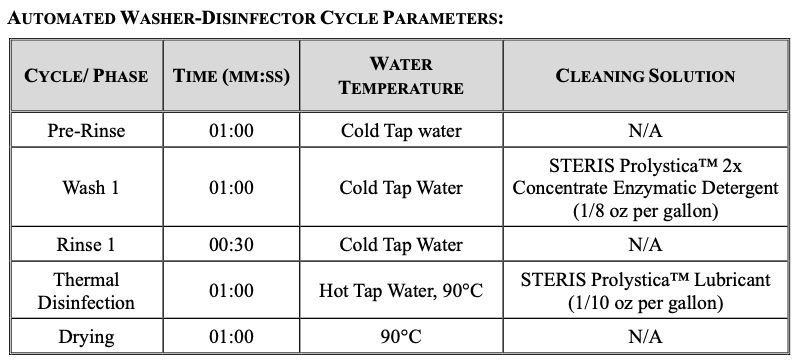
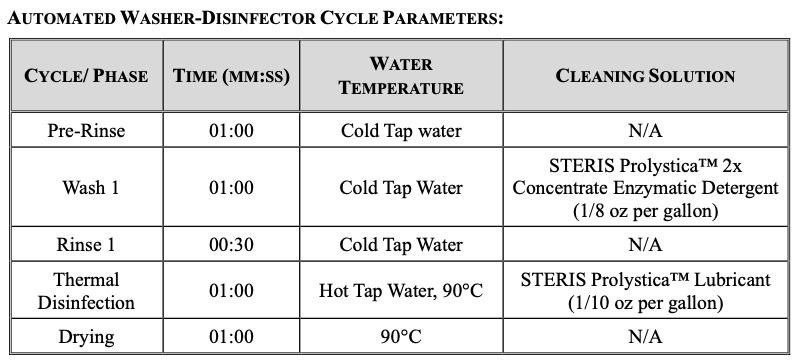
Three cycles of testing were performed in total. Each cycle consisted of twelve porcine bone test samples that were placed into wire mesh stainless-steel tea strainers, one bone sample per strainer. Each sample was inoculated with the commercially available G. stearothermophilus. The stainless steel strainers were used to ensure the bioburden remained present throughout the testing process. The inoculated bone remained within the strainers for the entirety of the test procedure until transferred to culture media. The instrument trays were processed containing the bone test samples in a standard manner which followed the healthcare sterile processing standards at our academic medical center. The trays and bone test samples were immersed into Prolystica™ Enzymatic cleaning solution and they were allowed to soak for five minutes at 30-35°C. The samples were then placed into an ultrasonic cleaner with the same preparation of Prolystica™ solution and sonicated for ten minutes. The bone samples were rinsed under warm running tap water for one minute to remove the residual detergent and dried with compressed air. The cycle tapes were inspected to verify that the parameters were met per the washer disinfector cycle listed.
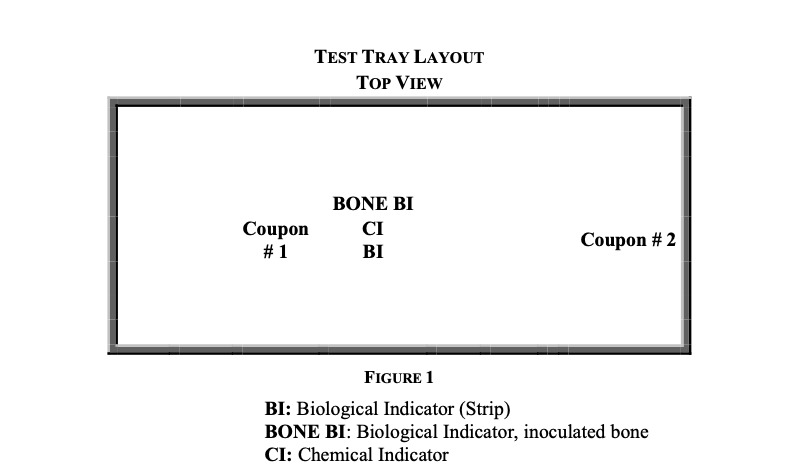
TEST TRAY LOADING CONFIGURATION

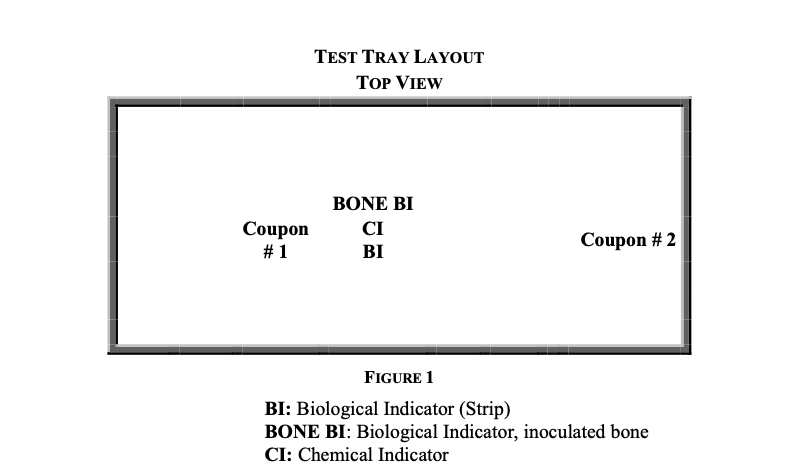
Twelve perforated sterilization trays were obtained and loaded with medical and simulated medical devices to have a combined minimum tray and instrument weight of twenty-five pounds. The washed and dried bone test samples remained in the strainers and were placed in the center of the test trays with a chemical indicator. Two stainless-steel coupons were placed in each tray. The coupons are rectangular stainless steel plates used to simulate a medical instrument with a large surface area and are commonly used in certification procedures for sterile processing (ANSI/AAMI/ISO 14937:2009/(R)2013, n.d.). One coupon was placed adjacent to the inoculated bone test samples and the other coupon located at the edge of the tray, Fig. 1.
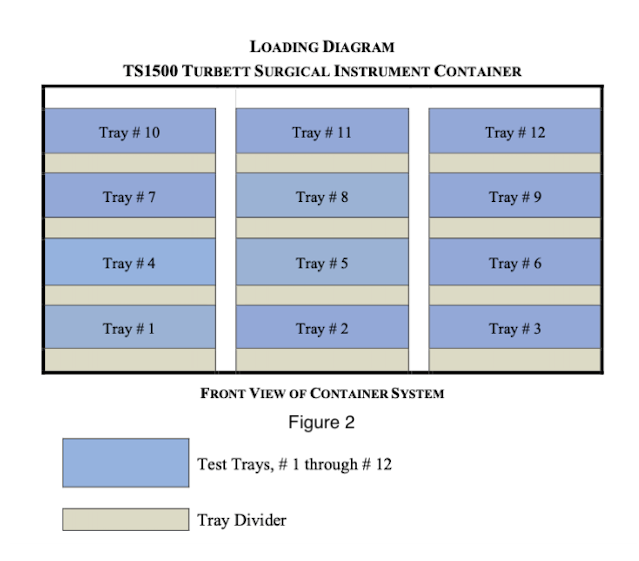
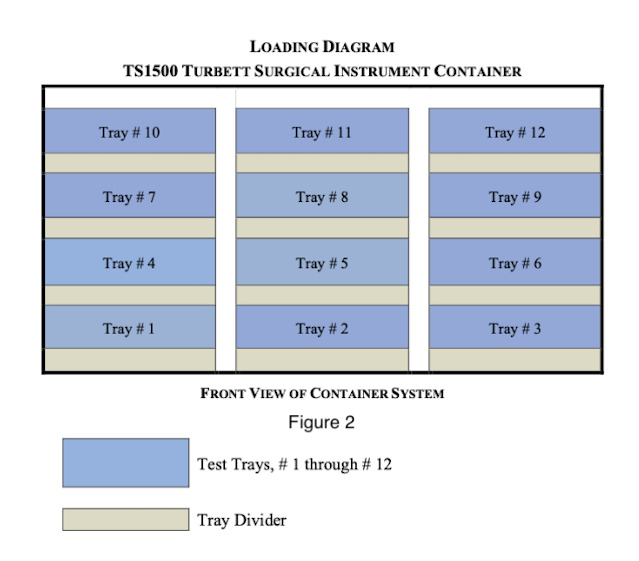
The multi-tray sterilization pod was manufactured by Turbett Surgical. The exact model used for testing was the TS1500 Instrument Pod and is approximately 34x22x24 inches in size. Each processing pod is designed to hold twelve trays without wrapping. Tray dividers were positioned within the base of the Instrument Pod and between each level of trays until all twelve trays were loaded into the instrument pod. The trays were unwrapped and an outer screen to serve as a filter was used as per the manufacturer recommendations. See the below listed diagram for orientation, Fig. 2.
The pod was pushed into the sterilizer until it was over the drain. The drain has been identified as the coldest location within the sterilizer chamber as determined by the sterilizer manufacturer. The pod was processed using the steam pre-vacuum sterilization cycle listed below and in accordance with ANSI/AAMI/ISO 14937:2009/(R)2013 and ANSI/AAMI ST79:2017/(R)2022. Following cycle completion, the pod was removed from the sterilizer and the pod was moved into the laminar flow hood room.The sterilizer cycle tape was reviewed to verify the cycle parameters were achieved.

TRANSFER PROCEDURE

The proper sterility testing attire was donned, including sterile gloves, hair covers, surgical masks, and gowns before proceeding. The entire transfer procedure was performed utilizing aseptic technique. An environmental control was established by uncapping and exposing one vessel of culture media within the laminar flow hood for the duration of the transfer period. The test trays were removed into the pre-cleaned laminar flow hood. The bone test samples and coupons were transferred to separate, individually labeled, vessels of culture media. The chemical integrator was observed for steam penetration. A positive control was established by inoculating media from the batch used in testing with an un-cleaned and un-sterilized bone test sample. An additional positive control was established for the lot of spore strips used in testing. The bone test samples, coupons, and controls were incubated at 55-60°C for a minimum of seven days. A total of 3 test cycles were performed and the test results listed in the table below, Table 1. There were no positive test samples and therefore no Gram-stain was required. The above testing was done in accordance with ANSI/AAMI/ISO 11138-7:2019.

RESULTS

The biological indicator, inoculated bone, spore strips, and coupons were negative for growth of the target organism (G. stearothermophilus) following the minimum incubation period of seven days ANSI/AAMI/ISO 11138-7:2019. The positive controls were positive for growth of the target organism (G. stearothermophilus) following the minimum incubation period of seven days. The negative and environmental controls were negative for growth of the target organism (G. stearothermophilus) following the minimum incubation period of seven days. The chemical integrator demonstrated steam penetration with an acceptable color change of white to blue into the “safe” zone of the indicator. The washer-disinfector and steam sterilizer cycle tapes were verified and showed that the appropriate parameters listed above were achieved.

TESTING RESULTS

Table 1.
Tray # Sample ID Results Cycle 1 Results Cycle 2 Results Cycle 3
1, 2, 3, 4, 5, 6, 7, 8, 9, 10, 11, 12
(36 samples of bone, 72 coupons, and 36 spore indicator strips)
Bone N N N
Strip N N N
Coupon 1 N N N
Coupon 2 N N N
Environmental Control N N N
Negative Control N N N
Negative Verification P P P
Positive Control- Spore Strip P P P
Positive Control -Inoculated Bone P P P

N = Negative for Growth P = Positive for Growth

Discussion

Sterile processing of instruments continues to be a complex environment due to the nature of instruments processed (Lopes et al. 2019), and variations in manufacturer recommendations as required by ANSI/AAMI/ISO 17664-1:2022 and AAMI TIR12:2020. These instrument specific requirements rely heavily on the individual departments’ interpretation of the various manufacturer recommendations (Brooks, Williams, and Gorbenko 2019). This results in considerable variation in methods for meeting the standards required by ANSI/AAMI/ISO.

Prior reports of focused sterile processing department standardization and validation have shown positive results in reducing surgical delays and improving overall efficiency (Huynh et al. 2019; Cichos et al. 2019). Ideally, automation of the validation process would reduce error further and provide objective evidence of sterilization steps. This then brings the possibility of implementing policies that reflect the actual risk of bioburden presence after full processing through the use of a validation protocol. A reduction in reprocessing, surgical delay, and increased surgical times would have dramatic monetary effects and potentially reduced postoperative complications. Concerns about bioburden after sterile processing are warranted given the dramatic effect that hospital acquired infections have on patients and the healthcare system (Marchetti and Rossiter 2013). One study performed a random inspection of depth gauges after sterile processing at their trauma center. Alarmingly, greater than ninety percent of the instruments inspected contained visible bioburden (Wanke et al. 2018). Delays in surgical procedures, increased surgical times, and reprocessing are a burdensome part of contemporary practice. In a study that looked at surgical procedure stoppage immediately before incision they found that over fifty percent were a result of supply and instrument management (Coudane et al. 2018). Bone bioburden presence after sterile processing represents an area for systems improvement and requires further analysis to build policies that improve safe and effective surgical care. It should also be emphasized that regardless of the results of this study, the removal of bone bioburden from instruments during processing should still be undertaken as routine practice. Our study suggests that reprocessing of entire autoclave cycles or multi tray pods is likely to not be necessary in the presence of visible bone.

The study was conducted at a research facility that performs certification and validation testing. Reproduction of this study design in various settings would be helpful to generalize the overall risk profile of bone bioburden. All efforts were made to create as much of a real world scenario in the highly controlled laboratory setting. Additionally, the highly controlled laboratory setting poses a potential limitation when compared to real world sterile processing departments.

Conclusions

This is the first investigation to the authors’ knowledge that examines bone bioburden in the context of a standard full sterile processing sequence. Similar prior studies have focused on the autoclave only efficacy. This study suggests that bone bioburden that has been through the full sequence of sterile processing is not contaminated and does not cross contaminate adjacent instruments or trays. The methodology used most closely replicated the scenario of freely exposed bone bioburden. Future studies to evaluate the effectiveness of a standard sterilization process on bioburden entrapped in cannulated instruments are necessary.

Submitted: January 13, 2025 EDT

Accepted: March 26, 2025 EDT

References

AAMI TIR39:2009/(R)2017. n.d. “Guidance on Selecting a Microbial Challenge and Inoculation Sites for Sterilization Validation of Medical Devices.” https:/​/​doi.org/​10.2345/​9781570203633.ch1.
ANSI/AAMI ST79:2017/(R)2022. n.d. “Comprehensive Guide to Steam Sterilization and Sterility Assurance in Health Care Facilities.” https:/​/​doi.org/​10.2345/​9781570208027.ch3.
ANSI/AAMI/ISO 11138-7:2019. n.d. “Sterilization of Health Care Products—Biological Indicators—Part 7: Guidance for the Selection, Use and Interpretation of Results.” https:/​/​doi.org/​10.2345/​9781570207327.
ANSI/AAMI/ISO 14937:2009/(R)2013. n.d. “Sterilization of Health Care Products — General Requirements for Characterization of a Sterilizing Agent and the Development, Validation and Routine Control of a Sterilization Process for Medical Devices.” https:/​/​doi.org/​10.2345/​9781570203695.
Bradley, D. F., K. Romito, J. Dockery, L. Taylor, N. ONeel, J. Rodriguez, and L. A. Talbot. 2021. “Reducing Setup and Turnover Times in the or with an Innovative Sterilization Container: Implications for the COVID-19 ERA Military Medicine.” Military Medicine 186 (Supplement_2): 35–39. https:/​/​doi.org/​10.1093/​milmed/​usab214.
Google Scholar
Brooks, J. V., J. A. R. Williams, and K. Gorbenko. 2019. “The Work of Sterile Processing Departments: An Exploratory Study Using Qualitative Interviews and a Quantitative Process Database.” American Journal of Infection Control 47 (7): 816–21. https:/​/​doi.org/​10.1016/​j.ajic.2018.12.010.
Google Scholar
Cichos, K. H., Z. B. Hyde, S. E. Mabry, E. S. Ghanem, E. W. Brabston, L. W. Hayes, G. McGwin, and B. A. Ponce. 2019. “Optimization of Orthopedic Surgical Instrument Trays: Lean Principles to Reduce Fixed Operating Room Expenses.” The Journal of Arthroplasty 34 (12): 2834–40. https:/​/​doi.org/​10.1016/​j.arth.2019.07.040.
Google Scholar
Coudane, H., E. Benfrech, C. Lecoq, L. Zabee, P. Tracol, J. L. Danan, P. Y. Bruno, and J. Lighezzolo Alnot. 2018. “No-Go Decision: A Newly Identified Adverse Event in Orthopaedic Surgery – Causes and Medico-Legal Implications.” Orthopaedics & Traumatology: Surgery & Research 104 (4): 519–22. https:/​/​doi.org/​10.1016/​j.otsr.2018.03.007.
Google Scholar
Huynh, E., S. Klouche, C. Martinet, F. Le Mercier, T. Bauer, and A. Lecoeur. 2019. “Can the Number of Surgery Delays and Postponements Due to Unavailable Instrumentation Be Reduced? Evaluating the Benefits of Enhanced Collaboration between the Sterilization and Orthopedic Surgery Units.” Orthopaedics & Traumatology: Surgery & Research 105 (3): 563–68. https:/​/​doi.org/​10.1016/​j.otsr.2019.01.012.
Google Scholar
Lopes, L. K. O., D. M. Costa, A. F. V. Tipple, E. Watanabe, R. B. Castillo, H. Hu, A. K. Deva, and K. Vickery. 2019. “Complex Design of Surgical Instruments as Barrier for Cleaning Effectiveness, Favouring Biofilm Formation.” Journal of Hospital Infection 103 (1). https:/​/​doi.org/​10.1016/​j.jhin.2018.11.001.
Google Scholar
Marchetti, A., and R. Rossiter. 2013. “Economic Burden of Healthcare-Associated Infection in US Acute Care Hospitals: Societal Perspective.” Journal of Medical Economics 16 (12): 1399–1404. https:/​/​doi.org/​10.3111/​13696998.2013.842922.
Google Scholar
Mayer, R. R., S. S. Bederman, V. M. Colin, M. M. Berger, T. C. Cesario, and R. Schwarzkopf. 2016. “Risk of Contamination in Assembled vs Disassembled Instruments in Hip Arthroplasty Surgery.” The Journal of Arthroplasty 31 (8): 1746–49. https:/​/​doi.org/​10.1016/​j.arth.2016.02.004.
Google Scholar
Resendiz, M., T. S. Horseman, A. J. Hover, D. F. Bradley, M. B. Lustik, and G. F. West. 2020. “Assessment of Surgical Instrument Bioburden after Steam Sterilization: A Pilot Study.” American Journal of Infection Control 48 (2): 219–21. https:/​/​doi.org/​10.1016/​j.ajic.2019.08.018.
Google Scholar
Smith, K., I. Araoye, S. Gilbert, K. Waites, B. Camins, M. Conklin, and B. Ponce. 2018. “Is Retained Bone Debris in Cannulated Orthopedic Instruments Sterile after Autoclaving?” American Journal of Infection Control 46 (9): 1009–13. https:/​/​doi.org/​10.1016/​j.ajic.2018.02.024.
Google Scholar
Wanke, T. R., J. L. Brock, R. Basile, B. Merk, and J. Azizi. 2018. “Residual Bioburden after Standard Cleaning of the Reusable Orthopedic Depth Gauge.” American Journal of Infection Control 46 (3): 362. https:/​/​doi.org/​10.1016/​j.ajic.2017.10.022.
Google Scholar

Attachments

Powered by Scholastica, the modern academic journal management system