

Loading [Contrib]/a11y/accessibility-menu.js

This website uses cookies

We use cookies to enhance your experience and support COUNTER Metrics for transparent reporting of readership statistics. Cookie data is not sold to third parties or used for marketing purposes.

Skip to main content
null
J Orthopaedic Experience & Innovation
  • Menu
  • Articles
    • Brief Report
    • Case Report
    • Case Series
    • Conference Proceedings
    • Data Paper
    • Editorial
    • Meeting Reports/Abstracts
    • Methods Article
    • Product Review
    • Research Article
    • Review Article
    • Review Articles
    • Systematic Review
    • All
  • For Authors
  • Editorial Board
  • About
  • Issues
  • Blog
  • "Open Mic" Topic Sessions
  • Advertisers
  • Recorded Content
  • CME
  • JOEI KOL Connect
  • Resident Research League
  • search
  • RSS feed (opens a modal with a link to feed)

RSS Feed

Enter the URL below into your favorite RSS reader.

https://journaloei.scholasticahq.com/feed
ISSN 2691-6541
Meeting Reports/Abstracts
Vol. 3, Issue 1, 2022June 11, 2022 EDT

Lack of Demographic Information in The Research Related to Total Joint Arthroplasty

Katelynn Donnelly, MS, Hannah Theriot, John Bourgeois, MPH, Andrew Chapple, PhD, Peter C. Krause, MD, Vinod Dasa, MD,
SDOHracial disparitiesTHATKA
Copyright Logoccby-nc-nd-4.0 • https://doi.org/10.60118/001c.33880

Articles in Vol. 3, Issue 1, 2022

Vol. 3, Issue 1, 2022
  • Comparing economic outcomes and reimbursement trends between primary total knee arthroplasty and unicompartmental knee arthroplasty
    Scott A WuMark A PlantzErik B GerlachPeter R SwiatekKevin D Hardt
  • Opioid Stewardship: Is there a “Better” Opioid
    Scott Sigman
  • An Alternative Wound Class for Orthopedic Surgery is more Strongly Associated with Risk for Postoperative Infection in Total Joint Arthroplasty than the Current Surgical Wound Classification System
    Benjamin WilkePrice SessumsGlenn ShiClaudia LibertinMichael HeckmanDanielle BrushaberCameron Ledford
  • 12 by 12: Obtaining True OR Efficiency with Radical Time Transparency and Operational Excellence
    Charles DeCookJeremy Statton
  • Opioid Sparing Techniques for the Sports Medicine and Shoulder Procedures
    Parth M. KamdarPaul M. Sethi
  • Comparative Analysis of Racial and Gender Diversity in Orthopedic Surgery Applicants and Residents from 2007 and 2019
    Anointing C. OnuohaAustin M. MeadowsMajd T. FarajMadelyn M. SkinnerCharles DayKarthik Ravi
  • Mini-Open Carpal Tunnel Release with a Pediatric Nasal Speculum: A 10-Year Retrospective Case Series
    Brandon LungLauren GrossmanMatthew KimDavid KomatsuJie YangEdward Wang
  • Spread Too Thin: How has the COVID-19 Pandemic Contributed to Burnout Among Academic Orthopaedic Surgeons?
    Nisha N. KaleMichaela A. StammMargaret J HigginsMary Mulcahey
  • Location of Disc Herniation May Affect Outcomes Following Lumbar Decompression
    Kevin C. JacobMadhav R. PatelElliot D.K. ChaConor P. LynchShivam PatelAndrew P. CollinsHanna PawlowskiMichael C. PrabhuNisheka N. VanjaniKern Singh
  • How a VR Surgical Training Company Came About: Osso VR
    Justin BaradRachel Mednick Thompson
  • The Anatomy of an Innovation- Ziptek for Tissue Repair
    William BennettRamses GalazPeter MangoneAaron SchacterMichell Ruiz-Suarez, MD
  • Summary of outcomes of a non-invasive biomechanical therapy for patients with knee osteoarthritis
    Matthew BartelsMichael Suk
  • A Personal Journey through, and review of, the Landscape of Surgical Robotics in Knee Arthroplasty: My Transition from Mako® to NAVIO™ and finally to the ROSA® Knee System
    Jess H. Lonner
  • Multimodal Opioid-sparing Analgesia for Total Knee Arthroplasty: Results from a Retrospective Case Series of 40 Patients
    Amy B. BronstoneClaudia LeonardiJarrod BrownRocio CrabbVinod Dasa
  • Moving From KOLs to DOLs - the changing influence of healthcare providers
    Alok SharanVinod DasaDavid FlickingerScott BullockJustin Martin
  • Aseptic Loosening in Single-Stage Revision Arthroplasty for Periprosthetic Joint Infection
    Kranti PeddadaBrandon WelcomeMitchell C. ParkerConnor M. DelmaChristopher T. HollandMauro GiordaniJohn P. MeehanZachary C. Lum
  • Paget-Schroetter Syndrome: A Case Report of effort induced upper extremity venous thrombosis
    Shariff K. BishaiDavid KnesekFrancisco RodriguezGuy Ball
  • Correct Time, Correct Patient, Correct Surgery
    Bryan T. Kelly
  • Contralateral Prophylactic Pinning for Slipped Capital Femoral Epiphysis: A Delicate Balance Between Slip Prevention and Femoral Morphologic Changes
    Allan K. MetzJoshua B. KlattDevin FroererJenna CheminantStephan K. Aoki
  • Preoperative Optimization Enables Identification of Undiagnosed Diabetics in Elective Orthopedic Surgery
    Brent SandersonAmmer DbeisCory GallDennis HorvathFredrick MenningerDamayea HargettEmily BensonStephan Sweet
  • Avascular Necrosis Leading to Total Hip Arthroplasty: An Incidence and Comorbidity Analysis in a Closed Urban Population
    Timothy ForsterKarina WangClaire BergenJames HongElizabeth LeonElias SchwartzLauren SternOlivia WilsonAustin St. PeterIra H. Kirschenbaum
  • Risk Factors for MCID Drop-Off in Patients Undergoing Anterior Cervical Discectomy and Fusion
    Madhav R. PatelKevin C. JacobAlexander W. ParsonsNisheka N. VanjaniElliot D.K. ChaConor P. LynchMichael C. PrabhuHanna PawlowskiKern Singh
  • Predictors of Early Clinically Significant Improvement Among Lumbar Fusion Patients: A Multivariate Analysis
    Madhav R. PatelKevin C. JacobHanna PawlowskiElliot D.K. ChaConor P. LynchMichael C. PrabhuNisheka N. VanjaniKern Singh
  • The Wireless Arthroscopic Era Begins: Arthroscopy’s Evolution from the Incandescent Era to the Fiber-Optic Era to the Wireless Era
    James S Williams Jr.Asheesh Gupta
  • The Talking Knee Is a Reality: What Your Knee Can Tell You After Total Knee Arthroplasty
    Fred D. CushnerPeter K. SculcoWilliam J. Long
  • Novel Simultaneous Two-Surgeon Approach for Two Level Minimally Invasive Transforaminal Lumbar Interbody Fusion: Application of a Tubular-based Camera
    Jonathan YunPhilip LouieKatie KrauseAlfred Ogden
  • Perception Meets Reality – Self-Reported Health on HCAHPS and Press Ganey Surveys Is Correlated with Validated Health Scores (ASA, CCI) in Orthopaedic Trauma Patients
    Adil S AhmedRyan L KimHarry RamsamoojMichael RobertsKatheryne DownesHassan R Mir
  • Virtual Reality (VR) in Medicine: A Systematic Review of Current Applications of VR and Potential Applications to Pediatric Orthopaedic Surgery
    Jessica KoshinskiNathan ChaclasMichael SukMark Seeley
  • Lumbar Fusion PROMs: Before and After WHO Declared COVID-19 a Pandemic
    Madhav R. PatelKevin C. JacobVivek P. ShahNisheka N. VanjaniHanna PawlowskiMichael C. PrabhuKern Singh
  • Lack of Demographic Information in The Research Related to Total Joint Arthroplasty
    Katelynn DonnellyHannah TheriotJohn BourgeoisAndrew ChapplePeter C. KrauseVinod Dasa
  • Days of Greatness: An Unlikely Journey of Discovery with Dr. Larry Dorr
    Russell J. Bodner
  • Ultrasound-Guided Tenotomy Via a Hydrosurgery Resection Device Improves Symptoms of Chronic Elbow Tendinopathy: A Multi-Center Prospective Study
    Kaylin Strauser-CurtisChristopher P. VaracalloTyler T. VossChad B. StephensReginald W. Kapteyn
J Orthopaedic Experience & Innovation
Donnelly, Katelynn, Hannah Theriot, John Bourgeois, Andrew Chapple, Peter C. Krause, and Vinod Dasa. 2022. “Lack of Demographic Information in The Research Related to Total Joint Arthroplasty.” Journal of Orthopaedic Experience & Innovation 3 (1). https://doi.org/10.60118/001c.33880.
Save article as...▾
Download all (4)
  • Download
  • Download
  • Figure 1. Summaries of Social Determinant Variable Inclusion
    Download
  • Figure 2. Publications by, Year, Journal, and Surgery Type
    Download

Error

Sorry, something went wrong. Please try again.

If this problem reoccurs, please contact Scholastica Support

Error message:

undefined

View more stats

Abstract

Despite research showing how social determinants of health (SDOH) affect orthopedic outcomes, little is known about how many THA and TKA randomized controlled trials (RCTs) actually include SDOH variables such as race, ethnicity, insurance, income, and education.

Click here to learn more about OIC?

The problem

“Despite research showing how social determinants of health (SDOH) affect orthopedic outcomes, little is known about how many THA and TKA randomized controlled trials (RCTs) actually include SDOH variables such as race, ethnicity, insurance, income, and education.”

The approach

“My co-authors and I conducted a PubMed literature review of RCTs published from 2017-2019 in four orthopedic journals: The Journal of Bone and Joint Surgery (JBJS), Journal of Arthroplasty, Clinical Orthopaedics and Related Research (CORR), and Osteoarthritis and Cartilage.”

“Using our inclusion criteria that the study must pertain to either TKAs or THAs and include a patient demographic table, we ended up with 72 publications. We collected data on the publication year, type of surgery, and the inclusion of race, ethnicity, insurance, income, and education in the demographic table or discussion.”

“In addition, we performed an analysis of counts and percentages of SDOH variables by journal year, journal name, and surgery type; Fisher’s exact tests were used for comparison.”

The results

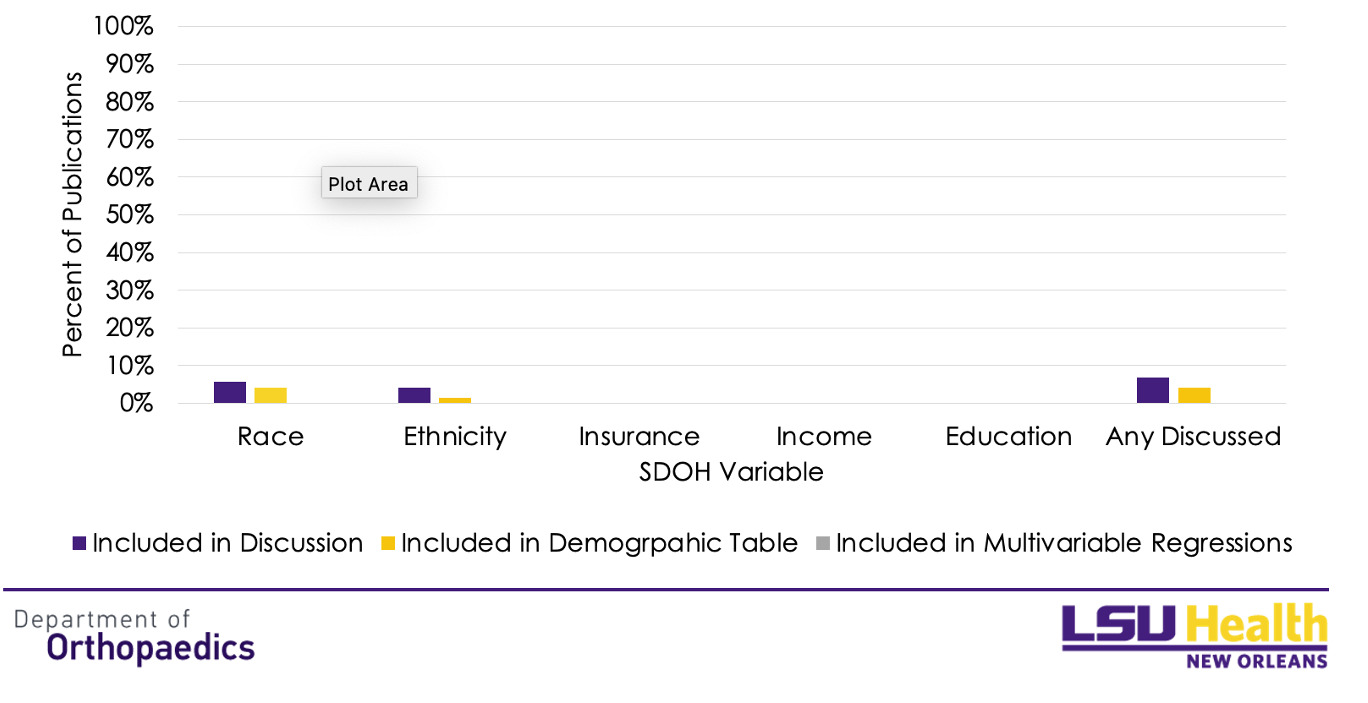
“We found that race was discussed in 4 of the manuscripts, and only included in 3 of the demographic tables. Ethnicity was discussed in 3 manuscripts and included in 1 demographic table, while insurance, income, and education were not included in any of the discussions or demographic tables. None of the SDOH variables were included in any of the multivariable regressions. Overall, only 5 of the manuscripts included any 1 of the SDOH variables, and only 3 included any of these variables within the demographic table. Therefore, there is a less than 10% reporting rate of any of the SDOH variables.”

Click here to learn more about Gate Science

Figure 1
Figure 1.Summaries of Social Determinant Variable Inclusion

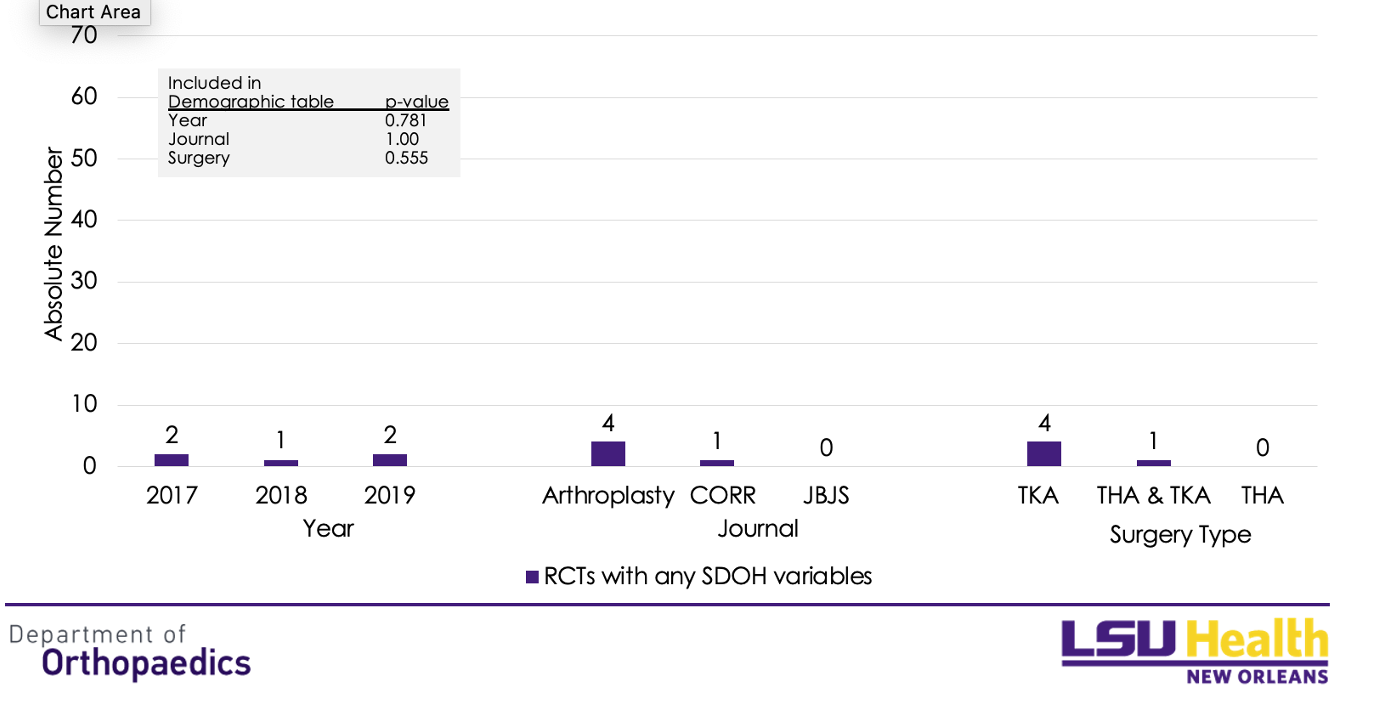
“Looking at the publications broken down by year, journal, and surgery type, we found that in 2017 there were only 2 publications that discussed any one of the SDOH variables, only 1 in 2018, and 2 in 2019. We found an insignificant difference within the 3 years analyzed, showing that there was no significant improvement and there was not an occurrence of just one bad year.”

Figure 2
Figure 2.Publications by, Year, Journal, and Surgery Type

“When broken down by journal type, no publications met the inclusion criteria in Osteoarthritis and Cartilage. Only 4 publications from the Journal of Arthroplasty discussed any of the SDOH variables; 1 publication in CORR addressed these variables, but no articles in JBJS looked at SDOH. We found an insignificant difference when broken down by journal type. They were also divided by the type of surgery, and we found that there was an insignificant difference.”

“Thus, when looking at 72 publications, we found that SDOH variables are vastly underreported in the TKA/TKA literature. There is growing evidence that SDOH variables impact outcomes and should be considered as consequential as gender and body mass index.”

“Inclusion of these SDOH variables allows researchers to determine the applicability of RCT findings to various patient populations outside of this study. We found an insignificant difference over the 3 years analyzed. It is also important to note that we only looked at RCTs, meaning that investigators had the choice of considering SDOH variables.”

“In conclusion, there is a significant shortcoming in the inclusion of SDOH variables in the TKA/TKA literature. Exclusion of these variables when establishing national standards and policies may be indirectly perpetuating disparities.”

“Research that does not rely on representative patient samples should be used with caution. We are advocating for the standardization of the inclusion of SDOH variables. Our call to action is that journals and their audiences should demand greater inclusivity and diversity in research.”

Submitted: March 25, 2022 EDT

Accepted: March 25, 2022 EDT

Attachments

Powered by Scholastica, the modern academic journal management system