
Intern - John W. Belk, MD
The alarm goes off at 4:15 AM. I brush my teeth, put on scrubs, and drive through the dark, quiet streets toward Denver Health (Figure 1). By 4:45 AM, I’m logged in and starting chart review for my patients. As the intern on the trauma service, my first job is to check in on my patients from yesterday to make sure I don’t miss anything important while I was gone. I scroll through vitals, hemoglobin trends, white blood cell counts, and inflammatory markers on every patient. This is when subtle problems tend to show up, before they become someone else’s emergency. If a patient needs blood, further workup, or closer monitoring, this is usually when it becomes obvious. At 5:00 AM sharp, I get a message from the overnight PGY-2 outlining the operative cases added overnight. They give a rough framework for the operating room and let me know which patients need to be ready. We split the list, and I head out to round. Rounds are efficient and focused. I check each patient’s pain, review overnight events, perform my physical exams, and make sure patients understand the plan for the day. There isn’t much time for small talk, but I always give them the opportunity to answer their pressing questions. Once rounds are finished, I head back to the workroom to write progress notes on every patient I saw and preoperative notes on those going to the operating room. By the time I look up, it’s almost time for fracture conference.
Fracture conference starts at 6:30 AM. As an intern, it is equal parts terrifying and educational. Images fly onto the screen. Plans are presented, questioned, adjusted, and occasionally abandoned altogether. Much of the discussion initially feels like listening to a language I vaguely recognize but definitely do not speak fluently. Approaches, fixation strategies, and complications are discussed at a level that makes it very clear who has been doing this longer than I have. Occasionally I’ll offer a thought, and the look of absolute confusion on a fourth-year resident’s face says everything. Simultaneously funny and mildly terrifying, and a clear reminder that I still have a very long way to go. I present the emergency department consults from the day prior—what I saw, what I did, and what I thought the plan should be. Then the questions start and sometimes I know the answer. Often, I do not. That part is uncomfortable, but unavoidable and part of my learning. The attendings are demanding without being hostile. They ask questions because they expect you to think, not because they expect you to fail. Conference concludes with a very clear understanding of what you didn’t know, which is oddly motivating. I take notes aggressively, knowing full well that half of what I’m writing down won’t truly click until I see it again. Watching the second-year residents present with calm confidence is impressive and mildly alarming. They seem impossibly competent, even though I know they were sitting in this same chair not that long ago.
Once fracture conference ends, the senior residents head to the operating room, and I become the primary day consult resident. From that point on, my pager decides how the day unfolds. At Denver Health, anything can come through the door. Some consults are straightforward and reassuring, while others are complicated, unfamiliar, and urgent. One moment it’s a fracture that needs a splint and clinic follow-up; the next, it’s something that makes you stop, take a breath, and call for backup. There is very little predictability, which keeps you constantly alert. Every consult feels like a small test. The volume of orthopedic pathology can feel overwhelming, especially early on. There are days when it feels like I should know everything about every bone, tendon, and ligament, which I very clearly do not. But slowly, patterns start to emerge. I get better at recognizing what matters, what can wait, and when I need help. As an intern, my goal isn’t technical mastery. It’s being a safe, reliable consultant who takes good care of patients and doesn’t miss the important part of patient care.
On the drive home, I almost always call my family or my fiancée, Brittany. It’s my chance to talk through the day—what went well, what was frustrating, and what’s still bouncing around in my head. They are excellent sounding boards, despite having absolutely no idea what I’m talking about most of the time. Somehow, saying it out loud still helps.
PGY2 - R. Stokes Rowe, MD
The alarm goes off early in second year. “Welcome to the show.” Feet hit the floor, and within the hour I’m caffeinated, motivated, and examining patients. It’s Friday- another 24 hours at Denver Health (or as we fondly refer to it, DG from when it was known as Denver General). As the largest urban Level I trauma center in the region, with one of the highest survival rates in the country, the volume here is only matched by the complexity. The day starts early with fracture conference, where we really cut our teeth. I present plans, defend decisions, and attempt, sometimes successfully, to quote evidence supporting what we did with yesterday’s consults. It’s an invaluable rite of passage. As PGY-2s, this is where we grow. The room becomes a cordial educational “shoot-out,” fitting for a hospital founded in the Wild West. This melting pot of learning brings some of the sharpest minds in orthopedics together to debate everything from pelvic fractures to complex hand replants—sometimes with us, sometimes in front of us. From there, it’s a dash to the OR to glove up and put the principles into practice. The breadth and depth of pathology is truly something special, fueled by a catchment area spanning seven contiguous states. Operative exposure is not theoretical here- I come to the OR prepared with a surgical plan. Our trust is earned through the preoperative discussions, not automatically given by simply showing up. I recognize the privilege of getting handed the knife and under the watchful eyes of my chiefs and attendings and there, I’m not just observing or discussing decisions—I’m making them, operating, and constantly refining my technique. Then comes the sound that both excites us and makes our stomachs turn. We don’t carry pagers at Denver Health, but all our phones play the same high-pitched three beeps when a consult hits. It could be anything—from a simple ankle fracture to a comminuted open pelvis in a polytrauma. During the day, these consults are split with “dueling interns,” a two-person effort dividing and conquering the ER. It’s my job not only to oversee them, but to teach along the way, while continuing to learn myself. Your orthopedic knowledge base advances quickly here, but only with a lot of diligent reading to keep up. DG has one speed: a rewarding but grueling balance of consults, clinic, and the OR until evening.
Clinic is another critical piece of the experience. I get to follow up on patients I first met in the ED and get real feedback on decisions I made that affected their care. Even better, it allows me to continue relationships and stay connected with patients my co-residents and I cared for earlier. Seeing how injuries evolve, how surgeries heal, and how patients recover, especially those you’ve gotten to know, is where the learning really sticks.
Now it’s 5:00 PM, and here comes the overnight call. As a PGY-2, you’re solo, but never unsupported. It’s an incredible honor to care for patients during what is often the worst day or night of their lives. Thankfully, the ED teams at Denver Health are exceptional—from one of the top emergency medicine residencies in the country to seasoned nurses, techs, and EMTs. It’s no wonder Denver Health is every resident’s favorite place to work. In the downtime, I have time to power-read articles and answer a few questions related to what I’ve seen that night. Every article and every question adds small improvements to my knowledge, and adds up quickly. Even when tired by the end of the day, I still try to find time to squeeze in a few questions before bed. At 6:00 AM, my watch has ended—for now. I hand off the pager to the next Bony Buff and head right back to fracture conference. Thankfully, the chiefs bring breakfast. Santos burritos, extra hot for the initiated (and strong of mouth), pair well with a night of rapid fire consults. After a well-delivered presentation, it’s finally time to get some rest…until Sunday, when we get to do it all over again.
PGY4 - Brandi A. Krieg, MD
Getting up before 5:30 AM is painful no matter what time it is and for me, the alarm goes off at 3:45 AM. I start by scrolling the admits from my bed on my phone while using the few alert neurons to not drop it on my face. I investigate what came in, if there is a hand replant in the OR, and how many hand infection cases are sitting in Murphy slings in the observation unit. Whatever it is, I see it, absorb it, then I convince myself to put on as many layers necessary to go for a run and to the gym. When you first walk into Denver Health, the smell of the Subway in the lobby hits you like the somewhat odd yet familiar scent of the eccentric old lady’s house across the street from when you were a kid. Rounding starts my day suited up in my obligatory Colorado “bony buff” embroidered outdoor gear over hospital teal scrubs and a Patagonia backpack that’s been old reliable from day one of residency. There can be replant patients in the ICU that need to be carefully examined for signs of congestion, lost leeches (yes, you read that correctly), or ischemia. There can be infections that need close evaluation for progression or improvement and trauma patients with fractures.
There is only one way to describe the Hand service and team at Denver Health: endurance and unexpected. Our hand faculty have the most endurance because this is not bread and butter hand surgery. The faculty take call for a full week at a time which sometimes means multiple replants in a week. Replant injuries are frequently transferred from places like Nebraska, Wyoming, Montana, and even South Dakota. While they do the occasional carpal tunnel, trigger finger and CMC arthroplasty, the bulk of their practice is the most comminuted elbows, forearms and traumatic upper extremities. There are rarely straightforward injuries, and the cold trauma is 1-3-month-old ‘evaporated into the ether’ or ‘seen at outside hospital was told to follow-up here’ type injuries. Importantly, as the PGY4 going into trauma on the Hand service, my unofficial duty is to claim every comminuted elbow that comes through as well and when the trauma service is overwhelmed with pelvis and polytrauma, it is an easy negotiation. I convince the hand fellow this is a very good idea, and we team up in a quest for these injuries for our Hand service. It makes sense to me since major cited techniques on how to address complex elbow injuries are written by our hand faculty at Denver Health in collaboration with the University of Colorado faculty.
After fracture conference, my day usually starts out with scheduled cases followed by the add-on upper extremity traumas. After coming back from a fellowship interview, my Tuesday includes a carpal tunnel release followed by a 3-month-old distal radius malunion that required both volar and dorsal approaches. A DG distal radius ORIF is frequently something with a plot twist to sweeten the complexity. Today it is a 3-month-old malunion. Last week it was bilateral impacted dorsally displaced intra-articular distal radius fractures that had not been provisionally reduced and was 5 weeks old. The third case was a peri-implant open both bone forearm fracture in a woman who had a distal radius fracture 20 years prior. After this case, the fourth case had to be pushed to the following day which was a man who sustained a degloving injury of the forearm and hand when his arm was caught in a conveyor belt, also sustaining tendon injury, multiple metacarpal fractures, a comminuted distal both bone fracture. Throughout the day, you have the privilege to experience these cases while building an invaluable toolbox for future injuries.
By the end of the day, I drop my last patient off in PACU (sometimes at 4:00 PM, sometimes 8:00 PM) and drag my lead and loupes back down to junior resident workroom where I have spent many long nights and days. You can only properly end a day of surgery at DG with the sustenance that sustains us and every PACU and ED patient: a bag of goldfish, a diet lemon lime Shasta mixed with a cranberry cocktail juice cup in a Styrofoam cup. While I consume this delicatessen I lay on the ancient call room bed watching the junior residents and interns discuss the daily consults providing only sarcastic words of encouragement until they turn and ask me for advice on the hand injuries of the day. This is rare since they have managed most things well on their own. After waiting the appropriate time to let the last patient wake-up, I suit back up in the standard Colorado resident attire complete with backpack to check an exam on the patient. He is back in his room with his wife at bedside. Because they have seen a million providers, I remind them, “I’m Dr. Krieg, I’m the one who wakes you up early every morning with this same backpack and jacket. I swear I’m a real doctor.” The couple chuckles, “and I’ll wake you up again tomorrow morning in the same outfit.” The wife compliments my “cute purse” which is otherwise known as my loupes case and I say good night. I call my family on the way home and then finish any leftover notes, review cases for the next day and try with all my leftover will to scroll through some OITE practice questions. Sometimes that is only two questions before I get sucked back into looking at XRs, approaches, fixation techniques. Tomorrow, we do it again…
PGY5 - Bryant P. Elrick, MD, MS
“Beep, beep, beep.”
The alarm sounds at 4:45 AM, I roll out of bed while the city is dark and quiet. Coffee first. Laptop open. I wait for the 5:00 AM text from the overnight PGY-2 night float resident. That message sets the tone, informing the entire resident team of new overnight operative consults. Included is their proposed plan for operative sequencing, room setup, and required equipment. What’s asked of juniors is substantial, but it’s not meant to break them. It’s meant to refine, like steel in a forge. This morning’s list reads like a greatest-hits album of orthopedic trauma. First case reads a high-speed motor cycle collision polytrauma including proximal humerus and midfoot fractures, bilateral femur fractures, and a pelvic ring injury with associated acetabular fracture–already taken to the OR overnight for impending compartment syndrome and temporizing femoral stabilization. Next is an auto-versus-pedestrian with a comminuted pilon fracture with ipsilateral talar neck and calcaneus fractures. Lastly, a transfer from a regional mountain hospital with pelvic ring injury after ski fall from height. At a busy Level 1 trauma center my role as chief of service is to synthesize and pressure-test. Leadership often happens quietly in the early hours, grounded in chart review, imaging scrutiny, reduction checks, and operative planning. Our juniors are rockstars, and rarely do I need to make major changes. Still, patient care, operative strategy, and the day-to-day logistics of keeping the trauma service moving fall squarely on the residents, with the trauma chiefs carrying added weight of ownership and responsibility for the team and its decisions.
By 6:00 AM, a finalized plan is sent to the urgent trauma OR attending that day. As they open their phone, I’m walking through the hospital doors. By 6:15 AM, the resident team gathers in the conference room. We run the list independently, reviewing inpatients, staffing nonoperative consults from the last 24 hours, and making treatment decisions. Junior residents here are entrusted with meaningful autonomy, and they earn it. This is their space to present and defend their thinking, while chiefs function as junior attendings. We challenge assumptions, refine plans, and push the team to think one step ahead. Every decision is scrutinized, not out of mistrust, but because that’s how patients stay safe and surgeons grow. These moments sharpen the juniors, but they also develop my own judgment and autonomy. Fracture conference begins at 6:50 AM. The format is unforgiving but fair, an oral-boards-style review of operative consults and postoperative cases from the day prior. You’re expected to clearly articulate your plan and defend it. Attendings probe. The pace is fast. The feedback is direct. It sharpens decision-making quickly.
Most days my schedule alternates between the urgent trauma room with the on-call trauma attending and fellow, and the elective trauma room treating outpatients. Elective cases often entail definitive fixation of injuries like high-grade tibial plateau or pilon fractures that have previously been ex-fixed. These rooms are also where leadership becomes tangible. Chiefs often walk junior residents through simpler cases like clavicle and ankle ORIFs, guiding, stepping back, letting them operate, and learning when to intervene. Today, I’m working with Dr. Cyril Mauffrey, chair of orthopedics at Denver Health and an internationally recognized pelvic and acetabular surgeon. Appropriately, our first case is a pelvic ring dissociation in a teenage skier, an injury pattern so rare that even he remarks he has not encountered this exact configuration before. There is no acetabular articular involvement, yet bilateral iliac fractures have effectively disconnected the axial skeleton from the ischiopubic segments, leaving the pelvis functionally floating. Despite the novelty, the tone is calm. We review CT scans carefully, discussing ligamentous integrity, reduction strategy, and fixation options. There is no rush, no theatrics, only deliberate planning. In the operating room, that preparation translates to controlled execution. A lateral window with an ASIS peel provides distal access and visualization of both tables. Reduction is achieved with strategy, not force, using a screw-based clamp for reliable control. Fixation is thoughtful and three-dimensional: a long reconstruction plate is carefully contoured over the iliac crest, molded along the inner table, then acutely bent into the true pelvis to hug the arcuate line, reinforced with perpendicular screws and LC-2 fixation crossing the fracture plane. It’s technical. It’s creative. And it’s effective. Watching Dr. Mauffrey manage a case without an algorithm is a masterclass. His calmness never wavers. His planning is meticulous. His execution is efficient and precise. Experiences like this define the training environment at DG. They build more than technical skill, they build judgment. They teach you to slow down, think clearly, and rely first on principles when the stakes are high and the solution isn’t written down.
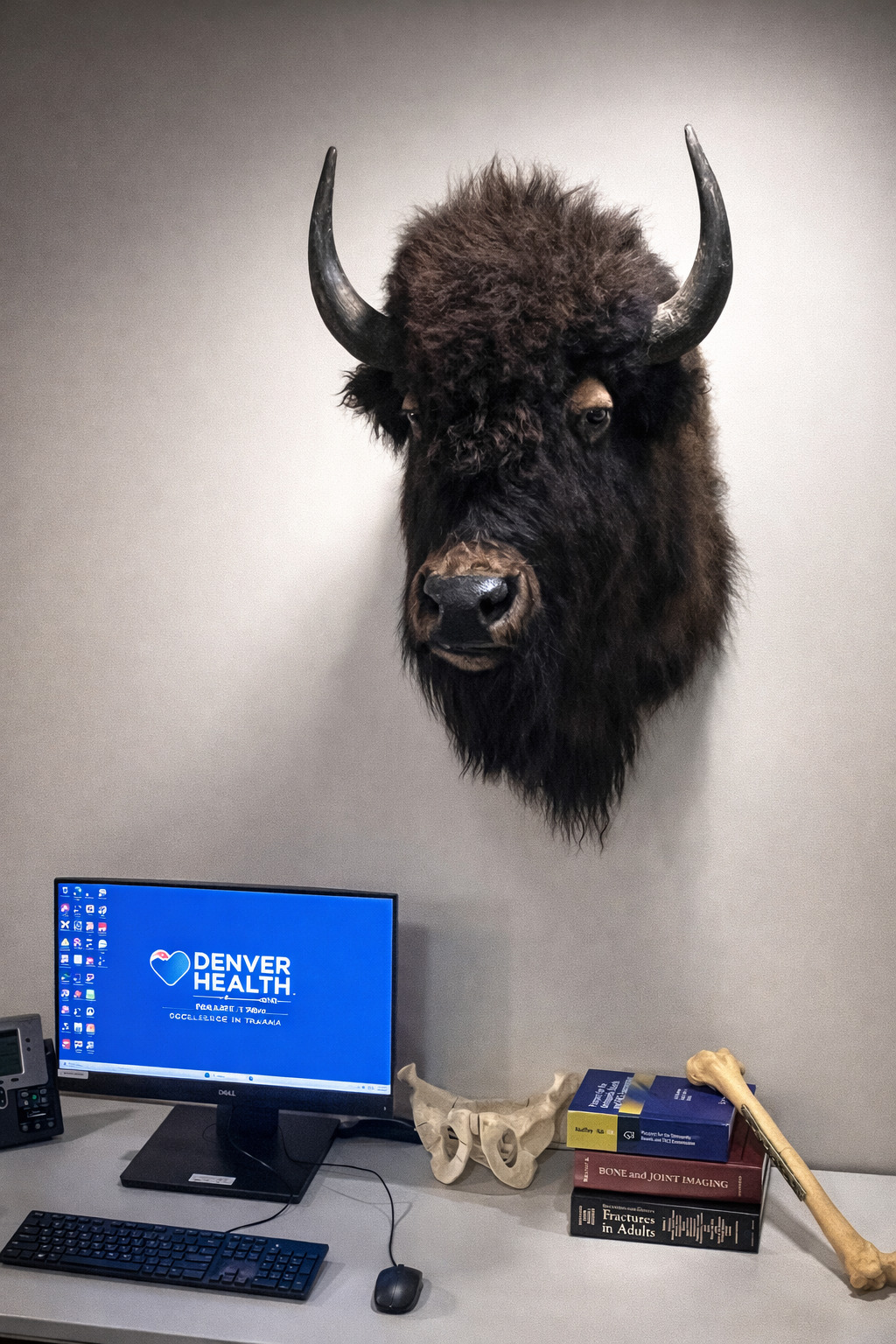
Between cases, there’s no downtime. I dictate operative notes, place case requests, and call patients to schedule surgery. Running the service means owning communication and logistics, not just time in the OR. The day continues with two more cases. The volume is steady and the pace unrelenting, conditions that shape our residency, grounded in hard work and constant readiness for what comes next. By 5:30 PM, the last case finishes and the dust begins to settle. Back in the call room, the mounted buffalo head looks down from the wall, a silent reminder of our culture—meet the storm. I debrief the team, communicate priorities to the overnight resident, and grab my computer to record today’s lessons: technical pearls, positioning nuances, decision-making insights. As someone pursuing a sports medicine fellowship, I know many of these complex trauma cases won’t define my future practice. That only heightens their value. Even if I never fix another complex pelvic fracture, the principles I’ve learned will anchor my surgical foundation.
I head home, decompress with a sweat, get outside with my dog, and end the day reviewing board questions before hitting the pillow. Sleep comes easily. The work here is hard, gritty and often invisible, but it matters. At a safety net hospital, you care for patients who truly rely on you. You lead. You teach. You refine. By the end of chief year, you don’t just feel trained. You feel ready.
